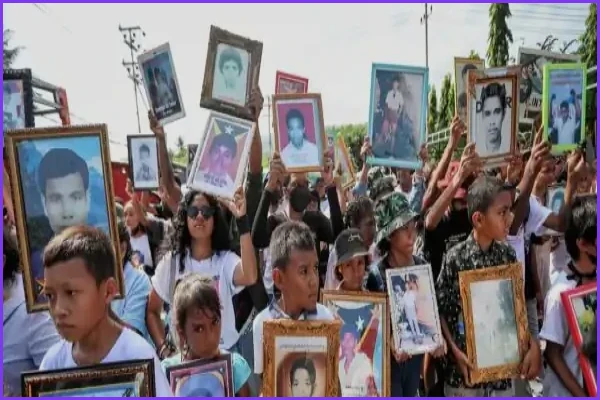
Every November 12, thousands of Timorese retrace the path from Motael church to Santa Cruz cemetery in Dili, commemorating the tragic 1991 massacre that unfolded during Indonesia's 24-year occupation of Timor-Leste. The annual procession, which included a major 30th anniversary march on November 12, 2021, is now officially recognized nationwide as National Youth Day to honor those who died in the nation's independence struggle.
The historical march originated 16 years into the Indonesian military occupation, which began in 1975 and lasted until 1999. In November 1991, resistance organizers held a peaceful rally along the route two weeks after Indonesian troops killed young activist Sebastião Gomes. Upon arriving at Santa Cruz cemetery, Indonesian soldiers opened fire on the assembled crowd, killing more than 271 people and leaving approximately 250 others listed as missing.
Decades after the violence, the full extent of wartime crimes continues to be documented. Timor-Leste’s Commission for Reception, Truth and Reconciliation gathered roughly 8,000 statements and determined that rape was systematically committed as a crime against humanity. The commission documented 853 cases while warning that the actual total was likely far higher. Overwhelming responsibility rested with Indonesian security forces and their auxiliaries, who were linked to more than nine out of ten documented cases.
Official accountability from Jakarta remains limited. In 2008, Indonesia's president acknowledged that his government and military held institutional responsibility for the violence surrounding the 1999 referendum and expressed regret, but Jakarta ruled out issuing a formal apology. To date, no Indonesian military commander has been successfully prosecuted for the atrocities, leaving survivors and advocates still seeking a formal apology, genuine reparations, and long-term assistance for victims and their children.
Domestically, Timor-Leste has yet to deliver full formal recognition or state reparations to survivors living at home. Although veterans' pensions consumed up to 64 percent of the country's social protection budget in 2019, conflict survivors are still waiting for state support and a national memorial. Many victims continue to face social stigma and ostracism, while children born of wartime sexual violence are frequently denied legal documentation and access to schooling.
To provide temporary relief, local and international organizations partnered with the Global Survivors Fund between 2023 and 2026 to run the Bukae program, named after the traditional basket Timorese carry on long journeys. The project offered interim financial support to 455 survivors and children born of war across all 13 municipalities. Most participants utilized $1,250 interim grants to repair their homes or start small businesses. However, the program was designed only as an initial step and has now concluded, with 17 survivors passing away during its run and 25 others dying after sharing their stories before aid arrived.
The groundwork for permanent government action has already been established. Both the 2005 Truth Commission report and a 2015 United Nations women's rights committee review explicitly urged Timor-Leste to implement national reparations. In February, Centro Nacional Chega!, the state's memory and human rights center, drafted a national reparations policy defining survivor support as a legal and moral duty of the state. Additionally, the survivors' network Pirilampu submitted a petition with over 700 signatures to political leaders last year.
International symbolic recognition has also expanded. In 2019, the sculpture Mother & Child was erected in London's St James's Square by the Justice for Lai Dai Han campaign, which supports children born to Vietnamese women raped by South Korean soldiers during the Vietnam War. In 2025, the sculpture Petrified Survivors was unveiled in The Hague as the world's first global memorial dedicated to survivors of conflict-related sexual violence. Created in partnership with Mane ho Vizaun Foun, it depicts a woman encased in stone alongside a firefly—a symbol chosen by Timorese survivors. The organization Pirilampu takes its name from the Tetun word for firefly.
Human rights advocates are now calling on the Parliament of Timor-Leste to pass the draft national reparations policy into law, formally honor survivors as contributors to national independence alongside military veterans, and build a permanent memorial at home. Referencing the legacy of the 1991 tragedy, President José Ramos-Horta previously described the memory of Santa Cruz as a torch of responsibility, a commitment that campaigners say must reach every survivor whose suffering occurred out of sight.

Md. Kazi Bijoy is a dedicated tech enthusiast and content creator with a passion for digital innovation. With years of experience in the tech industry, he specializes in breaking down complex topics into easy-to-understand guides. When he isn’t writing, he explores the latest gadgets and researches emerging trends in the digital world.