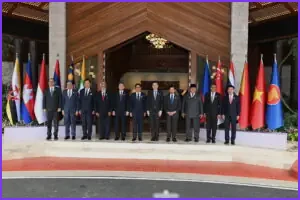
Southeast Asian leaders have agreed to maintain Myanmar's exclusion from high-level regional summits while adopting a phased "calibrated engagement" approach to deal with the country's ongoing political crisis, according to a joint statement issued following the 49th ASEAN Summit Retreat in Manila, Philippines, on November 15, 2026.
Under the newly endorsed framework, the Association of Southeast Asian Nations (ASEAN) will evaluate engagement based on progress and conditions on the ground. Leaders noted that the gradual restoration of Myanmar's full political representation could be considered if there is "sustained and concrete progress" in carrying out the bloc's Five-Point Consensus (5PC) conflict management plan.
Reaffirming the 5PC as the principal reference for resolving Myanmar's political crisis, the decision effectively rules out a rapid return for Min Aung Hlaing's junta. Established in April 2021, two months after the military overthrow of Myanmar's elected government, the 5PC demands an immediate end to violence, dialogue among all conflicting parties, and unimpeded access for humanitarian assistance. The junta's failure to deliver on key provisions led the bloc to bar Myanmar's political leaders from summits and foreign ministers' meetings in late 2021.
For the first time, ASEAN formally endorsed bilateral diplomacy conducted by individual member countries with Naypyidaw. The joint statement instructed foreign ministers to continue principled and constructive engagement with Myanmar. It also encouraged member states to engage constructively with all relevant stakeholders in consultation with the ASEAN Chair to drive substantive progress on the 5PC.
The adoption of "calibrated engagement"—a concept originally introduced by Thailand, which has actively pursued direct dialogue with the military government—is seen as an effort to close a growing divide within the bloc. Unilateral engagements by certain nations had created diplomatic tension with members taking a stricter stance toward the junta, prompting concerns that the 5PC had lost its relevance.
By incorporating references to "developments on the ground," ASEAN leaders acknowledged that bilateral talks between Myanmar and individual regional capitals were outpacing the bloc's collective diplomatic initiatives. The flexible stance aims to rebuild regional unity and revitalize ASEAN's diplomatic leverage.
The approach reflects a broader push during the Philippines' ASEAN chairmanship. Philippine President Ferdinand Marcos Jr. acknowledged at the previous summit in May that no progress had occurred in Myanmar, and stated in an interview last month that while the 5PC remained "absolutely correct," a "new approach" was necessary.
Speaking on Sunday at the retreat's opening in Manila, Marcos emphasized Myanmar's significance, stating, "Myanmar is not merely an issue on ASEAN's agenda. Myanmar is part of our Asian ASEAN family." He urged leaders to ask "what more can we do for Myanmar" and voiced hope that discussions would yield practical, forward-looking measures aligned with ground realities to foster a peaceful, inclusive, Myanmar-owned, and Myanmar-led resolution.
Following this week's summit in Manila, the Philippines will transfer the rotating ASEAN chair to Singapore, a country that has traditionally maintained a firmer posture on Myanmar's junta.
Related Articles

Mr. Udoy is a professional Web Developer and Blogger with 7+ years of experience in the tech world. He specializes in web architecture and digital storytelling. As the driving force behind worldincidents.com, he focuses on delivering high-quality, well-researched content to a global audience.