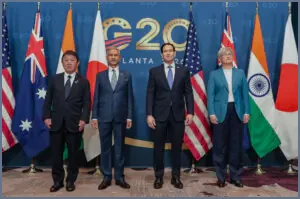
Indo-Pacific Quad Foreign Ministers met on the sidelines of the G20 Foreign Ministers’ Meeting in Atlanta, Georgia, Oct. 31, 2026. Leaders from Australia, India, Japan, and the United States have convened in Manila this week for a high-stakes summit, marking the first time the group’s heads of government have met since 2024. While the meeting aims to address practical security concerns, the primary objective remains the political signal it sends to the Indo-Pacific region and, specifically, to China. Beijing has long opposed the Quad, and its dismissive rhetoric—including claims that the summit is merely a "photo-op"—highlights the importance of the gathering.
The choice of Manila for this summit is symbolic. Manila was the city where the Quad made a comeback in November 2017, when senior officials from Australia, India, Japan, and the United States met on the sidelines of the Association of Southeast Asian Nations (ASEAN) and East Asia summits. For 10 years, the group had been dormant following its initial 2007 inception. The group’s resurrection was largely driven by a realization that China’s aggressive behavior continued despite the Quad’s initial absence. Since 2017, the Quad has matured into a formal pillar of its members' foreign policies, maintaining momentum through regular foreign ministers’ meetings and continuous military engagements, even during the pause in leaders' summits.
Despite the lack of a summit in 2025, the Quad has demonstrated its resilience and utility. The current meeting is expected to produce concrete outcomes, particularly regarding the security of free and unimpeded commercial shipping lanes to protect global energy supplies. Furthermore, the United States is pushing for collaboration on critical minerals, technology, and supply chains. As Secretary of State Marco Rubio noted in May, discussions are likely to address how the Quad can leverage AI to counter China, alongside private deliberations on the illicit smuggling of advanced Nvidia chips into the country.
The summit also serves to debunk claims that the Quad is incompatible with ASEAN. Meeting in the Philippines during an ASEAN event emphasizes the complementarity of the two groups. As U.N. disarmament chief Izumi Nakamitsu noted in 2023, "networked minilateralism" provides a practical path forward when traditional multilateral consensus is difficult to achieve.
This week’s display of unity is particularly timely, as U.S. President Donald Trump is scheduled to meet with Xi Jinping and potentially Vladimir Putin in Shenzhen shortly after the Quad summit. By coordinating their message in Manila, the leaders of Australia, India, and Japan have the opportunity to present a collective front on Indo-Pacific security priorities. This follows the successful approach used by Japanese Prime Minister Takaichi Sanae, who coordinated with Trump during his September visit to Washington to ensure a consistent stance on regional security.
You have reached the limit of 3 free articles this month.
The practical nature of the group means that the meeting will probably produce concrete outcomes, even though doing so is actually secondary to the signaling. A Reuters report quoting officials familiar with the meetingsaid,“The leaders are likely to take up the issue of free and unimpeded commercial shipping lanes in order to secure energy supplies from across the world.”
Related Articles

Mr. Udoy is a professional Web Developer and Blogger with 7+ years of experience in the tech world. He specializes in web architecture and digital storytelling. As the driving force behind worldincidents.com, he focuses on delivering high-quality, well-researched content to a global audience.