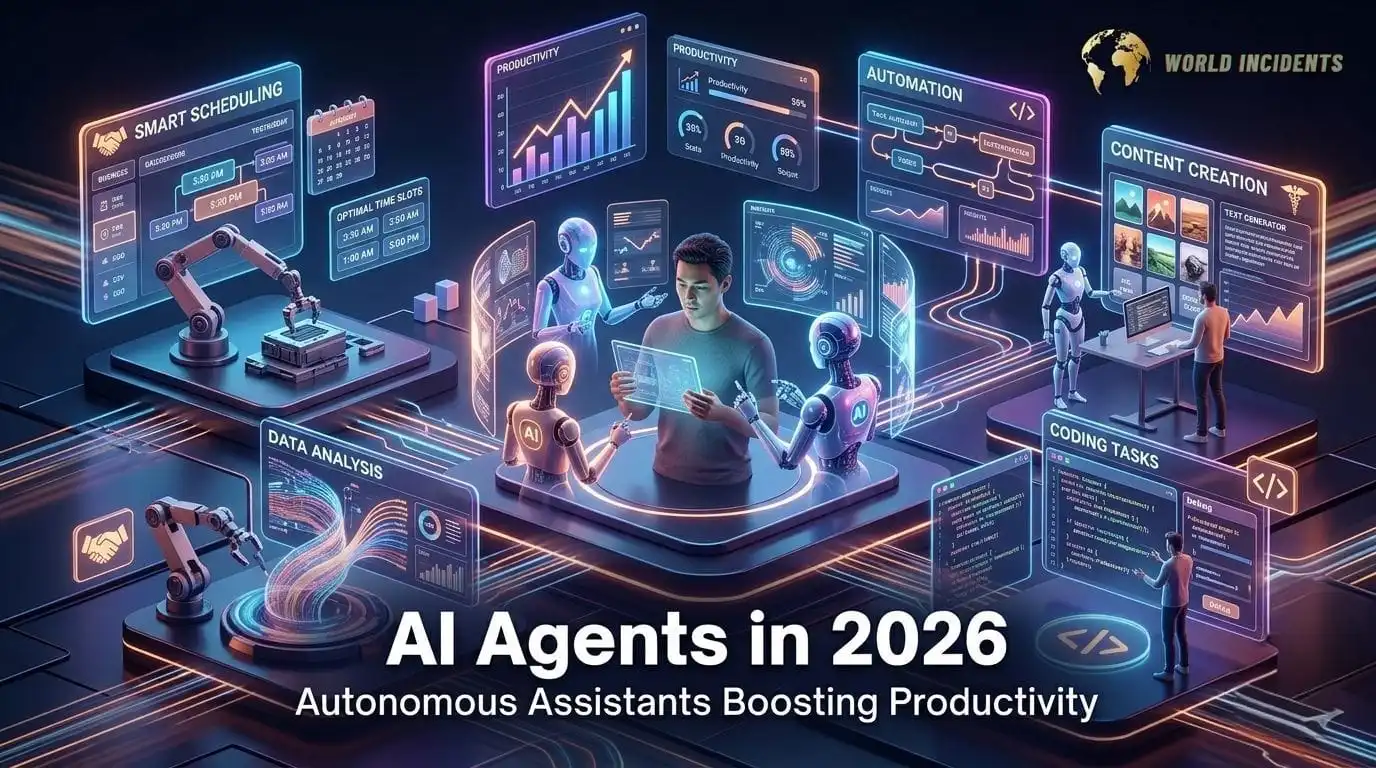
Incredible AI Agents in 2026: How Autonomous Assistants Are Revolutionizing Productivity
A new class of intelligence has entered the workforce. Not robots made of steel, and not simple chatbots that answer questions — but AI agents: sophisticated, goal-driven software systems that perceive their environment, make independent decisions, execute multi-step tasks, and learn from the results. In 2026, AI agents are no longer experimental curiosities confined to research labs. They are active, productive members of teams in companies across every industry and every continent. This is the definitive guide to understanding how AI agents work, why they matter, and how you can harness their extraordinary power to transform your personal and professional productivity.
What Are AI Agents and How Do They Differ from Chatbots?
The distinction between a chatbot and an AI agent is fundamental and consequential. A chatbot responds. An AI agent acts. Traditional AI assistants — even sophisticated ones — wait for instructions, generate a response, and stop. AI agents, by contrast, receive a goal, autonomously devise a plan, select and use tools, execute sequences of actions across multiple systems, monitor results, adapt strategies in real time, and pursue the objective until it is achieved — with minimal or no human intervention required at each step.
In technical terms, AI agents are built on the “Perceive → Plan → Act → Reflect” loop. They perceive input from their environment (emails, databases, APIs, the web), plan a course of action using reasoning capabilities, act by executing tools and functions, and reflect by evaluating outcomes and adjusting their approach. This cycle is what gives AI agents their remarkable autonomy and productive power.
📊 The Scale of Agentic AI in 2026
According to global enterprise technology surveys in early 2026, over 71% of Fortune 500 companies have deployed at least one category of AI agents in active operational workflows — up from 18% in 2023. The compound annual growth rate of the agentic AI market reached 340% between 2023 and 2025.
The Staggering Impact: By the Numbers
6 Types of AI Agents Transforming Industries in 2026
How AI Agents Are Revolutionizing Productivity Across Sectors
1. Software Development: From Weeks to Hours
Software teams using AI agents like Devin, GitHub Copilot Workspace, and Cursor Agent in 2026 report dramatic reductions in development cycle times. These AI agents autonomously interpret feature requirements, write code across multiple files, run test suites, identify and fix bugs, and submit pull requests — compressing work that previously took a developer days into a sequence of agent actions completing in hours. Engineering teams are not shrinking; they are redirecting human creativity toward architecture and strategy while AI agents handle implementation-level execution.
Read More: AI Note-Taking Apps in 2026: Can They Replace Traditional Studying?
2. Marketing and Content: Autonomous Campaign Management
Marketing departments deploying AI agents in 2026 operate with a level of scale and personalization that was operationally impossible just three years ago. A single marketing team with three human strategists can now manage content pipelines, social media scheduling, email campaign sequencing, A/B testing analysis, and SEO reporting simultaneously — because AI agents execute each of these workstreams in parallel, autonomously, reporting outcomes and awaiting strategic direction at key decision points.
3. Customer Service: 24/7 Intelligent Resolution
Customer service AI agents in 2026 bear no resemblance to the frustrating chatbots of earlier years. Modern service AI agents access customer account data, process refunds, escalate complex issues with full context to human agents, and resolve multi-step service requests — all within a single interaction and across any channel. Companies deploying these AI agents report customer satisfaction scores rising while response times fall by 70–85%.
4. Finance and Operations: Decision Speed at Scale
Financial services firms use AI agents to monitor market signals, flag anomalies in transaction data, generate compliance documentation, automate reporting workflows, and execute rule-based investment actions. Operational AI agents in logistics and supply chain contexts monitor inventory levels, predict shortfalls, initiate purchase orders, and coordinate supplier communications — all without human initiation at each step.
5. Personal Productivity: Your Digital Chief of Staff
For individual professionals, 2026’s most capable AI agents function as genuine digital chiefs of staff. They monitor your inbox and surface only what requires your attention, prepare briefing documents before every meeting, draft follow-up emails within minutes of calls ending, track project deadlines across tools, and proactively surface decisions that need human judgment — while handling everything routine autonomously.
Top AI Agent Platforms to Know in 2026
| Platform | Category | Autonomous Actions | Multi-Agent Support | Best For |
|---|---|---|---|---|
| AutoGPT 4.0 | General Purpose | ✔ Advanced | ✔ | Researchers & developers |
| Google Vertex AI Agents | Enterprise | ✔ Advanced | ✔ | Large-scale enterprise |
| Microsoft Copilot Agents | Productivity | ✔ | ✔ | Microsoft 365 users |
| Devin (Cognition AI) | Software Dev | ✔ Full-stack | Partial | Engineering teams |
| Zapier AI Agents | Workflow Automation | ✔ | Limited | SMBs & no-code users |
| Anthropic Claude Agents | Research & Analysis | ✔ Computer Use | ✔ | Complex reasoning tasks |
The Crucial Question: Should We Be Concerned About AI Agents?
The rise of AI agents raises legitimate questions that deserve honest engagement. When AI agents act autonomously — browsing the web, sending emails, writing and executing code, spending budgets — the boundaries of accountability become genuinely complex. Who is responsible when an AI agent makes a consequential mistake? How are autonomous AI agents prevented from performing actions outside their sanctioned scope?
Leading AI agents platforms in 2026 are addressing these concerns through architectures built around “minimal footprint” principles — AI agents are designed to request only necessary permissions, prefer reversible over irreversible actions, and escalate decisions to humans when uncertainty exceeds defined thresholds. Organizations deploying AI agents at scale are investing heavily in governance frameworks, audit trails, and human-in-the-loop checkpoints for high-stakes decision categories.
The productive path forward is neither blind adoption nor reflexive resistance. It is informed, governed deployment of AI agents with clear accountability structures, transparent operating boundaries, and continuous human oversight of outcomes — not every individual action.
How to Start Using AI Agents Effectively Today
For individuals and organizations new to AI agents, the following implementation approach reduces risk while maximizing early productivity gains:
- Start with bounded, reversible tasks: Deploy AI agents on research, summarization, and draft generation first — work where errors are low-stakes and easily corrected.
- Define clear goals, not processes: Give your AI agents objectives (“research competitor pricing and summarize in a table”) rather than step-by-step instructions. Let the agent determine how.
- Build review checkpoints: Design workflows where AI agents surface work at key stages for human review before proceeding to consequential actions.
- Monitor and measure: Track time saved, error rates, and output quality rigorously. Use data to expand agent scope where performance is proven.
- Upskill your team: The most valuable human skill in the age of AI agents is not task execution — it is strategic direction, judgment, and quality evaluation of agent outputs.
Conclusion: The Productivity Revolution Is Already Here
In 2026, AI agents are not a future possibility — they are a present competitive reality. Organizations that deploy AI agents thoughtfully are compressing timelines, reducing costs, and enabling their human teams to operate at levels of strategic depth that were previously out of reach. Individuals who master working with AI agents are outperforming peers by extraordinary margins.
The question is no longer whether AI agents will transform productivity. The evidence is conclusive: they already are. The question every professional and organization must now answer is how quickly and how wisely they will join this revolution — before their competitors do.
Frequently Asked Questions

Meet Md. Rubel Rana
As a core contributor to Worlddincidents.com, Rubel Rana brings a unique perspective to the world of journalism. Whether it’s deep-diving into historical trivia or covering the latest global headlines, Rubel Rana is committed to delivering high-quality, high-impact articles. Their writing blends meticulous research with a compelling voice, helping readers stay informed and curious about the world around them.
2 thoughts on “Incredible AI Agents in 2026: How Autonomous Assistants Revolutionize Productivity”