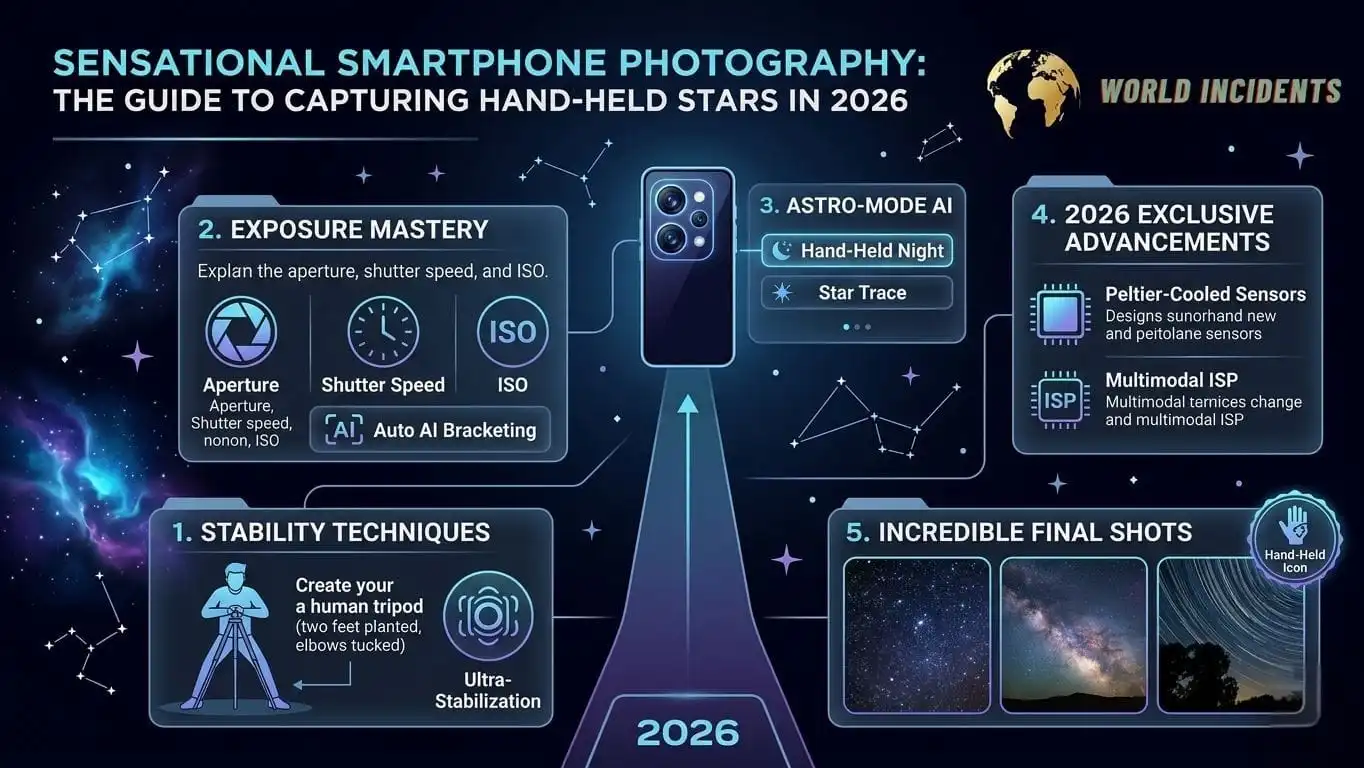
Smartphone Photography: The Sensational Guide to Capturing Hand-Held Stars in 2026
Look up on any clear night and the universe is waiting — a canopy of stars, the ghostly arch of the Milky Way, the silent drift of planets across the sky. For most of human history, capturing that grandeur required a professional observatory or at minimum thousands of dollars in specialist equipment. In 2026, the most powerful tool for smartphone photographyof the night sky fits in your pocket. This sensational guide reveals everything you need to know about capturing hand-held stars through smartphone photography — from understanding the science to mastering the settings, choosing the right device, and processing images that will stop your followers mid-scroll.
Why 2026 Is the Golden Era of Smartphone Astrophotography
The rapid convergence of computational photography, AI processing, and advanced sensor hardware has made 2026 an extraordinary moment for smartphone photography of celestial subjects. Sensors that once struggled in low-light conditions now feature dedicated astrophotography modes — purpose-built algorithms that stack dozens of sequential exposures automatically, align star trails with onboard gyroscopes, reduce noise with AI denoisers trained specifically on night-sky imagery, and deliver results that would have required a DSLR and a dedicated tracking mount just four years ago.
The democratization of smartphone photography for astrophotography is not a gradual evolution — it is a revolution. Global photography communities report that over 60% of all astrophotography images shared online in 2025–2026 were captured with smartphones, a figure that would have been unthinkable at the start of this decade.
🔭 Did You Know?
The human eye can typically resolve stars down to magnitude +6 in ideal dark-sky conditions. A modern flagship smartphone photography system in astrophotography mode can capture stars down to magnitude +9 — revealing celestial objects completely invisible to the naked eye.
The Science Behind Smartphone Star Photography
Understanding why modern smartphone photography can capture stars so effectively requires a brief look at the physics of light and sensor design. Stars are point sources of light — extraordinarily faint, moving (due to Earth’s rotation), and embedded in darkness. Capturing them requires three things: maximum light gathering, minimal noise, and motion compensation.
Modern flagship smartphone photography systems address all three. Larger sensor pixels (some exceeding 1.2 microns by 2026) gather more photons per unit time. Multi-frame stacking — where the processor combines 20–60 sequential short exposures — reduces random noise while preserving signal. Optical Image Stabilization (OIS), Electronic Image Stabilization (EIS), and in some cases dedicated AI motion prediction compensate for hand tremor during exposures. The result is a smartphone photography pipeline that extracts extraordinary detail from what was previously considered impossibly difficult lighting.
Read More: Quantum-Resistant Cryptography: Securing the Digital World Against Future Threats
6 Essential Smartphone Photography Tips for Capturing Stars
Best Smartphones for Astrophotography in 2026
| Phone | Astro Mode | Max Exposure | RAW Support | Sensor Size | Best For |
|---|---|---|---|---|---|
| Google Pixel 9 Pro XL | ✔ Dedicated | 4 minutes | ✔ RAW+ | 1/1.3″ | All-round star photography |
| Samsung Galaxy S25 Ultra | ✔ Expert RAW | 3 minutes | ✔ ProRAW | 1/1.14″ | Telephoto star detail |
| Apple iPhone 16 Pro Max | Night Mode+ | 30 seconds | ✔ Apple ProRAW | 1/1.28″ | Ecosystem users, post-processing |
| Xiaomi 15 Ultra | ✔ Leica Night | 2 minutes | ✔ RAW | 1″ Sony LYT-900 | Largest mobile sensor |
| Huawei Pura 70 Ultra | ✔ Moon+Stars | 2 minutes | ✔ RAW | 1/1.1″ | Asian market, variable aperture |
Step-by-Step: Your First Milky Way Shot with a Smartphone
Common Mistakes to Avoid in Smartphone Star Photography
Even experienced practitioners of smartphone photography make these avoidable errors when transitioning to night sky subjects:
- Using autofocus at night: Your camera cannot lock focus on stars. Always switch to manual focus and set infinity manually using a distant light source to calibrate.
- Shooting near city light domes: Even a faint orange horizon glow ruins dark adaptation and contaminates images. Face away from any light pollution when composing.
- Skipping dark adaptation: Your eyes need 20–30 minutes in complete darkness to fully adapt. Checking your phone screen (even at minimum brightness) resets this. Use a red-light torch for navigation.
- Over-processing: The most common mistake in post-processing star smartphone photography is excessive contrast, saturation, and sharpening. The best results are subtle — preserve natural star colors (blue, white, golden-orange) rather than pushing artificial vibrancy.
- Ignoring the foreground: Stars alone make a striking but one-dimensional image. Including a compelling foreground — a mountain silhouette, a lone tree, a historic building — transforms a technical exercise into art.
The Future of Smartphone Astrophotography
The trajectory of smartphone photography for astronomical subjects points toward capabilities that border on science fiction by current standards. Computational aperture synthesis — combining images from multiple phone cameras to simulate a much larger optical aperture — is in active development at major manufacturers and could deliver telescope-class resolving power from a handheld device within two to three years.
AI models trained on petabytes of professional astrophotography data are increasingly capable of recovering detail, reducing noise, and enhancing color accuracy in ways that outperform traditional processing workflows. The gap between dedicated astrophotography equipment and smartphone photography is narrowing — and the rate of narrowing is accelerating every product cycle.
Conclusion
The night sky is one of humanity’s oldest sources of wonder, inspiration, and scientific curiosity. In 2026, smartphone photography has made that sky accessible to everyone with a modern device and the willingness to step outside on a clear night. The techniques, tools, and tips in this guide provide everything you need to begin capturing stars that move people — images that remind viewers of the magnificent scale of the universe and the remarkable capabilities of the extraordinary device in your pocket.
Set your alarm for midnight, find your dark sky, and let your smartphone photography journey into the stars begin.
Frequently Asked Questions

Meet Md. Rubel Rana
As a core contributor to Worlddincidents.com, Rubel Rana brings a unique perspective to the world of journalism. Whether it’s deep-diving into historical trivia or covering the latest global headlines, Rubel Rana is committed to delivering high-quality, high-impact articles. Their writing blends meticulous research with a compelling voice, helping readers stay informed and curious about the world around them.
4 thoughts on “Smartphone Photography: Sensational Guide to Capturing Stars in 2026”