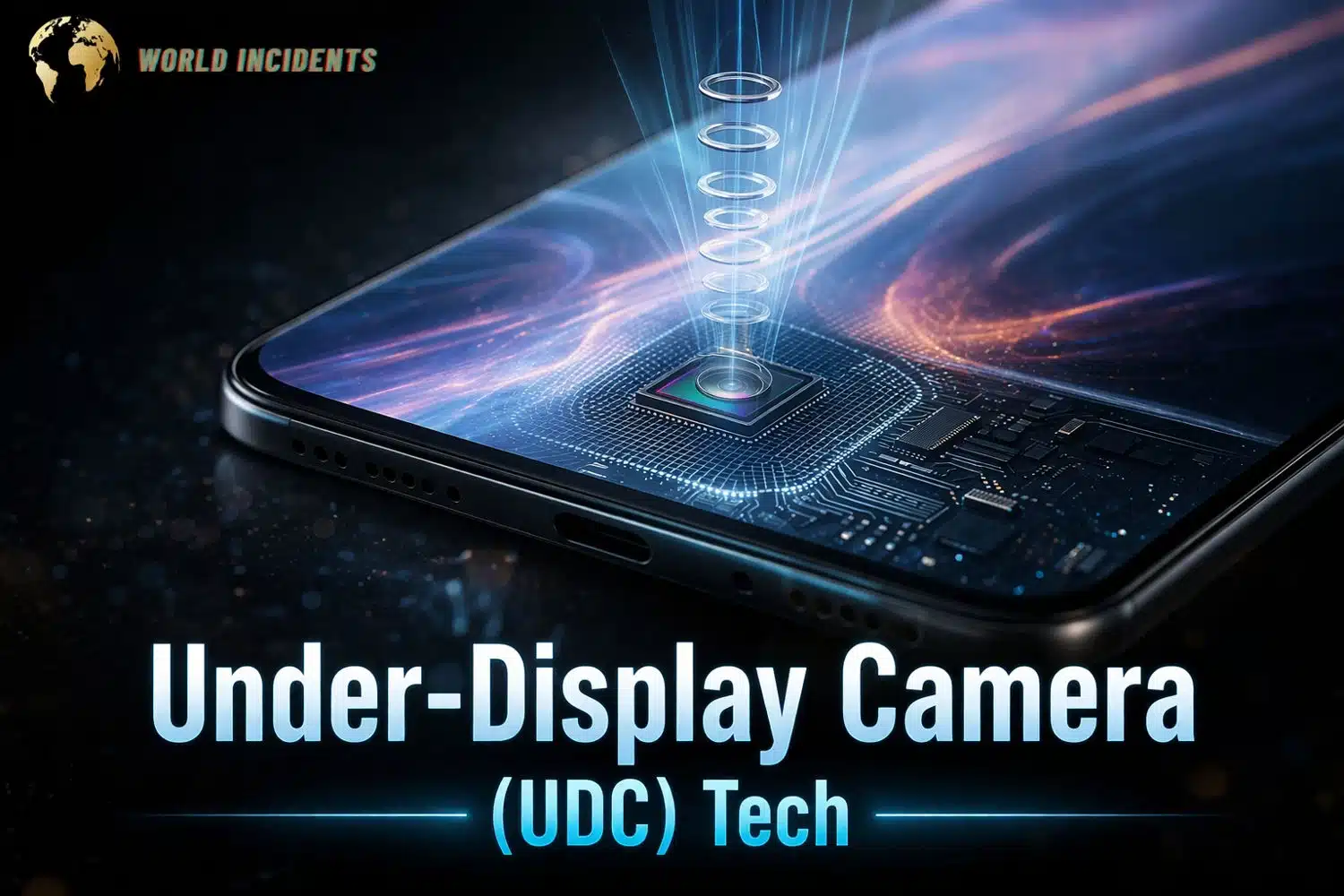
For nearly a decade, smartphone manufacturers have been on a quest for the “Perfect Screen”—a display completely uninterrupted by notches, punch-holes, or thick bezels. As we move through 2026, that dream has finally become a mainstream reality through Under-Display Camera (UDC) Tech. What was once a niche feature for experimental phones is now becoming the gold standard for flagship devices, blending invisible hardware with cutting-edge AI.
How Does Under-Display Camera (UDC) Tech Work in 2026?
The core challenge of placing a camera behind a screen has always been light transmission. In 2026, Under-Display Camera (UDC) Tech has solved this using a three-layer approach:
Transparent OLED Matrix: The area of the screen covering the camera uses a specialized pixel arrangement. This “Transparent Cathode” technology allows more photons to pass through the display to the camera sensor without compromising the screen’s resolution.
Independent Pixel Control: Modern Invisible lens integration utilizes a “One-Pixel-One-Circuit” design. This means each pixel over the camera can be turned off or dimmed independently to maximize light intake when you open the selfie app.
Light-Path Optimization: New 2026 panels feature a 60% transmittance rate, a massive jump from the 20-30% we saw in earlier generations of Invisible lens integration.
The Role of AI in Under-Display Camera (UDC) Tech
Even with better hardware, light passing through an OLED screen can become diffused, leading to “hazy” or “milky” photos. This is where AI-driven restoration comes into play for Invisible lens integration.
Today’s flagships use Generative AI Image Reconstruction. When you take a photo, the phone’s ISP (Image Signal Processor) uses a “Digital De-fencing” algorithm. It identifies the grid pattern of the screen pixels and digitally removes them from the final image. This makes photos taken with Invisible lens integration virtually indistinguishable from traditional punch-hole cameras in 2026.
Top Flagships Leading the Under-Display Camera (UDC) Tech Wave
If you are looking for the best implementation of this technology this year, these models are the frontrunners:
ZTE Axon 80 Ultra: ZTE continues to lead the pack, offering a 400 PPI (pixels per inch) density even over the camera area, making it truly invisible to the naked eye.
Samsung Galaxy Z Fold 8: Samsung has refined its Invisible lens integration for its foldable line, using it not just for video calls but for high-quality selfies on the massive internal display.
Xiaomi Mix 6: Xiaomi’s “CUP” (Camera Under Panel) technology focuses on color accuracy, ensuring that the screen area above the camera doesn’t show a “screen door” effect on white backgrounds.
Advantages of Under-Display Camera (UDC) Tech
Immersive Content: Whether you are gaming or watching 8K movies, Invisible lens integration provides a 100% screen-to-body ratio with no distractions.
Durability: Because the camera is under the glass, there are no moving parts (like pop-up cameras) and no exposed lenses that can be scratched or collect dust.
Future Aesthetics: Under-Display Camera (UDC) Tech allows for a symmetrical, minimalist design that defines the “glass slab” aesthetic of the late 2020s.
The “Hybrid” Challenges Still Remaining
Despite the progress, Under-Display Camera (UDC) Tech still faces minor hurdles:
Low-Light Performance: While AI helps, physics is physics. In extremely dark environments, Under-Display Camera (UDC) Tech can still struggle compared to a direct-lens camera.
Manufacturing Costs: Producing these specialized transparent panels remains expensive, which is why Under-Display Camera (UDC) Tech is currently found only in “Pro” or “Ultra” models.
Expansion into Laptops, Tablets, and Automotive Displays
As we move through 2026, the application of Under-Display Camera (UDC) Tech has moved beyond the smartphone market. Large-format devices like laptops and tablets are now adopting this “invisible lens” approach to eliminate bulky top bezels. Since productivity devices are used heavily for video conferencing, integrating Under-Display Camera (UDC) Tech allows for a truly edge-to-edge workspace, which is essential for creative professionals using 14-inch or 16-inch canvases.
Furthermore, the automotive industry has begun utilizing this hidden sensor technology within smart dashboards. High-end electric vehicles (EVs) now embed cameras behind the driver-side display for fatigue monitoring and gesture control. By leveraging Under-Display Camera (UDC) Tech, car designers can maintain a sleek, uninterrupted interior aesthetic without sacrificing the safety features required in modern autonomous driving systems.
Privacy and Psychological Comfort in UDC Design
Beyond aesthetics, Under-Display Camera (UDC) Tech is gaining popularity as a privacy-focused feature in 2026. Many users feel “watched” by visible camera lenses on their laptops or phones. By hiding the sensor beneath the screen, Under-Display Camera (UDC) Tech reduces this psychological discomfort, making the device feel like a simple, clean window rather than a monitoring tool. This “invisible interface” approach is especially trending in 2026 premium office setups and smart home hubs, where a minimalist and non-intrusive environment is highly valued
FAQ
Q1: Can you see the camera if you look closely?
Ans: In modern 2026 implementations of Under-Display Camera (UDC) Tech, the camera is invisible under normal brightness. You may only see a faint pattern if the screen is off and you shine a direct light on it.
Q2: Does it affect the screen’s touch sensitivity?
Ans: No. The touch layers are integrated separately, so Under-Display Camera (UDC) Tech does not interfere with scrolling or gaming latency.
Conclusion
As Under-Display Camera (UDC) Tech continues to mature, it is clear that the days of the “punch-hole” are numbered. With 2026 marking the year where image quality finally caught up with design, Under-Display Camera (UDC) Tech has cemented itself as the future of mobile interaction. For consumers who value a pure, unobstructed view, there has never been a better time to upgrade.
read more: Smartphone Photography
Quantum-Resistant Cryptography

Mr. Udoy is a professional Web Developer and Blogger with 7+ years of experience in the tech world. He specializes in web architecture and digital storytelling. As the driving force behind worldincidents.com, he focuses on delivering high-quality, well-researched content to a global audience.