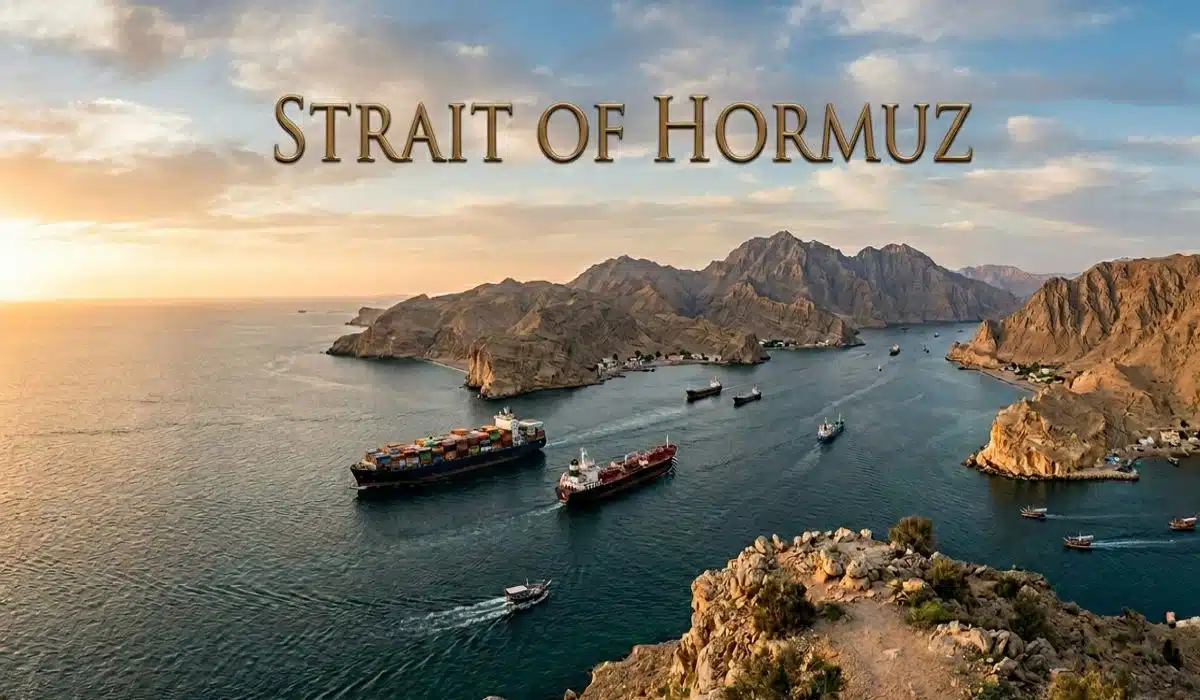
The Strait of Hormuz is only 21 miles wide at its narrowest point, yet it carries roughly 25% of the world’s total maritime oil trade. It is the lifeline for major oil producers including Saudi Arabia, the UAE, Kuwait, Iraq, and Iran.
Unlike other maritime routes like the Strait of Malacca, the Strait of Hormuz has no geographically proximate alternatives. While pipelines like the Habshan-Fujairah (UAE) and the East-West Pipeline (Saudi Arabia) exist, they can only handle a fraction of the volume that typically flows through the water. This lack of redundancy makes any disruption in the Strait of Hormuz a “red alert” event for global markets.
The 2026 Crisis
Since late February 2026, the Strait of Hormuz has seen a dramatic 95% drop in commercial traffic. Following the outbreak of the 2026 Iran War, the IRGC (Islamic Revolutionary Guard Corps) implemented a “restricted navigation” zone, effectively blocking vessels bound for the U.S., Israel, and their allies.
Impact on Shipping: Since the start of the conflict, over 22 merchant ships have been attacked in and around the Strait of Hormuz.
Oil Price Surge: As of mid-April 2026, Brent crude oil prices have soared to $126 per barrel, marking the largest monthly increase in history.
Global Shortages: Asian economies, which rely on the Strait of Hormuz for 84% of their crude oil imports, are currently facing significant fuel and fertilizer shortages.
The “Stranglehold” vs. International Law
The current blockade of the Strait of Hormuz has triggered intense legal debates. Under the UN Convention on the Law of the Sea (UNCLOS), the passage is an international strait where “transit passage” should be unimpeded. However, the 2026 conflict has turned geography into a weapon.
With the U.S. Navy’s Fifth Fleet enforcing a counter-blockade of Iranian ports, the Strait of Hormuz has become a high-stakes “Economic War” zone. The head of Iran’s military command recently warned that if maritime insecurity continues, the “powerful armed forces will not allow any exports or imports to continue” in the region.
The Ripple Effect on Liquefied Natural Gas (LNG)
It’s not just oil; the Strait of Hormuz is also the exit point for nearly 20% of the world’s Liquefied Natural Gas (LNG). Qatar, the world’s leading LNG exporter, relies almost exclusively on this route to reach customers in Europe and Asia. The 2026 closure has sent European gas prices to record highs, complicating the continent’s energy security at a time when they are already moving away from land-based pipeline dependencies.
The “Grocery Supply Emergency”
Beyond energy, the Strait of Hormuz serves as the primary gateway for essential food imports into the Gulf Cooperation Council (GCC) nations. By mid-March 2026, the blockade triggered a “grocery supply emergency,” as these nations rely on the strait for over 80% of their caloric intake. With 70% of maritime food shipments disrupted, major retailers like Lulu Retail have been forced to airlift staples such as rice and flour. This shift from sea to air has resulted in a staggering 40% to 120% increase in food prices across the region, proving that the Strait of Hormuz is as much a “breadbasket” chokepoint as it is an oil one.
Qatar’s LNG Force Majeure and the Ras Laffan Crisis
The 2026 conflict took a devastating turn when the Strait of Hormuz closure was coupled with targeted strikes on energy infrastructure. Following an attack on the inactive Ras Laffan Industrial City, QatarEnergy was forced to declare Force Majeure on all global contracts. This effectively cut Qatar’s LNG production capacity by 17% and sent Asian spot prices skyrocketing by 140%. Because LNG tankers cannot safely navigate the Strait of Hormuz under current hostilities, the world is facing a prolonged natural gas shortage that analysts estimate could take 3 to 5 years to fully resolve.
The 88% Collapse in Daily Vessel Transits
The sheer scale of the disruption in the Strait of Hormuz is best illustrated by the collapse in traffic data. Before the 2026 escalation, the strait saw an average of 138 commercial vessels per day. As of April 1, 2026, that number has plummeted to just 16 vessels per day—an 88% decrease. Most of the remaining traffic consists of heavily guarded convoys or the “shadow fleet” attempting to bypass sanctions. This “Vessel Traffic Collapse” has left over 150 tankers anchored outside the Strait of Hormuz, waiting for war-risk insurance premiums to stabilize or for military escorts to become available.
The Iraq and Bahrain Factor
The Strait of Hormuz crisis has created a systemic economic collapse for countries with limited alternative routes.
Iraq: With 90% of its GDP dependent on oil exports through the Persian Gulf, the blockade has effectively paralyzed the Iraqi economy, pushing the nation toward a severe recession.
Bahrain: Already one of the most indebted nations, Bahrain has seen its aluminum and oil exports—which provide two-thirds of government revenue—drop to near zero.
The regional instability caused by the Strait of Hormuz closure has forced the UAE to sign a $5.4 billion currency swap agreement just to prevent a total collapse of the Bahraini Dinar in April 2026.
The “Electronic Fog of War”
The 2026 conflict in the Strait of Hormuz has introduced a new dimension of naval combat: “The Electronic Fog of War.” Since the escalation in February 2026, commercial vessels in the region have faced unprecedented levels of GPS Spoofing and GNSS (Global Navigation Satellite System) interference. Open-source intelligence reports that within 24 hours of the initial strikes, over 1,100 commercial ships in the waters of the UAE, Qatar, and Oman reported navigation failures.
This electronic warfare has created a digital “mirage” where a ship’s onboard GPS might show its position 100 miles inland—placing massive oil tankers on top of nuclear power plants or desert airports—while they are actually still in the Strait of Hormuz. This technology, primarily deployed as an asymmetric weapon, has two devastating consequences:
Navigational Hazards: In a chokepoint just 21 miles wide, the loss of precise positioning leads to an extreme risk of collisions, especially as vessels are also turning off their AIS (Automatic Identification System) to avoid kinetic targeting.
Insurance and Compliance Crisis: Major war-risk insurers, including Lloyd’s List, have begun withdrawing coverage for the Strait of Hormuz because they cannot verify ship locations. Furthermore, spoofed signals showing ships “entering” sanctioned Iranian territory have triggered thousands of false-positive compliance alerts, paralyzing global maritime legal frameworks.
FAQ
Q1: Why is the Strait of Hormuz called a “chokepoint”?
Ans: It is called a chokepoint because it is a narrow, strategic waterway that can be easily blocked or controlled, significantly impacting global trade. The Strait of Hormuz is the only exit for massive volumes of oil and gas from the Persian Gulf.
Q2: Can oil tankers bypass the Strait of Hormuz?
Ans: Only partially. While Saudi Arabia and the UAE have some inland pipelines to reach the Red Sea or the Gulf of Oman, they can only divert about 5-6 million barrels per day. The remaining 15+ million barrels must pass through the Strait of Hormuz.
Q3: How many ships pass through the Strait of Hormuz daily?
Ans: Before the 2026 crisis, an average of 100 ships per day passed through the strait. As of April 2026, that number has plummeted to fewer than 5 ships per day due to war-risk insurance premiums and military hostilities.
read more: The Rise of “Slow Luxury” in Crochet Fashion

Mr. Udoy is a professional Web Developer and Blogger with 7+ years of experience in the tech world. He specializes in web architecture and digital storytelling. As the driving force behind worldincidents.com, he focuses on delivering high-quality, well-researched content to a global audience.