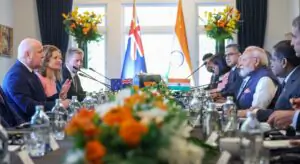
New Zealand is actively recalibrating its economic and security landscape, placing India at the forefront of this strategic pivot. This shift was underscored on July 11, 2026, when Indian Prime Minister Narendra Modi visited Auckland to meet with New Zealand Prime Minister Christopher Luxon. The visit, which follows the signing of a bilateral Free Trade Agreement (FTA) in April, marks the first time an Indian prime minister has traveled to New Zealand since Rajiv Gandhi in 1986.
For decades, New Zealand has relied heavily on China and Australia for economic stability, while looking to Western allies for security. However, rising militarization and political tensions in the Pacific have prompted a change in strategy. The current two-way trade between New Zealand and India stands at approximately $3.1 billion annually, with New Zealand exports—principally wool, logs, and apples—accounting for $718 million. The new FTA is designed to eliminate or reduce tariffs on 95 percent of exports, including kiwifruit, meat, coal, and forestry products. Trade Minister Todd McClay noted that the agreement places New Zealand exporters on equal footing with competitors and provides access to India’s rapidly growing middle class.
The agreement has faced scrutiny, particularly regarding a potential $20 billion investment commitment over 15 years. Critics question whether New Zealand can reach this target and warn that failure could jeopardize market access. Additionally, the Māori Party has voiced opposition, arguing the deal fails to protect Māori interests or uphold the Treaty of Waitangi. Despite these concerns, the government views the FTA as vital for an economy where trade accounts for 50 percent of its GDP. By diversifying away from a reliance on China, Wellington hopes to mitigate the vulnerabilities associated with such dependence, particularly the risk of China leveraging trade for political ends.
Beyond economics, the visit solidified a "strategic partnership" between the two nations, formalized in the "Roadmap to 2030." This framework integrates trade with security, detailing commitments to maritime security, cybersecurity, technology, and intelligence exchanges. A joint working group on counterterrorism was also established to combat violent extremism. This development expands upon the March 2025 Defense Cooperation Arrangement.
Prime Minister Luxon emphasized that national interests in the Indo-Pacific are increasingly interdependent, linking economic and security concerns. While India’s direct influence in the Pacific remains limited, the partnership provides New Zealand with additional resources as it navigates regional competition. You have reached the limit of 2 free articles this month. New Zealand remains committed to a nuclear-free Pacific, yet it continues to support regional security arrangements, including those with Australia, Japan, and South Korea. Whether these new security links with India evolve beyond rhetorical support remains to be seen, but the agreement clearly signals Wellington's intent to adjust its foreign policy to a changing global environment. Nevertheless, the new agreement signals an increased willingness to link security and trade issues in a more overt manner and suggests recognition that New Zealand foreign policy must adjust to changing economic and political circumstances.

Md. Kazi Bijoy is a dedicated tech enthusiast and content creator with a passion for digital innovation. With years of experience in the tech industry, he specializes in breaking down complex topics into easy-to-understand guides. When he isn’t writing, he explores the latest gadgets and researches emerging trends in the digital world.
1 thought on “New Zealand Balances Foreign Policy with Landmark India Trade Deal”