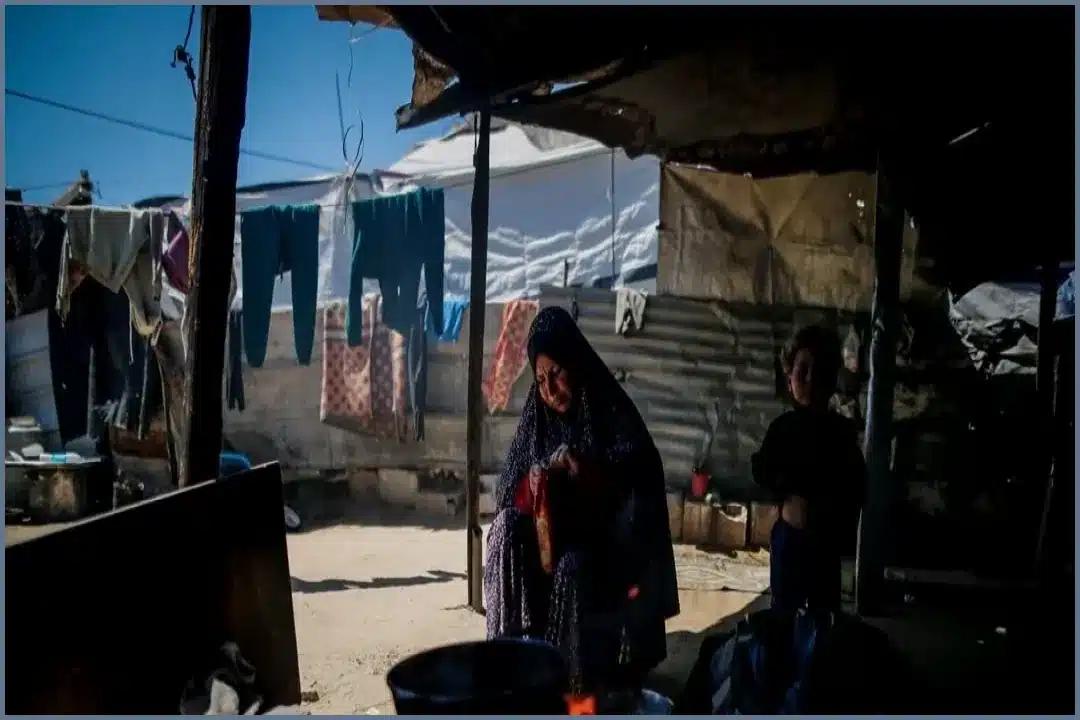
For Palestinian women in Gaza, the ongoing war has transformed the experience of pregnancy into a daily struggle for survival. Hadeel al-Madani, who is seven months pregnant, finds herself navigating a life of extreme hardship inside a tent. Simple daily routines, such as washing clothes by hand, cleaning, and cooking over open fires, have become physically exhausting tasks that she must perform while enduring the sweltering summer heat trapped inside poor-quality plastic fabric. Since the start of the conflict on October 8, 2023, the lack of electricity and running water has further exacerbated these conditions, leaving women like Madani in a state of constant anxiety for their unborn children.
Madani keeps a small supply of medicine among her few belongings, yet she worries that the intense heat or the presence of rodents and insects in the tent soil could compromise their effectiveness or pose a danger to her health. She describes her life as tragic, noting that the environment inside the tent is often hotter than the air outside. Her fears are shared by many, including Doaa al-Najjar, who is in her ninth month of pregnancy. Najjar has faced health complications due to the high temperatures, which she says cause her body temperature to rise dangerously. She recently sought medical treatment at a clinic after experiencing such symptoms, fearing the impact on her fetus.
The lack of basic supplies adds to the distress of expectant mothers. Najjar, who is waiting to give birth within days, notes that she has no bed, clothes, diapers, or milk for her newborn. She remains deeply concerned about the safety of her baby, specifically fearing that the lack of a raised bed will leave the infant vulnerable to insects and rodents. Comparing her current situation to life before the war, she emphasizes that the loss of peace of mind and the inability to secure basic necessities have made the prospect of childbirth a source of profound fear rather than joy.
Medical experts confirm that these individual stories reflect a broader systemic crisis. Iyad Abu Hosaira, head of the obstetrics and gynecology department at Al-Helou International Hospital in the Al-Nasr neighbourhood of Gaza City, explains that pregnant women are facing multiple, compounding hardships. These include repeated displacement, the destruction of homes, and the collapse of primary healthcare services due to the damage inflicted on hospitals and medical facilities. According to Abu Hosaira, the physical strain of tasks like carrying water gallons has directly exposed fetuses to danger, while the overall environment has contributed to widespread health issues, including anaemia.
The severity of the situation is captured in recent data from Gaza’s Health Ministry. In the first half of 2026, the ministry recorded 3,958 miscarriages. This represents a rate of 208.5 cases per 1,000 live births, a 3.3-fold increase compared to the 64 cases per 1,000 live births recorded in the second half of 2025. Monthly breakdowns show that June 2026 saw the highest number of cases at 790, while April recorded the highest monthly rate at 377.25 per 1,000 live births. Further analysis indicates that 73.6 percent of these miscarriages occurred before the 13th week of pregnancy, and 57.1 percent of pregnant women registered in 2025 suffered from anaemia.
The healthcare system remains severely crippled. By mid-July 2026, only 44 percent of pre-war health service points were still functioning. According to the World Health Organization, no hospital in the region is currently operating at full capacity, and more than half of all essential medicines are out of stock, leaving pregnant women with limited options for prenatal or emergency care.
“I’m waiting for the baby to come safely.”Najjar compares her current pregnancy with pregnancies before the war, saying that before the war, pregnant women had food, peace of mind and basic needs.Today, she cannot find anything needed for her expected newborn, no suitable living conditions, no bed, no clothes, no diapers and no milk.Although her delivery is approaching, Najjar is still thinking about how to secure these supplies while her family struggles to provide basic daily needs.She is also haunted by the fear of rodents and insects and the possible danger they pose to her baby, especially without a raised bed that could protect the child.“I fear for him from mice, rats, insects and the heat of the tent,” she said.
Related Articles

Mr. Udoy is a professional Web Developer and Blogger with 7+ years of experience in the tech world. He specializes in web architecture and digital storytelling. As the driving force behind worldincidents.com, he focuses on delivering high-quality, well-researched content to a global audience.
2 thoughts on “Gaza Pregnant Women Face Surge in Miscarriages Amid War”