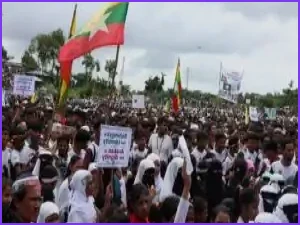
COX’S BAZAR, Bangladesh — Gathering in the sprawling, overcrowded refugee camps of Cox’s Bazar, hundreds of thousands of Rohingya refugees came together on August 25, 2026, to mark Rohingya Genocide Remembrance Day. The solemn event commemorated the ninth anniversary of the brutal 2017 military crackdown in Myanmar that forced more than one million people to flee their homeland. Despite nearly a decade in exile, the refugees used the anniversary to renew their collective calls for international justice, basic rights, and a safe, dignified return to Myanmar.
Aerial drone footage of the camps captured massive crowds walking from various sectors of the settlement toward central gathering points. Many participants carried posters and banners detailing the horrors of their displacement and demanding that the international community hold Myanmar's authorities accountable. Among the crowd were children who have grown up entirely within the confines of the Bangladeshi camps, possessing no personal memories of the villages their families were forced to abandon. Parents carried young sons on their shoulders, while girls and women in traditional thanaka, dresses, and burqas joined in solidarity, sharing water bottles and participating in collective prayers that frequently dissolved into tears.
The date of August 25 remains a painful scar for the Rohingya community. On this day in 2017, the Myanmar military launched a coordinated campaign to purge the Rohingya population from Rakhine State, using the pretext of an attack on a local police station. Human rights organizations and Rohingya civil society groups estimate that more than 300 Rohingya villages were partially or completely destroyed in the ensuing violence. Survivors recounted horrific atrocities, including the systematic rape of women and girls, children being thrown into fires, and families burned alive inside their homes. Countless others were arrested, and many families still do not know the fate of their jailed relatives. As people desperately fled toward Bangladesh, many drowned when their overcrowded trawlers capsized in the Naf River.
According to the medical humanitarian organization Doctors Without Borders, at least 9,000 Rohingya were killed in Rakhine State during the first month of the violence alone, with the vast majority dying from direct military violence. During the remembrance event, Rohingya teacher Wai Yan shared his firsthand experience of the massacre. "I witnessed the brutal massacre of my Rohingya community by the Myanmar military in 2017," Wai Yan said. "The bullets that flew over my head were like raindrops. All I saw were dead bodies with no one to bury them."
Nine years later, the suffering of the Rohingya has not ended, but rather evolved into a dual crisis. While those in the Cox's Bazar camps remain trapped in limbo, the Rohingya who stayed behind in Myanmar face renewed violence. The rebel Arakan Army is currently locked in a fierce conflict with the Myanmar military for control of Rakhine State. Human Rights Watch has reported that the Arakan Army has targeted Rohingya civilians through killings, unlawful detentions, forced recruitment of youth, and the burning of villages—abuses that the group warns may amount to war crimes. Many Rohingya fear that this new wave of violence is designed to drive the remaining population out of the country entirely, mirroring the military's 2017 campaign.
Repatriation efforts have completely stalled. Bangladesh, a small and densely populated nation, continues to shoulder the immense responsibility of hosting the refugee population. Not a single Rohingya refugee has officially returned to Myanmar through formal repatriation channels since 2017. Refugees and human rights advocates maintain that return is impossible until Myanmar recognizes the Rohingya as native people, guarantees their safety, and restores their citizenship and fundamental rights. While humanitarian aid has sustained the population, leaders emphasize that only political action can resolve the root causes of the displacement.
For the refugees, keeping the memory of the genocide alive is a crucial form of resistance. Abdo Rohim, an experienced Rohingya teacher, writer, and humanitarian worker, emphasized the importance of the annual commemoration. "If we don’t preserve our stories, others will forget what happened to us," Rohim said. "It is our responsibility to observe this important day, not only to remember our lost loved ones, but also to remind the world of what happened to us."
The sentiment was echoed by Sirajul Islam, a Rohingya poet, writer, and human rights activist, who spoke of the community's enduring hope despite years of exile. "Every year, we commemorate this day with the only hope to return home before the next anniversary comes," Islam said. "Today, we are marking the ninth anniversary but this time with both desolation and hope and with the searing question: Will our hope ever come true?"
Though international bodies like the United Nations and various human rights organizations continue to issue appeals for accountability, an end to persecution, and the restoration of Rohingya rights, refugees feel their pleas are largely being ignored. Nonetheless, community leaders remain determined to protect the truth of their history, asserting that remembrance is the key to one day returning home with dignity, safety, and freedom.
Related Articles

Meet Md. Rubel Rana
As a core contributor to Worlddincidents.com, Rubel Rana brings a unique perspective to the world of journalism. Whether it’s deep-diving into historical trivia or covering the latest global headlines, Rubel Rana is committed to delivering high-quality, high-impact articles. Their writing blends meticulous research with a compelling voice, helping readers stay informed and curious about the world around them.