
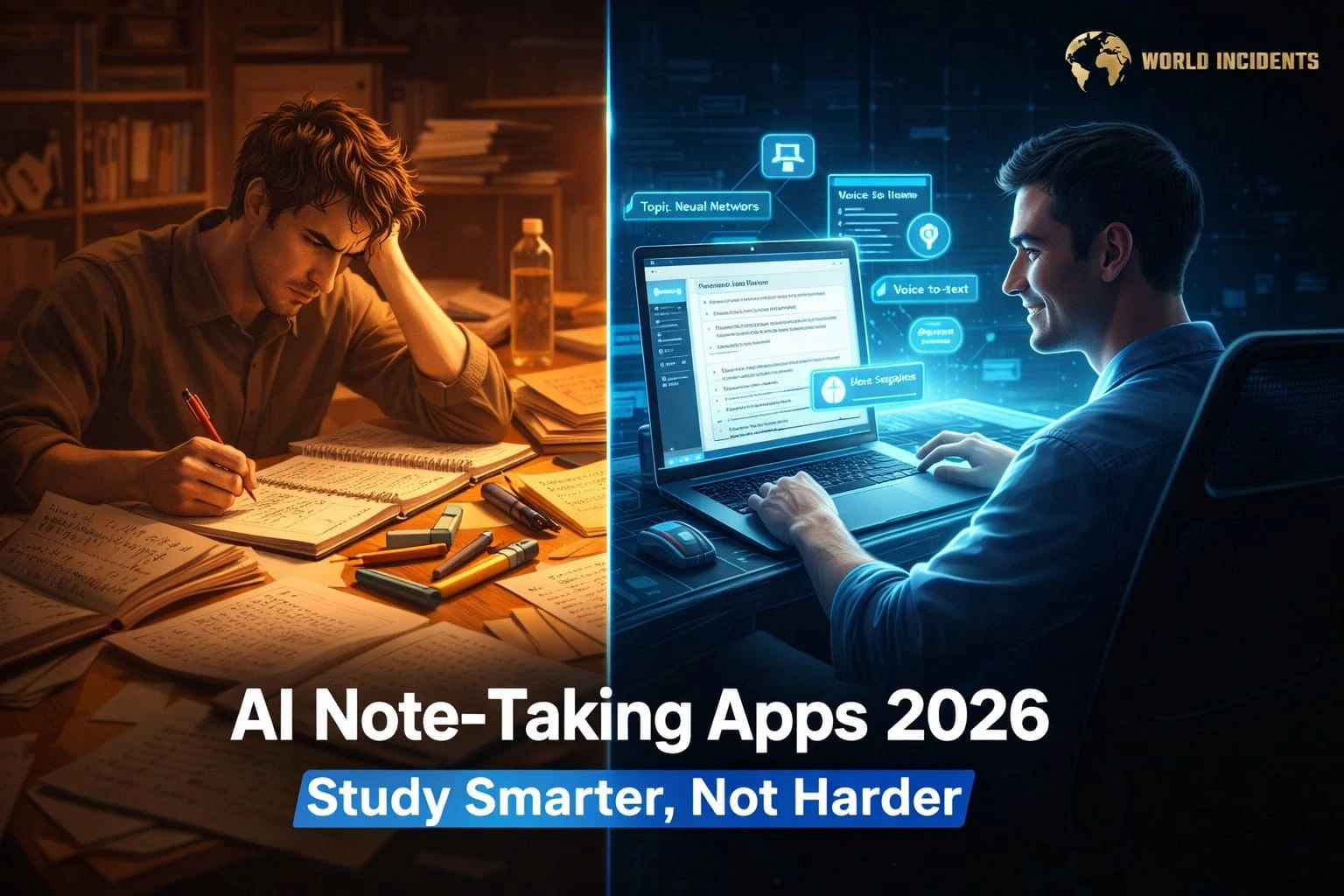
AI Note-Taking Apps in 2026: Can They Replace Traditional Studying?
The classroom has changed more in the past three years than in the previous three decades. At the center of this seismic shift sits a single, powerful category of software: AI note-taking apps. In 2026, millions of students, researchers, and professionals worldwide are turning to AI note-taking apps to capture, organize, and understand information faster than ever before. But a bold, urgent question now dominates education circles globally — can AI note-taking apps actually replace traditional studying?
This comprehensive guide explores what AI note-taking apps can and cannot do, compares them to time-tested study methods, highlights the best tools available today, and delivers an evidence-based verdict that every student and educator needs to read.
What Are AI Note-Taking Apps?
AI note-taking apps are software platforms that use artificial intelligence — including natural language processing, machine learning, and large language models — to automatically record, transcribe, summarize, organize, and even quiz users on their notes. Unlike traditional note-taking tools such as physical notebooks or basic digital editors, AI note-taking apps actively process and interpret information, transforming raw content into structured, searchable, and actionable knowledge.
The core capabilities of modern AI note-taking apps in 2026 include real-time audio transcription, intelligent summarization, concept mapping, cross-reference linking, smart flashcard generation, and AI-driven Q&A based on stored notes. Several leading AI note-taking apps now integrate directly with university learning management systems, research databases, and productivity ecosystems.
Read More: RTX 5060 vs RTX 4070 laptop: Which is better for gaming?
📊 Key Statistic — 2026
Global adoption of AI note-taking apps among university students reached 67% in early 2026 — up from 31% in 2023 — according to education technology research surveys across North America, Europe, and Southeast Asia.
The 7 Defining Strengths of AI Note-Taking Apps
1. Real-Time Transcription and Capture
The most immediate superpower of AI note-taking apps is their ability to transcribe spoken content in real time. Whether in a lecture hall, a Zoom class, or a research interview, these tools capture every word with impressive accuracy — often exceeding 95% — and instantly make it searchable. Students no longer miss critical points while writing; AI note-taking apps handle capture so the brain can focus on understanding.
2. Intelligent Summarization
After capturing content, AI note-taking apps distill hours of material into concise, structured summaries. A three-hour recorded lecture becomes a clean, organized set of key points within seconds. This summarization feature alone represents a dramatic productivity advantage over manual note-taking, which typically captures only 30–40% of lecture content accurately.
3. Automatic Concept Linking and Mind Mapping
Advanced AI note-taking apps identify relationships between ideas across different notes, sessions, and subjects — automatically building knowledge graphs. Students using these tools develop a richer, more connected understanding of their subject matter without the manual labor of creating mind maps by hand.
4. Smart Flashcard and Quiz Generation
Many leading AI note-taking apps transform notes into exam-ready flashcards and practice questions automatically. Based on spaced repetition algorithms, these apps schedule review sessions at the optimal moment for memory consolidation — a scientifically validated approach that dramatically outperforms passive re-reading.
5. Multilingual Support for Global Learners
For international students studying in a second language, AI note-taking apps with built-in translation and multilingual transcription remove a massive barrier to effective learning. Top platforms in 2026 support over 50 languages, enabling students to study in their native language while consuming content in another.
6. Seamless Cross-Device Synchronization
Unlike physical notebooks that stay on a desk, AI note-taking apps sync instantly across smartphones, tablets, laptops, and desktops. A student can review AI-generated summaries during a commute, add voice notes between classes, and access complete organized knowledge bases from any device — building study habits that integrate naturally into everyday life.
7. Personalized Learning Insights
The most sophisticated AI note-taking apps now provide genuine learning analytics — tracking which topics a student reviews most, identifying knowledge gaps, and recommending resources to fill them. This level of personalized academic insight transforms passive note storage into an active, adaptive learning system.
Best AI Note-Taking Apps Available in 2026
| App | AI Transcription | Auto Summary | Flashcards | Offline Mode | Best For |
|---|---|---|---|---|---|
| Notion AI 3.0 | ✔ | ✔ | Partial | ✔ | Organized note management |
| Otter.ai Pro 2026 | ✔ | ✔ | ✘ | Limited | Lecture transcription |
| Mem AI | ✔ | ✔ | ✔ | ✔ | Knowledge management |
| Reflect AI | Partial | ✔ | ✔ | ✔ | Deep thinkers & writers |
| Google NotebookLM 2 | ✔ | ✔ | ✔ | ✘ | Research & citations |
| Obsidian AI Plugin | Plugin | ✔ | ✔ | ✔ | Privacy-focused students |
Traditional Studying: What Still Works — and Why
Before declaring any winner, intellectual honesty demands a rigorous look at what traditional studying still does exceptionally well. Research in cognitive psychology consistently confirms that certain manual study techniques produce deeper, more durable learning outcomes than passive digital consumption.
Handwriting Enhances Memory Encoding
Decades of research — most prominently the landmark Mueller and Oppenheimer studies — demonstrate that students who handwrite notes retain conceptual understanding significantly better than those who type. The physical act of writing forces the brain to process and condense information, rather than transcribe it verbatim. This deeper encoding is difficult for AI note-taking apps to replicate on the cognitive side, even if they handle the capture side brilliantly.
Active Recall and Struggle Drive Retention
The “desirable difficulties” principle in learning science argues that effortful retrieval — studying without notes, solving problems from memory, teaching concepts aloud — creates stronger neural pathways than easy, frictionless consumption. Over-reliance on AI note-taking apps to summarize and organize everything risks removing the productive struggle that drives genuine expertise development.
Focused Attention Without Digital Distraction
Traditional studying with physical materials forces a kind of enforced focus that digital environments rarely match. Every device running AI note-taking apps is also a portal to social media, messaging, and entertainment. The discipline required for deep, uninterrupted study remains a human skill that no app can cultivate on a student’s behalf.
The Verdict: Replacement or Revolution?
The answer the evidence demands is nuanced but clear: AI note-taking apps do not replace traditional studying — they revolutionize it. The most effective students in 2026 are those who strategically combine the capture and organization power of AI note-taking apps with the cognitive depth of traditional study techniques.
Use AI note-taking apps to transcribe lectures automatically, generate smart summaries, and create spaced-repetition flashcards. Then complement these tools with handwritten review sessions, active recall practice, and deliberate problem-solving without AI assistance. This hybrid approach extracts maximum value from both worlds: the efficiency of artificial intelligence and the irreplaceable depth of human cognition.
How to Build the Perfect AI-Enhanced Study Routine
Integrating AI note-taking apps into your study life effectively requires a deliberate strategy. Here is a proven framework for 2026:
- During Class: Let your chosen AI note-taking app transcribe and capture. Focus your attention on understanding, not writing.
- After Class (Within 24 Hours): Review the AI-generated summary. Add your own handwritten annotations, questions, and connections in a physical notebook.
- Daily Review: Use AI-generated flashcards for spaced repetition sessions — 15 to 20 minutes per subject per day.
- Weekly Deep Study: Close your laptop. Practice active recall from memory. Solve problems without consulting your notes or AI tools.
- Exam Preparation: Use AI note-taking apps to surface weak areas, then apply traditional intensive study methods to master them.
The Future: Where AI Note-Taking Apps Are Heading
The evolution of AI note-taking apps is accelerating rapidly. By 2027, leading platforms are expected to offer real-time debate facilitation — where the app challenges students on their understanding as they study. Emotion-aware AI will detect confusion or fatigue and adjust the study pace accordingly. Integration with augmented reality glasses will eliminate the need for any screen entirely, overlaying AI-generated notes directly into the student’s field of vision during lectures.
The trajectory is unmistakable: AI note-taking apps will become as fundamental to education as the textbook itself — not replacing the act of learning, but permanently transforming its architecture.
Conclusion
In 2026, AI note-taking apps are among the most powerful academic tools a student can master. They save time, reduce overwhelm, personalize learning, and unlock capabilities that no individual student could achieve through manual effort alone. But they work best as amplifiers of human effort, not substitutes for it.
The future of studying is not AI or tradition — it is AI and tradition, strategically combined by students who understand the strengths of both. Master your AI note-taking apps. Master your active recall. Master the discipline of focused attention. Do all three, and academic excellence in 2026 is well within reach.
Frequently Asked Questions
Are these smart study apps suitable for all age groups and education levels?
Absolutely. Most leading platforms offer intuitive interfaces designed for users from middle school through postgraduate level. Many include teacher and institutional dashboards, making them suitable for classroom-wide adoption from secondary school onwards. Adult learners and professional development users also benefit significantly.
Do these tools work for subjects like mathematics and science, not just text-heavy courses?
Yes, though with varying effectiveness. For theoretical and lecture-based STEM content, transcription and summarization work excellently. For equation-heavy mathematics, some platforms now include LaTeX rendering and formula recognition. However, hands-on lab work and practical problem-solving still benefit most from traditional study methods.
Is there a risk of students becoming too dependent on these tools?
Yes — and it is a legitimate concern raised by educators worldwide. Over-reliance on automated summaries without engaging critically with source material can reduce deep comprehension. Experts recommend using these tools as a starting point for study, not as a replacement for genuine intellectual engagement with the subject matter.
How secure is student data on these platforms?
Data security varies by platform. Leading providers in 2026 comply with GDPR (Europe), FERPA (USA), and equivalent regulations in other regions. Students should review each platform’s data policy carefully, particularly regarding whether notes and transcriptions are used to train AI models. Some privacy-focused options process all data on-device.
Are there reliable free options, or is a paid subscription necessary for real value?
Several high-quality platforms offer genuinely useful free tiers — including Google NotebookLM and Notion AI’s basic plan. However, advanced features like unlimited transcription, full AI summarization, and flashcard generation typically require paid subscriptions ranging from $8–$20 per month. Many universities now provide institutional licenses at no cost to enrolled students.
Can these tools help students with learning differences such as dyslexia or ADHD?
Very significantly. Students with dyslexia benefit from accurate text-to-speech, auto-summarization that reduces reading load, and visual concept mapping. Students with ADHD benefit from structured note organization, short-session spaced repetition reminders, and the elimination of cognitive overhead from manual organization. Accessibility is one of the strongest cases for these tools in education.