
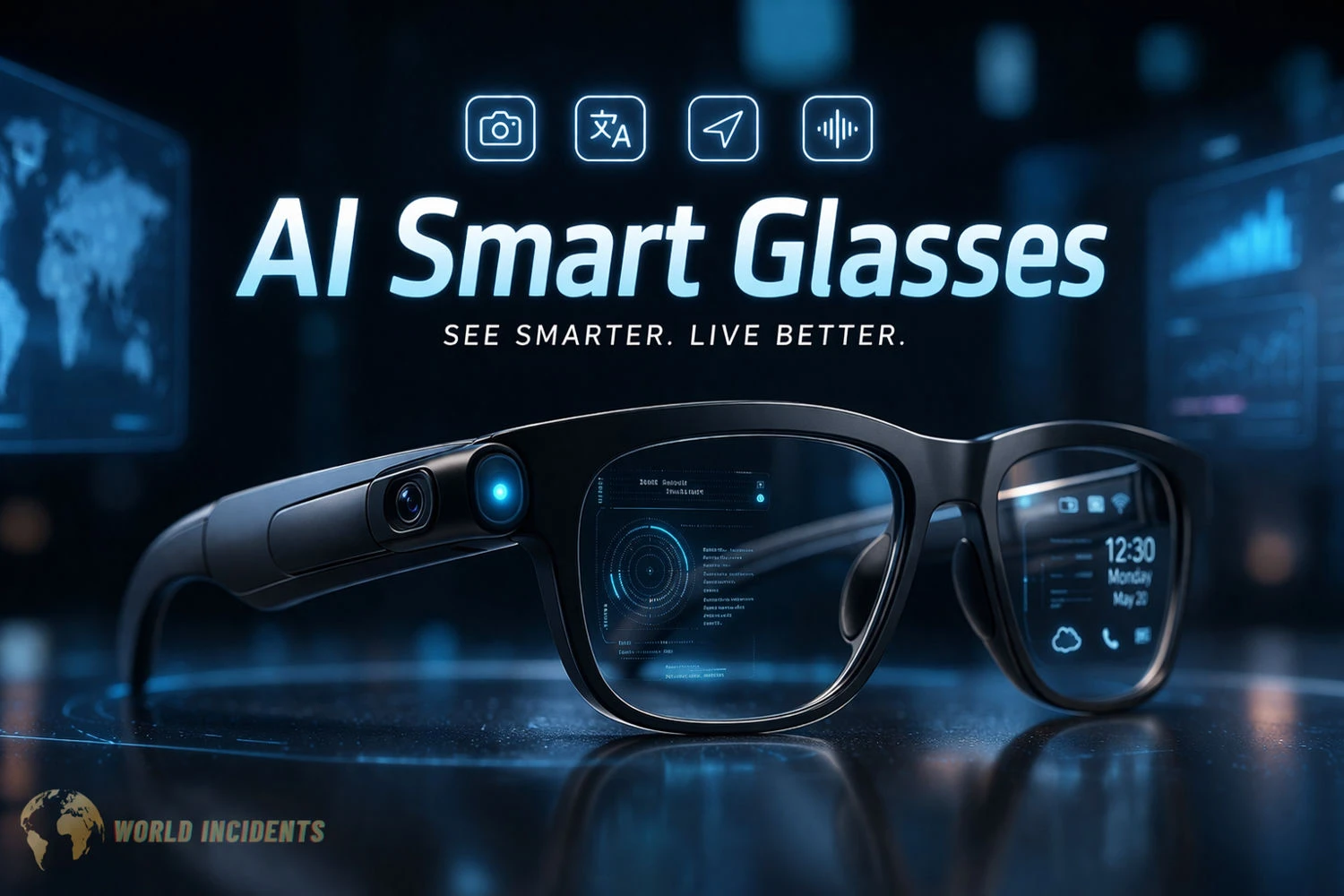
AI Smart Glasses, wearable tech 2026, augmented reality glasses, smart eyewear trends, multimodal AI, future of smartphones, AR productivity tools, real time translation glasses, tech gadgets 2026, spatial computing, smart frames, AI assistant wearablesIn March 2026, we are witnessing the most significant shift in personal technology since the launch of the original iPhone. The screen in your pocket is slowly being replaced by the lenses on your face. AI Smart Glasses have officially moved past the “early adopter” phase and into the mainstream, transforming from bulky prototypes into stylish, indispensable everyday tools.
Unlike the “smart glasses” of a few years ago that were merely cameras on frames, the AI Smart Glasses of 2026 are powered by multimodal Large Language Models (LLMs) that can see, hear, and understand the world around you in real-time.
What Makes 20
26 AI Smart Glasses Different?
The breakthrough in 2026 lies in “Multimodal Perception.” Previous iterations could only record video or play audio; however, today’s AI Smart Glasses use integrated neural processing units (NPUs) to interpret visual data instantly.
Visual Intelligence: Point your glasses at a car engine, and the AI overlays repair instructions directly onto your field of vision.
Real-Time Translation: When speaking to someone in another language, AI Smart Glasses provide live, holographic subtitles at the bottom of your lens.
Contextual Awareness: The glasses recognize your surroundings. If you walk into a grocery store, your AI assistant automatically displays your shopping list and highlights the items on the shelves.
The Fusion of Style and Silicon
One of the biggest hurdles for wearable tech was the “nerd factor.” In 2026, leading tech giants have partnered with luxury eyewear brands to ensure that AI Smart Glasses are indistinguishable from high-end prescription frames.
By using “Micro-LED” and “Waveguide” technology, manufacturers have shrunk the display components to the size of a grain of rice. This allows for a lightweight design that can be worn for 12+ hours without discomfort. Furthermore, the 2026 models feature “Silent Bone Conduction” audio, allowing you to hear your AI assistant and take calls without anyone around you hearing a sound.
Boosting Productivity with AI Smart Glasses
For professionals, AI Smart Glasses have become the ultimate “Second Brain.” Instead of constantly checking a phone or laptop, users can maintain “Heads-Up” productivity.
Meeting Summaries: During a live meeting, the glasses can record and transcribe key points, highlighting action items in your peripheral vision.
Navigation 2.0: No more looking down at a map. AI Smart Glasses project blue arrows onto the actual pavement or road in front of you, making navigation safer and more intuitive.
Facial Recognition (Professional Context): At networking events, the AI can provide a “digital name tag” above people you’ve met before, pulling up their LinkedIn profile or notes from your last conversation.
Privacy and Ethics in a “Recorded” World
As AI Smart Glasses become ubiquitous in 2026, privacy remains a top priority. Modern frames now include physical “Privacy Shutters” or highly visible LED rings that glow bright purple whenever the camera or microphone is active. Furthermore, most 2026 AI models utilize “Edge Computing,” meaning your personal data and visual feeds are processed locally on the glasses or a paired secure device, rather than being uploaded to a cloud server.
Micro-LEDs and Waveguide Technology
The reason AI Smart Glasses finally look like “normal” eyewear in 2026 is due to the breakthrough in Diffractive Waveguide technology and Micro-LED displays. In previous years, smart glasses required bulky prisms that made the frames thick and heavy. Today, the display engine is no larger than a matchhead, sitting discreetly in the temple of the frame. This engine fires light into a chemically treated glass lens that contains nanometer-scale gratings. These gratings “bend” the light and guide it directly into the wearer’s pupil, creating a crisp, high-definition image that appears to float at a natural focal distance. This technology allows AI Smart Glasses to maintain high transparency, meaning the wearer’s eyes are fully visible to others, maintaining the social “eye contact” that was lost with earlier, more opaque headsets.
Powering these sophisticated optics is the 2026 Distributed Processing Architecture. To keep the frames cool and lightweight, the “heavy lifting” of the AI is split between the glasses and a “Puck” or a high-speed 5G smartphone. The glasses handle the immediate “Low-Latency” tasks like motion tracking and image projection, while the paired device handles the complex “Multimodal AI” reasoning. This synergy allows for a battery life that finally lasts an entire workday. Additionally, the lenses themselves are now “Photochromic,” meaning they automatically tint when you step outside, turning your AI Smart Glasses into high-quality sunglasses while maintaining the brightness and clarity of the digital overlay. This seamless blend of hardware and software is why 2026 is being hailed as the “Year of the Lens.”
A New Era of “Hands-Free” Applications
The true power of AI Smart Glasses in 2026 isn’t just the hardware, but the specialized operating systems—often referred to as “Spatial OS”—that allow for a completely hands-free user interface. Unlike smartphones that require touch input, 2026 smart eyewear utilizes a combination of Eye-Tracking and Gaze-and-Pinch gestures. By simply looking at a digital icon floating in your living room and tapping your fingers together in the air, you can launch applications, resize windows, or “pin” a virtual weather dashboard to your kitchen wall. This “Persistent Digital Layer” means that your apps stay exactly where you leave them in physical space. If you pin a YouTube recipe video next to your stove, it will be there every time you put on your AI Smart Glasses and walk into the kitchen, creating a seamless blend between your digital and physical environments.
Furthermore, the 2026 developer ecosystem has shifted toward “Proactive Intelligence.” Instead of you opening an app, the AI Smart Glasses anticipate your needs based on your current activity. If the glasses detect you are holding a tennis racket, they automatically load a “Virtual Coach” overlay that analyzes your swing mechanics and provides real-time posture corrections. This “Contextual App Injection” is a fundamental shift in how we interact with software. We are no longer searching for tools; the tools are finding us. In 2026, this has led to the death of the traditional “App Store” in favor of “Skill Streams,” where your AI Smart Glasses download temporary capabilities—like a furniture assembly guide or a stargazing map—only when the situation demands it, keeping your visual field clean and your processing speed lightning-fast.
FAQ:
Q1: Do AI Smart Glasses work with prescription lenses?
Ans: Yes. In 2026, almost all major manufacturers offer a “clip-in” or integrated prescription service, making them accessible to everyone who wears glasses.
Q2: How long does the battery last?
Ans: The 2026 standard for AI Smart Glasses is “All-Day Battery,” which typically ranges from 14 to 16 hours of mixed-use, with fast-charging cases that provide a 50% boost in just 15 minutes.
Q3: Can I use them without a smartphone?
Ans: While many models still pair with a phone for extra processing power, the “Standalone” versions of 2026 feature built-in eSIMs, allowing for 5G connectivity anywhere in the world.
read more: Sony PS5 Prices..
Is Rec Room Shutting Down in 2026?