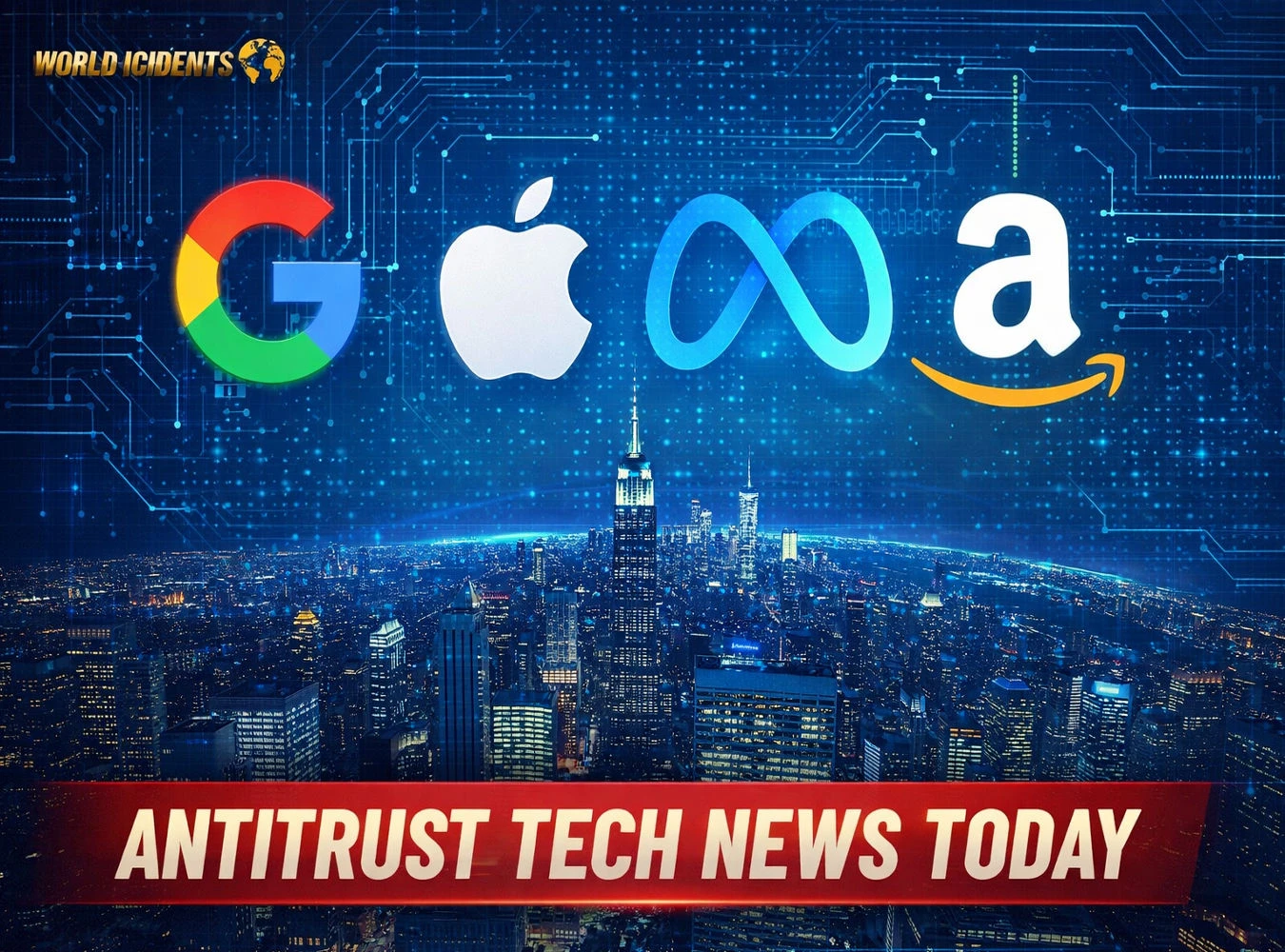
The antitrust tech news today suggests we have reached the most significant regulatory crossroad since the 1990s. In February 2026, the global tech landscape is being redrawn not by engineers, but by judges and regulators. The “laissez-faire” approach that allowed Big Tech to grow into multi-trillion-dollar entities has been replaced by a “Correction Era.”
From the U.S. Department of Justice (DOJ) to the European Commission, the focus has shifted from mere fines to structural remedies. This means “breakups” are no longer a theoretical threat—they are becoming a legal reality. This 3500-word deep dive examines every major battlefront in the antitrust war of 2026.
1. Google’s Double Crisis: Search and AdTech
The biggest antitrust tech news today involves Google, which is currently fighting on two massive fronts.
The Search Monopoly: Behavioral vs. Structural Remedies
Following the 2024 ruling that labeled Google an “illegal monopolist,” 2026 has become the year of implementation. While the DOJ initially requested a full sale of Chrome, Judge Amit Mehta has opted for behavioral remedies for the search business.
Current Status: Google is now forced to share its search data with smaller competitors (like DuckDuckGo and Perplexity AI) to level the playing field.
The “Default” Ban: Google is officially barred from paying Apple and Samsung billions to be the default search engine, a move that is already shifting market shares in early 2026.
The AdTech Breakup: A Historic Precedent
In more aggressive antitrust tech news today, the Google AdTech trial (concluded late 2025) is nearing its remedy phase. Unlike the search case, legal analysts expect a forced divestiture of Google’s AdX exchange. If this happens, it will be the first time a major tech platform has been forcibly dismantled in decades.
2. The New Frontier: Microsoft and the AI Monopoly Probe
As AI dominates the 2026 economy, antitrust tech news today has increasingly focused on the “AI Stack.”
The FTC’s Investigation into Microsoft and OpenAI
The Federal Trade Commission (FTC), now chaired by Andrew Ferguson, has accelerated its probe into Microsoft. The core issue is “acqui-hiring”—the practice where a big firm hires a startup’s entire staff to circumvent merger laws.
Cloud Bundling: Microsoft is under fire for allegedly bundling its “Azure AI” tools with Office 365 in a way that prevents competitors like Salesforce or Slack from competing fairly.
OpenAI Relationship: Regulators are examining whether Microsoft’s $13 billion investment is actually a “de facto merger” that should have been blocked.
3. Nvidia and the “Hardware Choke Point”
You cannot discuss antitrust tech news today without mentioning Nvidia. With a nearly 90% market share in AI chips, Nvidia is the most scrutinized hardware company in history.
Supply Manipulation: Regulators are investigating whether Nvidia prioritized chip delivery to customers who didn’t use competing hardware (like AMD or Intel).
Software Lock-in: The DOJ is looking into CUDA, Nvidia’s software platform, arguing that it creates a barrier that prevents developers from switching to other chip architectures.
4. Europe’s Digital Markets Act (DMA) in 2026
In Europe, the antitrust tech news today is dominated by the full enforcement of the DMA.
Apple’s Compliance: After long battles, Apple has finally allowed “sideloading” and third-party app stores across the EU. However, the European Commission is currently investigating if Apple’s new “Core Technology Fee” still violates the spirit of the law.
Meta’s Ad-Free Model: The EU has challenged Meta’s “Pay or Consent” model, arguing that privacy should not be a paid luxury.
5. Strategic Impact: What This Means for You
Why is antitrust tech news today important for the average consumer?
More Choice: As defaults are removed, you will see a surge in specialized AI search engines and niche social networks.
Lower Costs: If the “Apple Tax” or “Google Ad Tax” is reduced, the savings are expected to trickle down to app prices and digital services.
Data Privacy: Fragmentation of Big Tech means your data is no longer centralized in one “Master Profile” owned by a single company.
FAQ:
Q1: Will these trials make my tech devices more expensive?
Initially, some services might change their pricing models. However, the long-term goal of all antitrust tech news today is to lower prices by removing monopoly “taxes” that companies currently charge.
Q2: Is “Big Tech” really being broken up?
Structural breakups (selling off parts of a company) are the “nuclear option.” While 2026 has seen more calls for this than ever, most changes remain “behavioral”—changing how companies operate rather than splitting them apart.
Q3: How does AI change antitrust law?
AI is the newest battleground. Regulators are moving much faster than they did with the internet to ensure that the “AI giants” of tomorrow don’t become the “monopolies” of today.
Conclusion
The antitrust tech news today serves as a reminder that no company is “too big to fail” or “too big to be regulated.” As we move through 2026, the focus will remain on fostering an environment where a new startup in a garage has a fair chance against a trillion-dollar titan. The courtroom battles of today are paving the way for the innovations of tomorrow.
read more: Edge computing benefits