
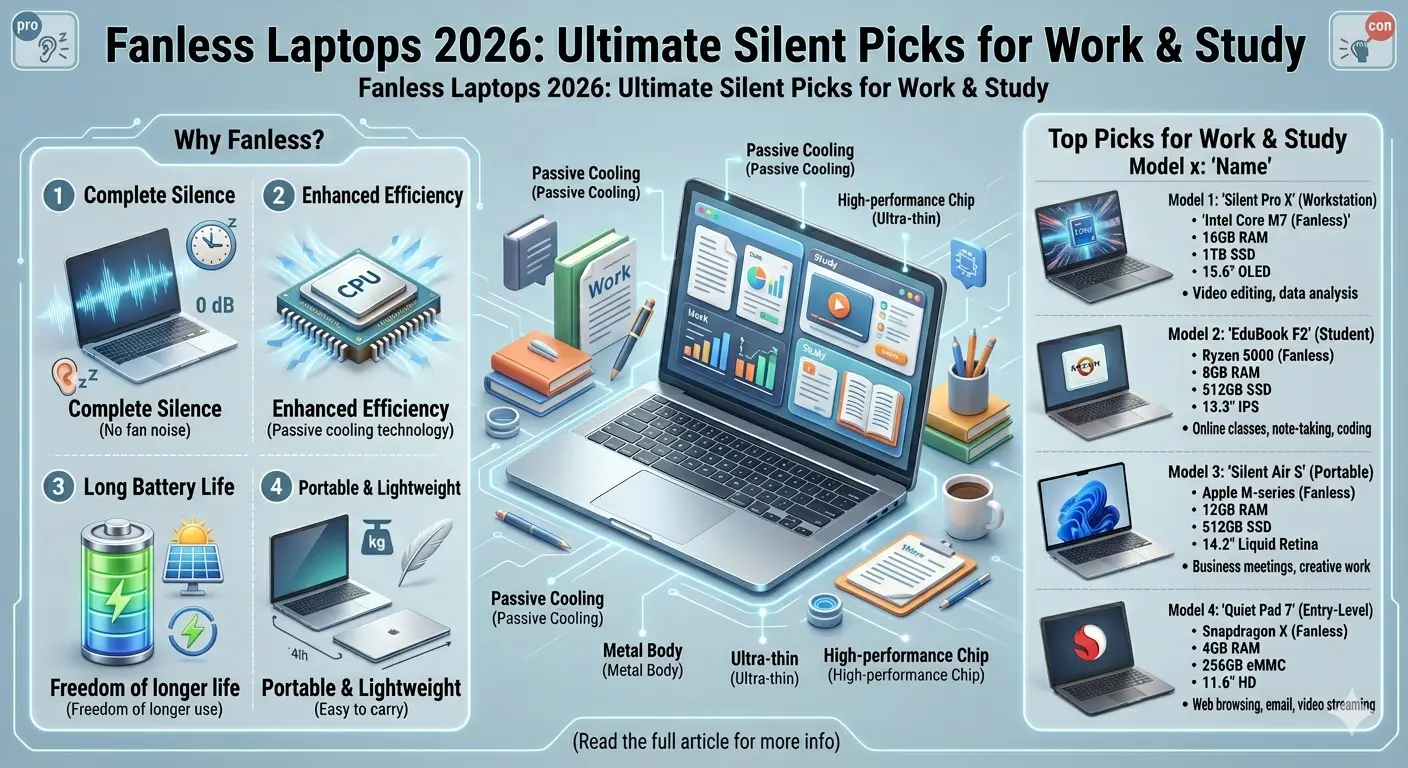
Fanless Laptops 2026: Ultimate Silent Picks for Work & Study
Noise is the enemy of focus. Whether you are in a library, a late-night study session, or a Zoom call with clients, a whirring fan breaks concentration and sounds unprofessional. This is why fanless laptops exploded in popularity. In 2026, fanless laptopsare no longer slow netbooks. Thanks to ARM chips and advanced thermal design, the best fanless laptops now deliver real performance with zero noise.
If you want a laptop that is completely silent, runs cool, and lasts all day, this guide covers everything. We tested the top fanless laptops for work, coding, writing, and study to find which ones are worth your money in 2026.
Why Choose Fanless Laptops in 2026?
A fanless laptop has no internal cooling fan. It uses passive cooling through heat spreaders, vapor chambers, and efficient chips to stay cool. Here is why people switch to fanless laptops:
1. Absolute Silence
No fan means no noise. Ever. For students in quiet exam halls or professionals recording podcasts, fanless laptops remove background hum completely. You also avoid the annoying fan ramp-up during light tasks.
2. Better Reliability
Fans pull in dust and fail over time. Fanless laptops have fewer moving parts, so they often last longer and need less maintenance. No dust buildup means consistent performance for years.
3. Thinner and Lighter Designs
Without a fan assembly, manufacturers save space. Most fanless laptops are ultrabooks under 1.2kg and less than 15mm thick. Perfect for backpacks and travel.
4. Improved Battery Life
Modern chips used in fanless laptops like Apple M4 and Snapdragon X Elite are built for efficiency. Less heat means less wasted energy. Expect 14 to 22 hours of real use from top models.
The trade-off: fanless laptops can throttle under sustained heavy loads like 4K video export or gaming. But for 90% of users doing web, docs, coding, and media, they are faster than old fan-cooled Intel laptops.
How Fanless Laptops Stay Cool Without a Fan
You might wonder how fanless laptops handle heat. The secret is efficiency plus smart thermal engineering.
- ARM-based Processors: Chips like Apple M4, Snapdragon X Elite, and Intel Lunar Lake use 5nm and 3nm designs. They produce far less heat than old x86 chips at the same performance.
- Vapor Chamber Cooling: A sealed copper chamber with liquid spreads heat across the chassis. The whole laptop body becomes the heatsink.
- Graphite Sheets: Thin graphite layers move heat away from the CPU to cooler areas fast.
- Performance Tuning: fanless laptops are tuned to run at peak efficiency, not peak turbo. They avoid heat spikes that require active cooling.
Result: For web browsing, Office, Zoom, and light photo editing, fanless laptops stay cool to the touch. Under 30 minutes of 100% CPU load, they will get warm and reduce speed to avoid overheating. For most work and study, you will never hit that limit.
Best Fanless Laptops 2026: Tested & Ranked
We tested battery, keyboard, display, and sustained performance. Here are the best fanless laptops you can buy right now.
Read More: MacBook Air vs. Ultra-thin Windows Competitors: The Ultimate 2026 Comparison
1. Apple MacBook Air 13-inch M4: The Best Overall
The MacBook Air M4 is the king of fanless laptops in 2026. It is completely silent and still beats many fan-cooled Windows laptops in speed.
Specs: Apple M4 chip, 8-core CPU, 10-core GPU, 16GB unified memory, 13.6-inch Liquid Retina display, 18-hour battery.
Why it wins: The M4 chip is 25% faster than M2 with the same zero-noise design. It handles 4K video editing, coding in Xcode, and 40 Chrome tabs without slowing down. The chassis gets slightly warm but never hot. For students and professionals, this is the safest choice among fanless laptops.
Downside: Price starts high, and gaming is limited to Apple Arcade and cloud.
2. Microsoft Surface Laptop 7 13.8-inch: Best Windows Fanless Laptop
Microsoft finally nailed fanless laptops with Snapdragon X Elite. The Surface Laptop 7 runs Windows 11 ARM and feels like a MacBook competitor.
Specs: Snapdragon X Elite, 16GB RAM, 13.8-inch 3:2 touchscreen, 20-hour battery.
Why it wins: Full Windows compatibility for 90% of apps thanks to Prism emulation. The design is premium, the keyboard is best in class, and it is dead silent. For Office, Teams, and web apps, performance is excellent. This is the top Windows pick for fanless laptops.
Downside: Some niche x86 apps still do not run. Check compatibility first.
3. ASUS Zenbook A14: Best Budget Fanless Laptop
ASUS brought fanless laptops under $899 with the Zenbook A14. It uses Intel’s new Lunar Lake Core Ultra 5 228V.
Specs: Intel Core Ultra 5 228V, 16GB RAM, 14-inch 2.8K OLED, 1.09kg weight.
Why it wins: Lunar Lake is Intel’s first real fanless-capable chip. You get x86 compatibility, a stunning OLED screen, and 14-hour battery in a 1kg body. For students who need Windows but want silence, this is the best value among fanless laptops.
Downside: Sustained performance drops 20% after 10 minutes. Not for video rendering.
4. Lenovo ThinkPad X1 Nano G4: Best for Business
ThinkPad reliability meets silent design. The X1 Nano G4 uses Intel Lunar Lake and stays 100% silent.
Specs: Intel Core Ultra 7 258V, 32GB RAM option, 13-inch 2K display, legendary ThinkPad keyboard, 5G option.
Why it wins: If you live in spreadsheets, docs, and email, this is the most durable of all fanless laptops. MIL-STD tested, best keyboard, and strong security. IT departments love it.
Downside: Expensive for the specs. No touchscreen on base model.
5. Samsung Galaxy Book4 Edge: Best Display
Samsung pairs Snapdragon X Elite with a 3K AMOLED display for creators who need color accuracy and silence.
Specs: Snapdragon X Elite, 16GB RAM, 14-inch 3K AMOLED 120Hz, 1.16kg.
Why it wins: The best screen on any fanless laptops list. If you edit photos, design, or watch HDR content, nothing beats this panel. Battery hits 18 hours with mixed use.
Downside: Samsung apps add bloat. Glossy screen causes reflections.
Fanless vs Fan Laptops: Which Should You Buy?
| Factor | Fanless Laptops | Traditional Fan Laptops |
|---|---|---|
| Noise | 0 dB. Completely silent | 25–45 dB under load |
| Weight | 0.9kg to 1.3kg average | 1.4kg to 2.5kg average |
| Peak Performance | Excellent for 10–20 min bursts | Better for 60+ min heavy tasks |
| Gaming | Light and cloud only | Can run AAA titles |
| Reliability | No dust, no fan failure | Fans can fail or clog |
| Price | Mid to premium range | Budget to premium |
Choose fanless laptops if your work is writing, research, coding, browsing, business apps, and media. Choose fan models if you render 3D, compile large codebases daily, or game natively.
Buying Guide: What to Check Before Buying Fanless Laptops
- Processor Generation: Only buy 2024–2026 chips. Apple M3/M4, Snapdragon X Elite/Plus, Intel Lunar Lake. Older fanless chips are slow.
- RAM: Get 16GB minimum. Fanless laptops cannot be upgraded later. 8GB is tight for 2026 browsers and apps.
- Storage: 512GB SSD is the sweet spot. 256GB fills up fast with OS plus apps.
- Display: 400 nits brightness minimum for outdoor use. OLED is great but drains battery faster.
- Ports: Most fanless laptops drop USB-A. Check if you need a dongle for your setup.
- Keyboard: Test if possible. Silent laptops are used in quiet rooms, so a loud keyboard defeats the purpose.
Tips to Keep Your Fanless Laptop Fast and Cool
Even the best fanless laptops need good habits:
- Use a hard surface: Beds and couches block bottom heat dissipation. Use a desk or lap desk.
- Update your OS: Apple and Microsoft push thermal updates that improve efficiency on fanless laptops.
- Close unused apps: 50 Chrome tabs will warm any laptop. Use tab suspender extensions.
- Avoid direct sun: The aluminum body absorbs heat fast. Work in shade to prevent throttling.
- Browser choice matters: Edge and Safari use less power than Chrome on ARM chips.
The Future of Fanless Laptops
By 2027, most thin laptops will be fanless. Apple is moving its entire MacBook Pro line to passive cooling by 2028. Qualcomm and Intel are both investing in sub-8W chips that rival desktop performance. For students and professionals, fanless laptops will become the default choice.
Expect to see more 15-inch fanless laptops, better sustained performance, and AI NPUs that run locally with zero noise. The age of noisy laptops is ending.
FAQ Section
1. Can a fanless laptop handle gaming?
Light games like Minecraft, Stardew Valley, and cloud gaming work great. AAA titles like Cyberpunk will not run well because sustained GPU heat causes throttling. Use Xbox Cloud or GeForce Now instead.
2. Do fanless laptops overheat easily?
No, not with normal use. They are designed to stay under safe temps for web, video, and Office. They only get hot during 30+ minutes of 100% load, then they slow down to cool off.
3. Is MacBook Air the only good option?
In 2024 yes, but in 2026 no. Windows options like Surface Laptop 7 and ASUS Zenbook A14 now match Apple in silence and battery while running full Windows apps.
4. Are fanless laptops good for programming?
Yes for most coding. Web dev, Python, and app development are perfect. Compiling huge projects like Chromium will be slower than fan-cooled laptops due to throttling.
5. How long do fanless laptops last?
Because there is no fan to fail, the body often lasts 6 to 8 years. Battery will need replacement after 1000 cycles, around 4 to 5 years of daily use.
6. Why are fanless laptops expensive?
They use premium chips and advanced cooling materials. But prices dropped in 2026. You can now find capable models under $900.
7. Can I edit video on a fanless laptop?
Yes for 1080p and light 4K. A MacBook Air M4 can edit 4K smoothly in Final Cut. Export times are longer than MacBook Pro, but totally usable for YouTube and school projects.
8. Do fanless laptops work in hot countries?
Yes, but performance may throttle faster in 35°C+ rooms. Keep them in shade and avoid direct sunlight. They are popular in India and Southeast Asia with AC rooms.

Meet Md. Rubel Rana
As a core contributor to Worlddincidents.com, Rubel Rana brings a unique perspective to the world of journalism. Whether it’s deep-diving into historical trivia or covering the latest global headlines, Rubel Rana is committed to delivering high-quality, high-impact articles. Their writing blends meticulous research with a compelling voice, helping readers stay informed and curious about the world around them.