
Sensational Claude Mythos: How Project Glasswing Redefines AI Intelligence.
The year 2026 has become a pivotal moment in the history of silicon and sentiment. While the world was busy adapting to the previous iterations of Large Language Models (LLMs), a new whisper began to circulate within the corridors of Anthropic. That whisper has now materialized into a framework that promises to alter our understanding of machine cognition forever. This is the era of Claude Mythos, a revolutionary leap integrated with the highly secretive Project Glasswing.
For the international tech community, this isn’t just an incremental update; it is a fundamental shift in how neural networks process context, ethics, and reasoning. To understand the gravity of this evolution, we must dive deep into the mechanics of Claude Mythos and explore how it intends to bridge the gap between human intuition and machine calculation.
The Genesis of Claude Mythos
Anthropic has always prioritized “Constitutional AI”—the idea that an AI should be governed by a set of core principles. However, with the introduction of Claude Mythos, the company has moved beyond mere rules. Mythos represents a “Neural Narrative” approach. Instead of simply predicting the next token in a sentence, the model builds a coherent internal world-view, allowing for a level of consistency previously unseen in digital intelligence.
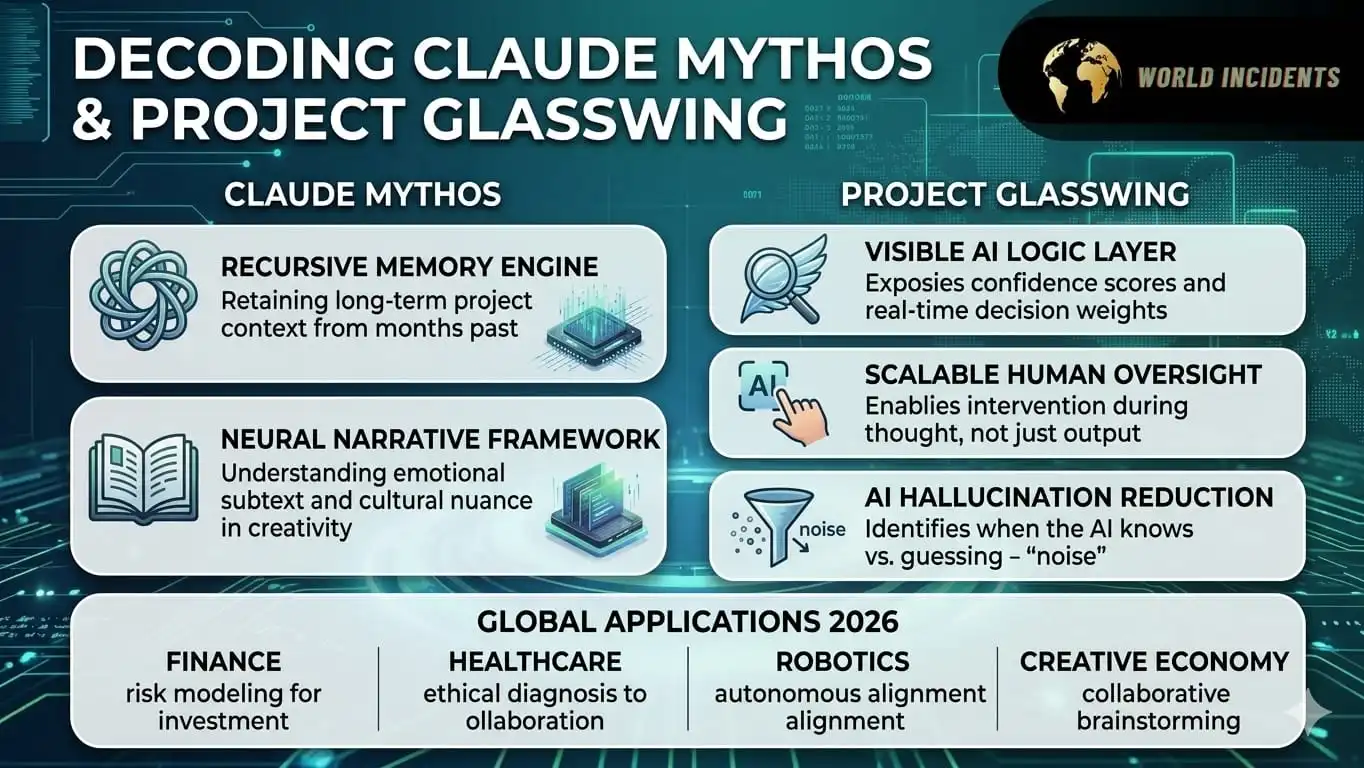
The development of Claude Mythos was driven by the need for more “transparent” intelligence. In the past, AI models were often criticized for being “black boxes.” Project Glasswing was specifically designed to fix this. By utilizing the Claude Mythos framework, developers can now peer into the decision-making layers of the AI, seeing not just the output, but the logical journey the model took to get there.
Decoding Project Glasswing: The Transparent Frontier
The codename “Glasswing” is not accidental. Inspired by the Greta oto butterfly, known for its transparent wings, Project Glasswing signifies Anthropic’s commitment to “visible” AI logic. When paired with Claude Mythos, this technology allows the model to display its internal weights and confidence scores in real-time.
Why Project Glasswing Matters
Read More: Snapdragon X2 Elite: Defining the 2026 Era of AI-Powered Computing
Eliminating Hallucinations: Through the Claude Mythos architecture, Project Glasswing identifies when the AI is “guessing” rather than “knowing.”
Scalable Oversight: It allows human auditors to intervene during the thought process of Claude Mythos, not just after the result is generated.
Efficiency: Project Glasswing optimizes how Claude Mythos utilizes compute power, making it faster and more cost-effective for enterprise-level applications.
Technical Architecture: Under the Hood of Claude Mythos
At its core, Claude Mythos utilizes a “Multi-Headed Contextual Engine.” Traditional models often lose their “train of thought” over long conversations. Claude Mythos solves this by employing a recursive memory layer. This means that if you start a project with Claude Mythos in January, the model retains the nuanced stylistic preferences and technical constraints of that project by December without needing constant re-prompting.
This architectural shift is what makes Claude Mythos the centerpiece of Project Glasswing. It allows for a “Glass Box” approach to AI. For international industries—from Swiss finance to Japanese robotics—the reliability provided by Claude Mythos is the primary reason it is being adopted at an unprecedented rate.
The Role of Anthropic Mythos in Global Markets
The transition from a service-based AI to a framework-based AI like Claude Mythos is significant. We are seeing Claude Mythos being used to solve complex global incidents. Whether it is predicting supply chain disruptions or assisting in climate modeling, the predictive accuracy of Claude Mythos has set a new benchmark.
Furthermore, the “Anthropic Mythos” philosophy emphasizes safety. In 2026, the risk of autonomous AI systems acting out of alignment is a major concern. Claude Mythos mitigates this by using the Project Glasswing layer to constantly check its outputs against human ethical standards. This “Dual-Layer Verification” makes Claude Mythos the safest model for sensitive sectors like healthcare and law.
How Claude Mythos is Redefining Creativity
While its technical specs are impressive, the impact of Claude Mythos on the creative arts is equally sensational. Unlike earlier models that often felt “robotic,” Claude Mythos has an uncanny ability to understand subtext, irony, and cultural nuance. This is due to the “Mythos” element—a vast library of human storytelling structures that the model uses to frame its responses.
When a writer uses Claude Mythos to brainstorm a novel, the AI doesn’t just suggest plot points; it analyzes the emotional arc through the lens of Project Glasswing to ensure the narrative resonates with human psychology. This synergy between data and “mythos” is why this framework is dominating the 2026 creative economy.
Implementing Project Glasswing in Your Workflow
For developers looking to integrate Claude Mythos, the process is now more streamlined thanks to the Glasswing API. This interface allows for:
Layer-Specific Tuning: Adjusting how Claude Mythos prioritizes certain datasets.
Transparency Reports: Automatically generating logs that explain why Claude Mythos gave a specific answer.
Adaptive Learning: Allowing Claude Mythos to learn from small, private datasets without risking data leakage.
The global tech community is already calling Claude Mythos the “Developer’s AI” because it empowers the user rather than hiding the technology behind a paywall of mystery.
The Future: Evolution Beyond Claude Mythos
What comes after Claude Mythos? If Project Glasswing is any indication, the future is “Liquid Intelligence.” We are looking at a world where Claude Mythos doesn’t just live in a cloud server but is distributed across devices, becoming a personal, transparent, and hyper-intelligent companion.
Anthropic’s vision with Claude Mythos is clear: to create an intelligence that is as reliable as glass and as profound as myth. As we move deeper into the decade, the lessons learned from Claude Mythos will undoubtedly pave the way for the first true Artificial General Intelligence (AGI).
Conclusion: Embracing the Mythos
The rise of Claude Mythos and the success of Project Glasswing prove that the future of AI is not just about being “smarter”—it’s about being more understandable. By focusing on transparency and deep contextual reasoning, Claude Mythos has redefined what we expect from our digital tools. For anyone serious about the future of technology, understanding and adopting Claude Mythos is no longer optional; it is essential.
Frequently Asked Questions (FAQ)
1. Is Claude Mythos available for public use?
Currently, the framework is being rolled out to enterprise partners and select developers through the Project Glasswing beta program, with a full global release expected later in 2026.
2. How does Project Glasswing improve AI safety?
It provides a “Transparency Layer” that allows humans to see the internal reasoning of the AI. This makes it easier to catch biases or errors before they affect the final output.
3. Can Claude Mythos be used for coding?
Yes, it is highly optimized for software engineering. Its ability to retain long-term project context makes it superior for managing large codebases compared to previous models.
4. Does Anthropic Mythos require more hardware power?
Surprisingly, no. Due to the efficiency optimizations in Project Glasswing, the model actually consumes less power per query than its predecessors while delivering more accurate results.
5. How is this different from regular Claude models?
While previous models focused on conversation, this framework focuses on “Visible Reasoning.” It is designed to be a collaborative partner that explains its logic, rather than just an answering machine.

Meet Md. Rubel Rana
As a core contributor to Worlddincidents.com, Rubel Rana brings a unique perspective to the world of journalism. Whether it’s deep-diving into historical trivia or covering the latest global headlines, Rubel Rana is committed to delivering high-quality, high-impact articles. Their writing blends meticulous research with a compelling voice, helping readers stay informed and curious about the world around them.