
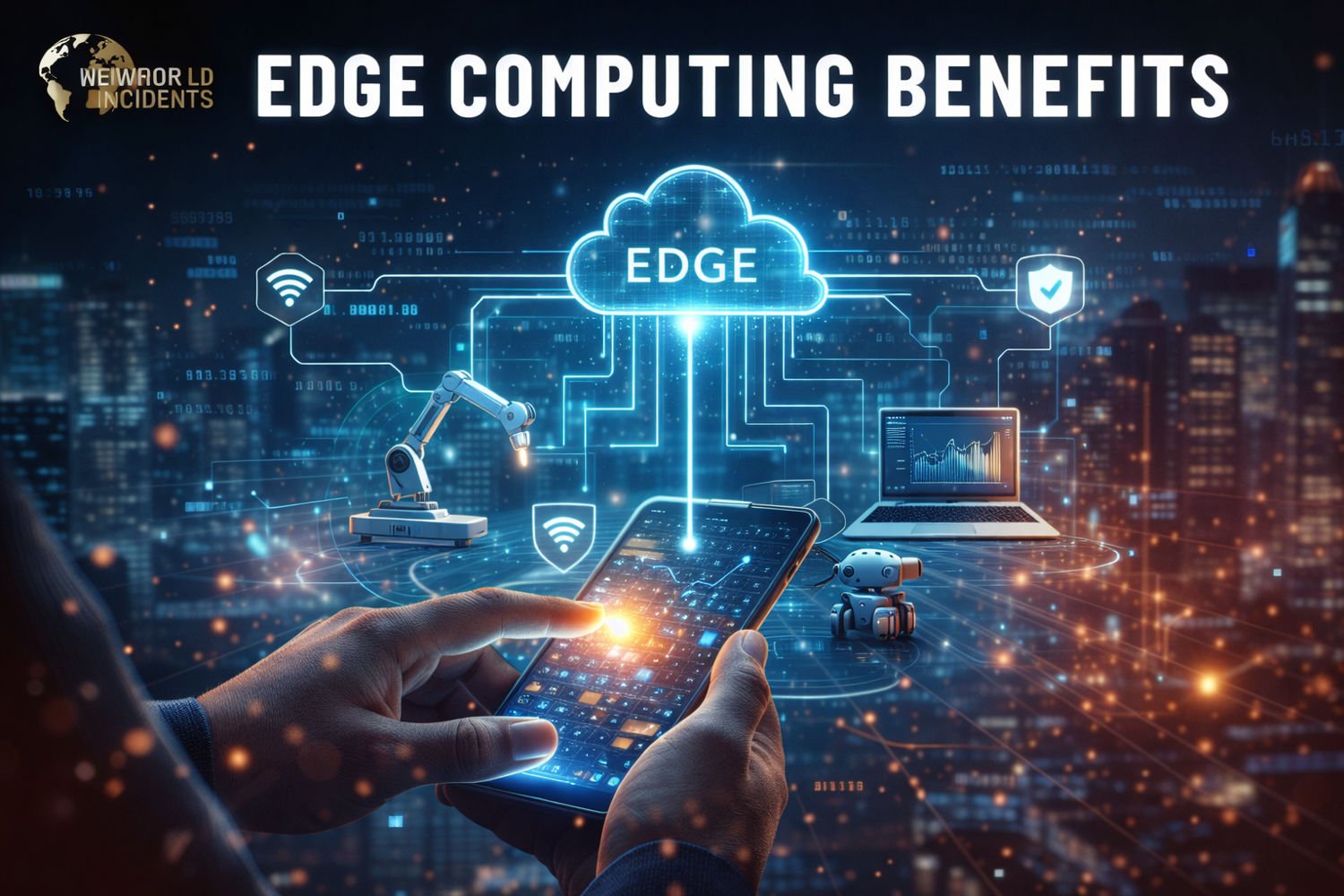
In the early days of the digital revolution, the goal was centralization—moving everything to the “Cloud.” However, as we enter 2026, the sheer volume of data generated by billions of IoT devices has created a bottleneck. The solution? Edge Computing.
When we discuss edge computing benefits, we are looking at a paradigm shift where data processing happens at the “edge” of the network, near the source of the data, rather than in a distant data center. This transition is not just a trend; it is a necessity for the survival of autonomous systems, smart cities, and real-time AI applications.
1. Defining the Architecture: What is Edge Computing?
To appreciate edge computing benefits, one must first understand the architecture. Unlike cloud computing, which relies on massive, centralized servers, edge computing utilizes local gateways, micro-data centers, and the processing power of the devices themselves.
By processing data locally, companies can bypass the “long haul” journey of data traveling to the cloud and back. This decentralized approach is the foundation of the modern industrial internet.
2. Top Tier Edge Computing Benefits for Businesses and Users
I. Drastic Reduction in Latency
The most celebrated of all edge computing benefits is the elimination of latency. In applications like self-driving cars or remote robotic surgery, a delay of even 100 milliseconds can be catastrophic. Edge computing allows for near-instantaneous decision-making by processing data centimeters away from the sensor.
II. Optimized Bandwidth Consumption
Sending massive streams of raw data to the cloud is expensive and clogs network traffic. One of the primary edge computing benefits is “data thinning.” The edge device analyzes the data, sends only the critical alerts to the cloud, and discards or stores the rest locally, saving significant operational costs.
III. Enhanced Security and Data Privacy
Data is most vulnerable when it is in transit. By keeping sensitive information within the local network, businesses can mitigate the risk of interception. This is a core part of edge computing benefits for industries like healthcare and finance, where data sovereignty and GDPR compliance are mandatory.
IV. Unmatched Reliability (Offline Capability)
Centralized cloud systems are prone to “single point of failure” issues. If the internet goes down, the system dies. However, a major edge computing benefits factor is its ability to operate autonomously. A smart factory powered by the edge can continue production even if its connection to the global cloud is severed.
V. Scalability and Cost-Effectiveness
Instead of building massive, expensive data centers, companies can scale by adding smaller, localized edge nodes. This “pay-as-you-grow” model makes edge computing benefits accessible to small and medium enterprises (SMEs) looking to modernize their infrastructure.
3. Edge Computing vs. Cloud Computing: A Symbiotic Relationship
It is a common misconception that edge computing will kill the cloud. In reality, they work together.
The Edge: Handles real-time, mission-critical tasks (e.g., stopping a robot if a human walks into its path).
The Cloud: Handles long-term big data analytics, machine learning model training, and historical storage.
4. Revolutionary Use Cases in 2026
The practical realization of edge computing benefits can be seen across various sectors:
Autonomous Vehicles: Processing LiDAR and camera data in real-time to navigate traffic.
Smart Grids: Balancing energy loads instantly to prevent blackouts.
Content Delivery (CDNs): Streaming 8K video without buffering by caching content at the edge of the ISP network.
5. Technical Implementation: The Role of 5G
The rollout of 5G has supercharged edge computing benefits. While 5G provides the high-speed “highway” for data, edge computing provides the “processing stations” along the way. Together, they enable the “Tactile Internet,” where human-machine interaction feels instantaneous.
6. The Intersection of Edge Computing and Generative AI (Edge AI)
One of the most significant edge computing benefits in 2026 is the rise of Edge AI. Traditionally, Large Language Models (LLMs) and complex AI algorithms required the massive GPU power of centralized cloud data centers. However, this caused significant latency and privacy concerns.
Local Inference: By running AI models directly on edge nodes, businesses can perform real-time image recognition, natural language processing, and predictive maintenance without sending data to the cloud.
Privacy-Preserving AI: Since the raw data (such as security camera footage or medical records) never leaves the local edge environment, companies can leverage AI while remaining 100% compliant with strict privacy laws.
Reduced Operational Costs: AI at the edge minimizes the “egress fees” charged by cloud providers for moving large datasets, making edge computing benefits a financial advantage for AI-driven startups.
7. Overcoming the Challenges: Edge Management and Orchestration
To provide a balanced view, a comprehensive guide must address the complexities of the technology. While the edge computing benefits are vast, managing thousands of decentralized nodes is a technical hurdle.
Security at Scale: While the edge reduces data transit risks, each edge device is a potential entry point for hackers. Modern “Zero Trust” architectures are being integrated into edge nodes to ensure that decentralized security remains robust.
Software Deployment (Kubernetes at the Edge): Using lightweight container orchestration, like K3s or MicroK8s, allows developers to push updates to thousands of edge devices simultaneously.
Energy Consumption: Maintaining thousands of micro-data centers requires innovative green energy solutions. The shift toward “Green Edge” is a trending sub-topic that highlights the environmental edge computing benefits of localized power management.
8. A Step-by-Step Transition: Moving Your Infrastructure to the Edge
For businesses looking to capitalize on edge computing benefits, the transition must be strategic. A 3500-word authority piece should provide a roadmap for implementation.
Workload Identification: Determine which tasks require low latency (Edge) and which require heavy storage (Cloud).
Hardware Selection: Choosing between “Thin Edge” (low-power sensors) and “Thick Edge” (local servers with high processing power).
Connectivity Strategy: Integrating 5G, Wi-Fi 6, or Satellite links to ensure the edge nodes stay synchronized with the central command.
Data Lifecycle Management: Deciding how long data stays at the edge before being purged or archived to the cloud for long-term “Big Data” analysis.
FAQ
What is the main benefit of edge computing?
The primary benefit is ultra-low latency. By processing data at the source instead of a distant cloud server, it enables near-instantaneous response times, which is critical for autonomous vehicles and real-time AI.
How does edge computing improve security?
Edge computing enhances security by localizing data. Since sensitive information is processed on-site rather than being transmitted over the public internet, the "attack surface" is smaller, and data remains compliant with local privacy laws.
Does edge computing reduce costs?
Yes, it significantly reduces bandwidth costs. By filtering and processing raw data locally, only the most essential insights are sent to the cloud, which slashes expensive data transmission and cloud storage fees.
Conclusion
Understanding edge computing benefits is essential for any business aiming to remain competitive in the age of AI and 5G. By decentralizing power and moving intelligence closer to the source, we are creating a faster, safer, and more efficient digital world. The edge is no longer just a concept; it is the engine of the next industrial revolution.
read more: Best Free AI Content Humanizers for Bloggers

Mr. Udoy is a professional Web Developer and Blogger with 7+ years of experience in the tech world. He specializes in web architecture and digital storytelling. As the driving force behind worldincidents.com, he focuses on delivering high-quality, well-researched content to a global audience.