
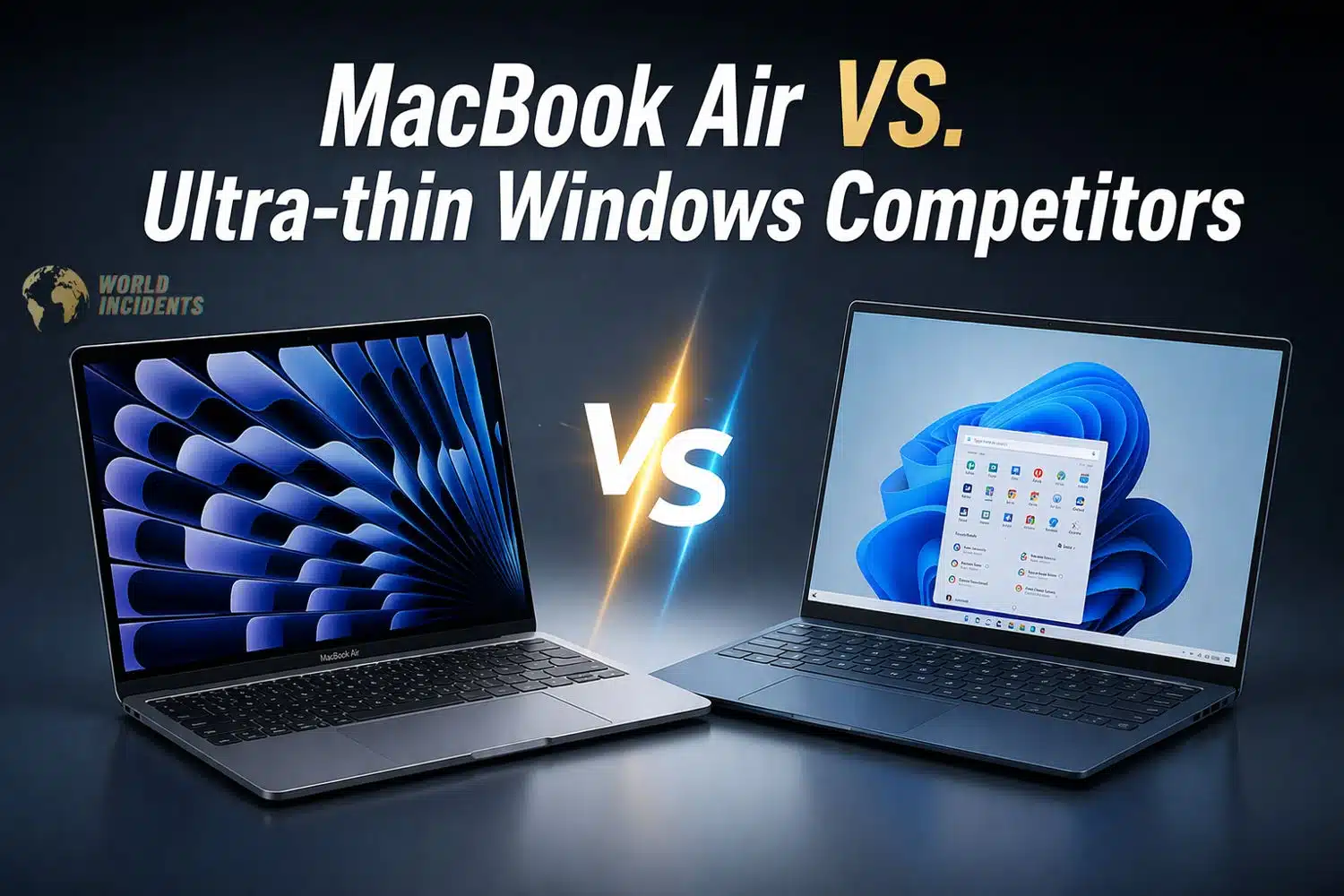
When choosing a new laptop in 2026, the primary debate for most users remains the MacBook Air vs. Ultra-thin Windows Competitors. For years, the MacBook Air stood as the undisputed king of the “thin and light” category, but the gap has never been narrower than it is today. With the recent launch of the MacBook Air with the M5 chip, Apple has once again raised the bar for efficiency and AI integration. However, the Windows ecosystem has responded with a formidable lineup of ultra-thin rivals from Dell, ASUS, and Lenovo, powered by the latest Intel Panther Lake and Snapdragon X Elite Gen 2 architectures.
Choosing between a MacBook Air and a premium Windows ultrabook is no longer just about choosing an operating system; it is about choosing a lifestyle and a workflow. Whether you are a student in Dhaka looking for all-day battery life or a professional content creator needing a sleek machine, understanding the nuances of these devices is crucial. In this comprehensive guide, we will dive deep into how the MacBook Air M5 stacks up against its fiercest Windows rivals to help you decide which ultra-portable powerhouse deserves a place in your backpack.
MacBook Air vs. Ultra-thin Windows Competitors
When we dive into the technical specifics of the MacBook Air vs. Ultra-thin Windows Competitors, we see how much the landscape has shifted in 2026. The MacBook Air relies on its vertically integrated hardware and software, which gives it a massive advantage in system responsiveness. However, if you look closely at the MacBook Air vs. Ultra-thin Windows Competitors benchmark scores, Windows machines often lead in multi-threaded applications due to higher clock speeds.
For the average user, the MacBook Air vs. Ultra-thin Windows Competitors choice often comes down to keyboard and trackpad preference. While Apple’s Force Touch trackpad is legendary, many ultra-thin Windows competitors now feature haptic touchpads that feel remarkably similar. Furthermore, in the MacBook Air vs. Ultra-thin Windows Competitors connectivity test, Windows ultrabooks consistently win by offering more than just USB-C ports, making them a more versatile choice for professionals who refuse to carry dongles.
Minimalism vs. Versatility
In the physical battle of MacBook Air vs. Ultra-thin Windows Competitors, we see two distinct philosophies. The MacBook Air M5 continues Apple’s legacy of “less is more” with its 11.3mm unibody chassis and fanless design. It is built for those who value silent operation above all else. On the other hand, many ultra-thin Windows competitors like the Dell XPS 13 and ASUS Zenbook S 13 use advanced materials like plasma ceramic aluminum to offer even lighter builds. While the Air is iconic, these Windows rivals often provide more variety in colors and textures.
Display and Visual Experience
For many users, the screen is the most important part of a laptop. The MacBook Air M5 features a beautiful Liquid Retina display with 500 nits of brightness and P3 wide color support. It’s sharp, color-accurate, and great for general productivity. However, it still lacks a high refresh rate (stuck at 60Hz) and uses traditional LCD technology.
In contrast, almost every top-tier Windows competitor in 2026, such as the Lenovo Yoga Slim 7i Aura Edition, comes standard with a 2.8K or 3K OLED panel. These displays offer infinite contrast ratios, deeper blacks, and 120Hz ProMotion-style refresh rates that make every scroll and animation look buttery smooth. If your work involves deep color grading or if you simply enjoy watching HDR content, the Windows ultrabooks currently hold a significant edge in display technology.
The M5 Chip vs. Intel and Snapdragon
Performance is where the battle gets intense. The Apple M5 chip features a 10-core CPU and a powerful Neural Accelerator in every core, making it up to 9.5x faster than the original M1 model for AI tasks. The unified memory architecture ensures that the system feels incredibly responsive, even with multiple apps open.
However, the Windows side has seen a massive leap with Intel’s Panther Lake and Snapdragon’s ARM-based chips. For the first time, Windows laptops like the MSI Prestige 13 AI+ are matching (and sometimes exceeding) the MacBook Air in multi-core performance. While the MacBook Air remains the king of “burst” performance and silent cooling, Windows machines with small, whisper-quiet fans can often sustain heavy workloads—like 4K video rendering—for longer periods without thermal throttling.
Battery Life and Portability
Portability is the heart of the MacBook Air vs. Ultra-thin Windows Competitors discussion. The MacBook Air M5 promises up to 18 hours of battery life, which remains incredibly consistent across various tasks. While Windows laptops used to struggle in this area, the newest ultra-thin Windows competitors powered by ARM architecture are now reaching 15-17 hours of usage. If you are a traveler or a student, both options now provide true “all-day” battery life, but the MacBook still feels slightly more optimized for power management.
Copilot+ PC vs. Apple Intelligence
2026 is the year of AI, and this is clearly visible in the MacBook Air vs. Ultra-thin Windows Competitors rivalry. Windows laptops are now marketed as Copilot+ PCs, featuring dedicated NPUs for local AI tasks like real-time captions and “Recall.” Apple’s response is Apple Intelligence, which is deeply integrated into the macOS experience. Whether you prefer the AI tools in the Windows ecosystem or the private, seamless integration of Apple’s AI, both the MacBook Air and its ultra-thin Windows competitors are now smarter than ever.
Ports and Connectivity
One area where Windows competitors consistently win is port selection. The MacBook Air M5 is limited to two Thunderbolt 4 ports and a MagSafe charging port. This often means carrying a dongle for HDMI or USB-A devices.
Conversely, ultra-thin Windows laptops like the ThinkPad X1 Carbon Gen 13 managed to fit USB-C, USB-A, and even HDMI ports into a chassis just as thin as the Air. Furthermore, many Windows laptops in 2026 now support Wi-Fi 7 and 5G/LTE connectivity, whereas the MacBook Air still lacks a cellular data option.
Conclusion
In 2026, the choice between a MacBook Air M5 and an ultra-thin Windows competitor is closer than ever.
Choose the MacBook Air M5 if:
- You want a fanless, silent machine with the best resale value.
- You are already deep into the Apple ecosystem (iPhone, iPad, Apple Watch).
- You prioritize consistent battery life and a refined, simple user experience.
Choose a Windows Ultra-thin Competitor if:
- You want a superior OLED display with a 120Hz refresh rate.
- You need more ports and the flexibility of a touchscreen or 2-in-1 design.
- You require specific Windows-only software or want the latest Copilot+ AI features.
Ultimately, both paths lead to incredible performance. The MacBook Air remains the gold standard for refined simplicity, while the Windows world offers cutting-edge hardware variety that is hard to ignore.
FAQ
Q1: Is the MacBook Air better for students than Windows laptops?
A: Yes, for most students, the MacBook Air is better due to its lightweight design, incredible battery reliability, and the fact that it stays cool without fans in a quiet library.
Q2: Can Windows ultra-thin laptops match Apple’s battery life?
A: In 2026, yes. Specifically, models with Intel Panther Lake and Snapdragon X Elite chips have surpassed MacBook Air in light-task battery tests.
Q3: Does the MacBook Air support two external monitors?
A: Yes, starting from the M3 chip, the MacBook Air supports two external displays when the laptop lid is closed.
Q4: Which ultra-thin laptop has the best keyboard?
A: This is subjective, but the Lenovo Yoga and Dell XPS series are widely praised for their tactile feedback, while the MacBook Air is known for its stable and precise Magic Keyboard.
read more: 7 Best Offline AI Tools 2026
Yahoo’s “Scroll Stoppr” Phenomenon

Mr. Udoy is a professional Web Developer and Blogger with 7+ years of experience in the tech world. He specializes in web architecture and digital storytelling. As the driving force behind worldincidents.com, he focuses on delivering high-quality, well-researched content to a global audience.