
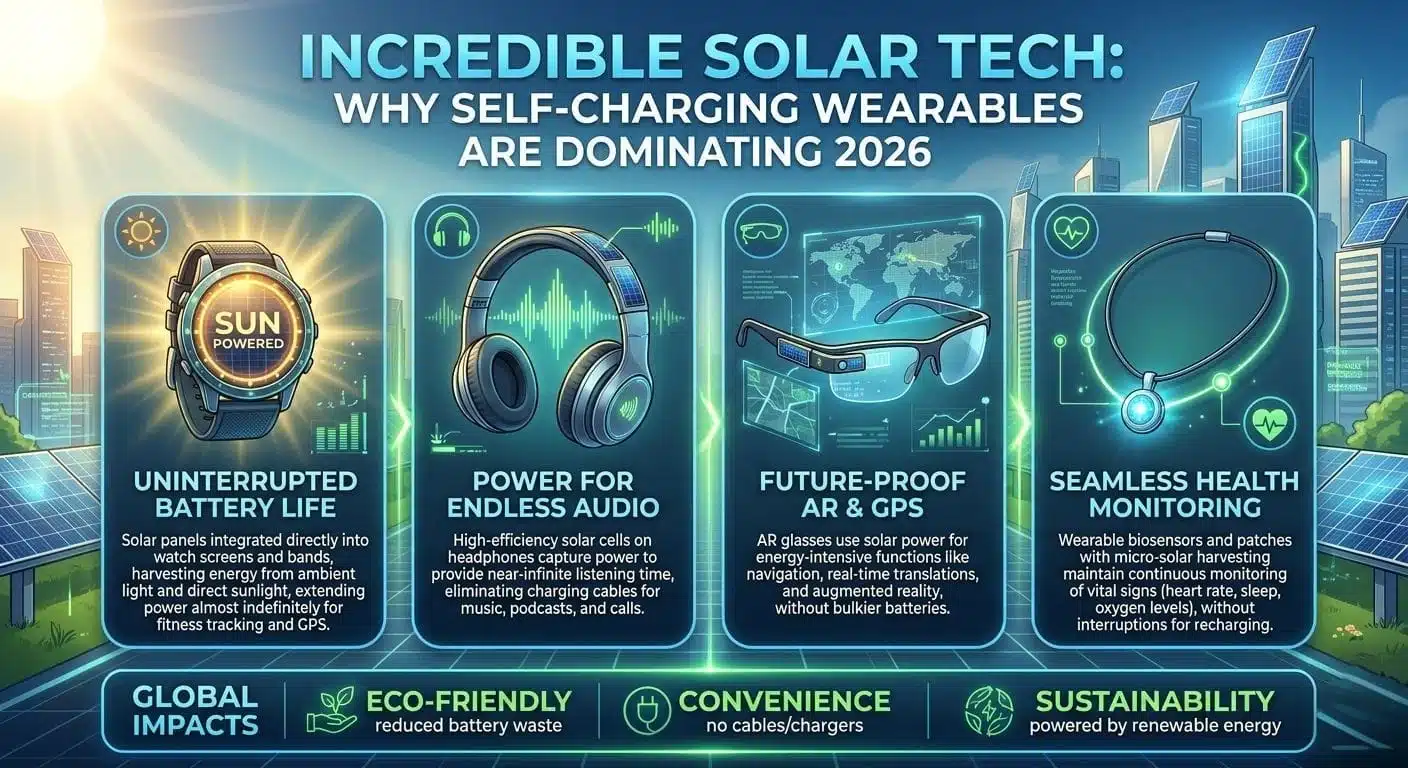
Incredible Solar Tech: Why Self-Charging Wearables are Dominating 2026.
Every wearable device owner knows the frustration: a smartwatch dying mid-run, a fitness tracker going dark on a hiking trail, a health monitor losing power during a long-haul flight. In 2026, this frustration is becoming obsolete. A new generation of self-charging wearables powered by solar and ambient energy harvesting technology is reshaping the entire wearable industry — and the adoption numbers are staggering. Self-charging wearables are not a niche curiosity. They are the dominant trend defining what consumers expect from wearable technology this year.
What Are Self-Charging Wearables?
Read More: Tandem OLED Display Laptops: The Ultimate 2026 Guide to the Future of Visuals
Self-charging wearables are electronic devices worn on the body — smartwatches, fitness trackers, health monitors, hearables, and smart rings — that generate their own electricity through energy harvesting technologies. The most dominant of these technologies in 2026 is photovoltaic solar charging: ultra-thin solar cells embedded in or beneath the device’s display or casing that continuously convert light — both sunlight and indoor ambient light — into electrical energy.
Beyond solar, leading self-charging wearables in 2026 employ a combination of harvesting methods: thermoelectric generators that capture body heat differential, piezoelectric systems that harvest energy from motion and vibration, and triboelectric nanogenerators that generate electricity from the mechanical contact between skin and device. The result is wearable hardware that draws on multiple ambient energy streams simultaneously, dramatically extending operational life while reducing — or in some cases entirely eliminating — the need for cable charging.
🌱 The Green Impact of Self-Charging Wearables
A standard smartwatch requiring daily charging consumes approximately 3.6 kWh of grid electricity per year. A fully self-charging wearable operating entirely on solar and body-heat harvesting eliminates this consumption entirely — multiplied across tens of millions of devices, the environmental impact of widespread adoption is substantial and measurable.
The Market Explosion: Self-Charging Wearables in Numbers
The Science Behind Solar Wearable Charging in 2026
The photovoltaic cells powering today’s best self-charging wearables bear little resemblance to the bulky rooftop solar panels of a decade ago. Perovskite solar cells — a breakthrough crystalline material developed by researchers in the early 2020s — have achieved energy conversion efficiencies exceeding 30% in laboratory conditions, with commercial wearable implementations reaching 22–25% efficiency in 2026. These cells can be manufactured at nanometer-level thickness, making them invisible beneath a watch face or wristband surface.
The critical advancement that made self-charging wearables practical for daily use was the development of indoor-optimized photovoltaic films. Earlier solar wearables could only meaningfully charge outdoors in direct sunlight — a severe limitation for most users. The 2025–2026 generation of self-charging wearables harvests energy efficiently from fluorescent lighting, LED office environments, and even smartphone screen light — making continuous partial charging a reality in virtually any indoor environment worldwide.
Top Self-Charging Wearables to Buy in 2026
Best Overall
Best Smart Features
Best Value
Best Health Monitor
Head-to-Head Comparison: Best Self-Charging Wearables 2026
| Device | Solar Type | Max Battery | Indoor Solar | Health Tracking | Price From |
|---|---|---|---|---|---|
| Garmin Enduro 3 Solar | Perovskite MIP | Unlimited outdoor | Limited | Advanced | $899 |
| Huawei Watch GT 5 Pro Solar | Thin-film PV | 21 days | ✔ Yes | ECG + SpO2 | $449 |
| Casio G-Shock GBD-H2000 | Multi-layer Solar | Unlimited | Limited | Basic | $349 |
| Samsung Galaxy Watch Ultra Solar | Transparent PV | 12 days | ✔ Yes | BioActive+ | $649 |
| Garmin Fenix 8 Solar | Perovskite MIP | 37 days | Limited | Advanced | $799 |
Why Self-Charging Wearables Are Winning: 6 Key Reasons
1. Freedom from the Charging Ritual
The most visceral advantage of self-charging wearables is liberation from the daily charging ritual that plagues conventional smartwatch owners. Sleep tracking is disrupted when devices charge overnight. Health monitoring has gaps when devices are removed for charging. Self-charging wearables eliminate these gaps entirely — providing continuous, uninterrupted data streams that are medically and athletically invaluable.
2. Perfect for Travel and Adventure
For travelers, hikers, mountaineers, and remote workers, access to charging infrastructure cannot always be guaranteed. Self-charging wearables operate independently of the power grid — harvesting energy from the sun and the user’s own body heat and motion. Multi-week expeditions, international travel across time zones, and extended off-grid living all become dramatically simpler when your wearable powers itself.
3. Environmental Responsibility
Consumer electronics are among the fastest-growing contributors to global e-waste and electricity consumption. Self-charging wearables represent a meaningful step toward sustainable consumer technology. By eliminating daily charging cycles, these devices reduce grid electricity consumption, extend battery chemical lifespan, and reduce the frequency of battery replacement or device disposal — aligning with the sustainability values increasingly central to global consumer purchasing decisions in 2026.
4. Superior Health Monitoring Continuity
Medical and wellness applications of self-charging wearables are significant and growing. Continuous cardiac monitoring, sleep apnea detection, blood glucose trend analysis, and real-time stress hormone indicators all require devices worn continuously for extended periods — sometimes days or weeks without interruption. Self-charging wearables make this continuous biological monitoring not just possible but practically effortless.
5. Cost Efficiency Over Device Lifetime
While self-charging wearables carry a modest premium at purchase, the total cost of ownership over three to five years compares favorably to conventional alternatives. Eliminated charging accessories, reduced battery degradation from charge cycling, and extended device lifespan from better battery chemical management all contribute to lower long-term costs for users who invest in this technology.
6. The Technology Is Maturing Rapidly
Each new product cycle brings meaningfully improved solar conversion efficiency, better indoor light harvesting, and thinner, lighter solar cell integration. The self-charging wearables launching in mid-2026 already represent a dramatic leap over their 2024 predecessors — and industry roadmaps suggest the next two years will deliver another step-change in ambient energy harvesting capability.
The Future of Self-Charging Wearables: What’s Coming Next
The trajectory for self-charging wearables beyond 2026 is extraordinary. Research teams at MIT, KAIST, and multiple corporate R&D labs are developing wearable thermoelectric generators capable of producing 50–100 microwatts continuously from body heat alone — enough to power next-generation ultra-low-power health sensors indefinitely without any solar contribution whatsoever. Hybrid self-charging wearables combining solar, thermoelectric, and piezoelectric harvesting in a single device are expected to achieve genuine perpetual operation — no charging, ever — within three to five years.
Flexible perovskite solar cells integrated directly into fabric — powering smart clothing, medical patches, and sports compression garments — represent the next frontier beyond wrist-worn self-charging wearables. The era of wearable technology that charges itself from the ambient world is not arriving. It has arrived.
Conclusion
In 2026, self-charging wearables have crossed the threshold from impressive novelty to mainstream expectation. Driven by breakthroughs in perovskite solar cells, indoor light harvesting, and multi-source energy combining, today’s leading self-charging wearables deliver performance, health monitoring, and endurance that their cable-charging counterparts simply cannot match. For athletes, travelers, health-conscious consumers, and sustainability-focused buyers worldwide, the choice is increasingly clear: self-charging wearables are not the future of wearable technology — they are its dominant present.
Frequently Asked Questions

Meet Md. Rubel Rana
As a core contributor to Worlddincidents.com, Rubel Rana brings a unique perspective to the world of journalism. Whether it’s deep-diving into historical trivia or covering the latest global headlines, Rubel Rana is committed to delivering high-quality, high-impact articles. Their writing blends meticulous research with a compelling voice, helping readers stay informed and curious about the world around them.