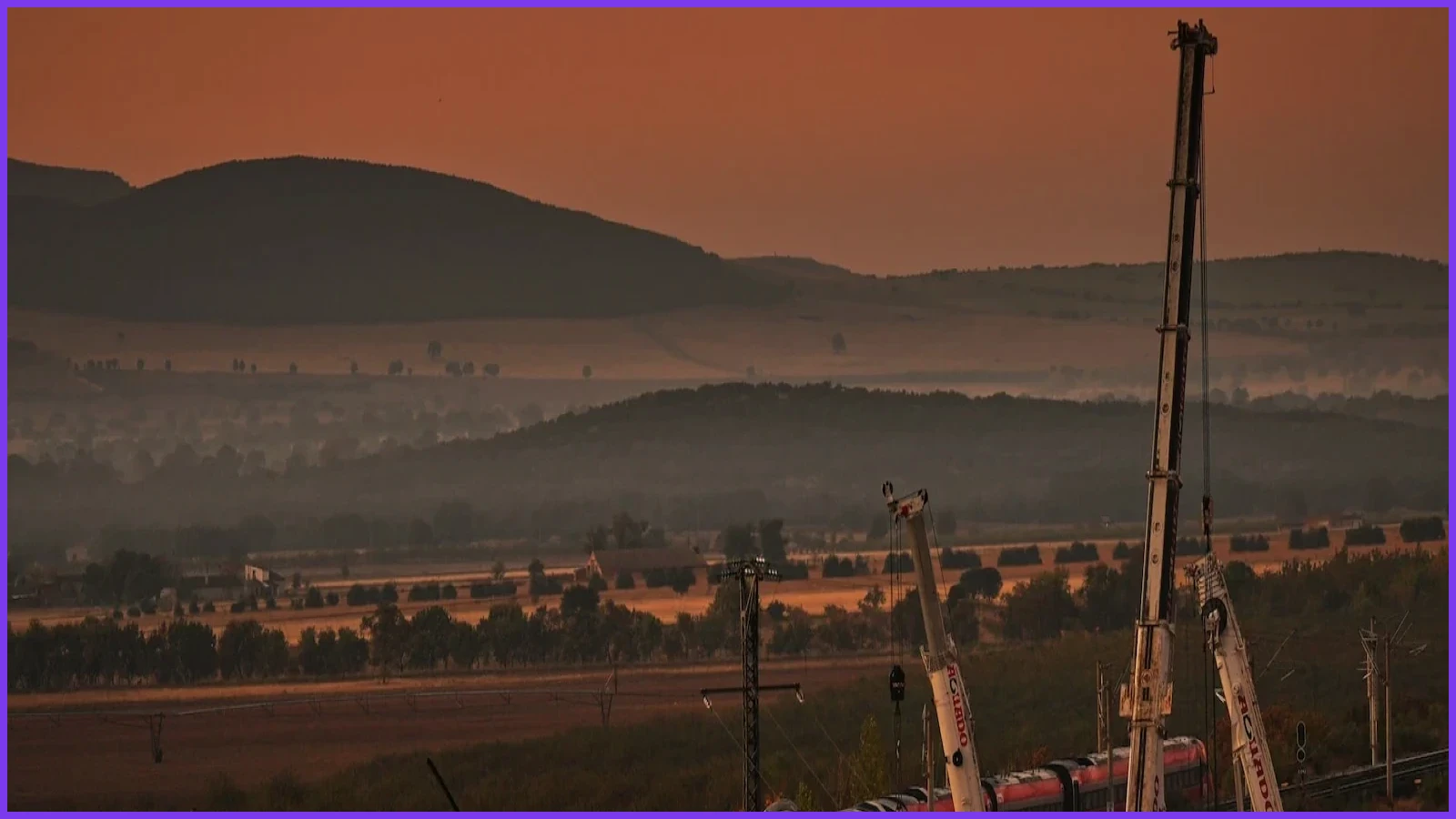
A catastrophic train collision in Spain’s Toledo province has resulted in the deaths of 69 people, prompting a national investigation and an intense debate over whether the disaster was the result of human error or systemic failures within the nation’s high-speed rail network. Prime Minister Pedro Sánchez has pledged a thorough inquiry to uncover the cause of the tragedy, while King Felipe VI, who visited injured survivors at a Toledo hospital on Thursday, emphasized the necessity of implementing measures to prevent any recurrence of such a disaster.
The incident, which occurred on Wednesday, has left Transport Minister Óscar Puente under significant pressure to resign. Puente has publicly attributed the crash to the poor judgment of a traffic controller. According to the minister, the controller made an “erroneous” and “inexplicable” decision to authorize a state-owned RENFE train to resume travel at full speed while a stop signal remained active on the line. The minister noted that a privately owned IRYO train was also on the track, positioned 15.5 miles (25 kilometers) away, and its engineer had been unable to override an automatic stop, leading to the collision at 8:53 a.m.
The chain of events began at 8:30 a.m. on Wednesday when the communication system critical to the line’s security, known as LZB, went down. This system is designed to monitor the position of trains and can trigger automatic braking to prevent collisions. With the system offline, human controllers at a post in Madrid assumed full responsibility for monitoring the safety of trains across a 63-kilometer (39-mile) stretch between Madrid and Seville. At the time of the malfunction, authorities believe there were six trains on that section of the track. At 8:36 a.m., a controller authorized the RENFE train to resume normal speed, while the IRYO train remained stationary.
Railway unions have strongly countered the minister’s assessment, arguing that the focus on a single worker ignores broader, deteriorating working conditions. Raquel Ayllón, a spokesperson for the SCF railway traffic controllers union, stated that the workload for staff has become increasingly unmanageable and that requests for more personnel have gone unheeded for years. Ayllón asserted that blaming a worker operating under such poor conditions is unjust, adding that the persistent failure of safety systems is the true issue. She noted that human error is not incomprehensible, but the recurring failure of the safety system is.
The technical investigation centers on the three-decade-old LZB security system, which is currently being phased out. Diego Martín, spokesperson for the SEMAF union of train engineers, stated that the system has failed repeatedly in the past and should have been replaced long ago. Train workers held a previously scheduled strike on Thursday to demand that the government fulfill its commitments to improve safety conditions, a move that followed a separate, major rail accident in January that killed 46 people further south on the same line.
Questions regarding the impact of rail liberalization have also emerged. Since 2021, when Spain opened its high-speed network to private operators, rail traffic has increased significantly. Joan Rodríguez, a spokesperson for the train workers' union, pointed out that the surge in usage between cities like Madrid and Barcelona has strained the system. Between 2019 and 2024, the average number of daily trips increased from 56 to 89. While not definitively citing privatization as the primary cause, union representatives have suggested that the infrastructure's upkeep may not have kept pace with the increased volume of travel. In the wake of the crash, officials are also investigating the unauthorized leak of audio recordings between the control room and train engineers to the media, an action unions have labeled as irresponsible.
Related Articles

Mr. Udoy is a professional Web Developer and Blogger with 7+ years of experience in the tech world. He specializes in web architecture and digital storytelling. As the driving force behind worldincidents.com, he focuses on delivering high-quality, well-researched content to a global audience.