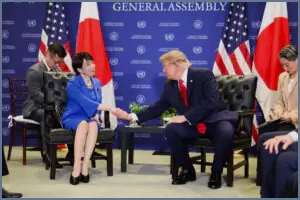
Japanese Prime Minister Takaichi Sanae met with U.S. President Donald Trump in New York on September 22, 2026, on the sidelines of the United Nations General Assembly. The meeting occurred just one day prior to Chinese President Xi Jinping's arrival in the United States for a state visit. The diplomatic encounter took place against the backdrop of a second presidential term for Trump, during which protectionist trade measures—notably unilateral trade actions and reciprocal tariffs—have re-emerged as core pillars of American foreign policy, creating a critical strategic juncture for Japan as the United States shifts away from its historical role as a primary champion of open markets.
In response to this shifting global structure, Tokyo is seeking to bolster its economic strategic autonomy and diversify its international economic partnerships while maintaining the foundational importance of its bilateral alliance with Washington. Japanese strategic diversification is designed to fortify bilateral stability alongside an indispensable alliance rather than distance Tokyo from its long-standing partner. At the same time, Japan aims to distinguish itself from Washington's protectionist trend by steadfastly advocating an international economic order rooted in predictable and rules-based trade.
Meanwhile, Beijing has viewed changing American policies as an opportunity to position itself as a defender of globalization while expanding its influence across the Global South. A high-profile summit between the U.S. and China in late 2026 highlighted this shifting dynamic, drawing significant international attention but yielding minimal structural adjustments to their core economic rivalry, leaving Indo-Pacific regional partners to navigate continued uncertainty. Rather than engaging in a contest with China for regional hegemony, Tokyo's strategy focuses on collaborating with a broad coalition of partners—including the European Union, the United Kingdom, Australia, and key Indo-Pacific nations—to maintain an open, inclusive, and rules-bound economic environment.
The broader retreat of American leadership in multilateral trade reached a symbolic turning point in 2017 when the United States withdrew from the Trans-Pacific Partnership (TPP). Following the U.S. departure, Japan assumed leadership among the remaining signatories to negotiate the 11-nation Comprehensive and Progressive Agreement for Trans-Pacific Partnership (CPTPP), which entered into force in 2018. Going beyond standard tariff reductions, the CPTPP established high-standard regulations governing digital commerce, state-owned enterprises, intellectual property, and service market liberalization.
Following the formal accession of the United Kingdom, the CPTPP framework currently encompasses approximately 15 percent of global gross domestic product. As more economies apply for entry, maintaining the accord's strict standards—particularly regarding state subsidies and non-market policies—remains crucial for preserving the integrity of both the agreement and the wider multilateral trading system. Concurrently, institutional ties between Japan and Europe have expanded. Building upon their 2019 Economic Partnership Agreement (EPA), the comprehensive Strategic Partnership Agreement (SPA) is now active. Additionally, post-Brexit bilateral EPAs and the U.S.-UK CPTPP connection have established strategic linkages connecting Europe with the Indo-Pacific.
This diplomatic momentum produced a key milestone during the Japan-EU Summit, where leaders established the Japan-EU Competitiveness Alliance. The new framework aims to enhance mutual resilience through deepened collaboration on critical minerals, semiconductors, supply chain security, and emerging technologies, alongside joint efforts to revitalize the World Trade Organization (WTO).
Underpinning Tokyo's strategy is the concept of "Open, Predictable, and Resilient Trade," which rejects the idea that open markets and economic security are mutually exclusive. Instead, Japan views maintaining open trade and reducing single-source supply chain dependencies as complementary goals tailored for today's fragmented global economy. As the post-World War II economic architecture crafted under American leadership gives way to accelerated multipolarity and fragmentation, Japan seeks to act as a bridge connecting nations at varying stages of economic development by identifying shared strategic interests and constructing practical coalitions. In engaging the Global South, Tokyo emphasizes a pragmatic approach that respects national sovereignty and addresses local development needs over rigid demands for compliance with external standards.
You have reached the limit of 3 free articles this month.
Related Articles

Mr. Udoy is a professional Web Developer and Blogger with 7+ years of experience in the tech world. He specializes in web architecture and digital storytelling. As the driving force behind worldincidents.com, he focuses on delivering high-quality, well-researched content to a global audience.