A successful humanitarian intervention in the Russian-occupied town of Oleshky has drawn renewed attention to the diplomatic dynamics surrounding the war in Ukraine. Facilitated through efforts involving U.S. First Lady Melania Trump and Pope Leo XIV, a temporary localized ceasefire enabled the evacuation of nearly 800 civilians from the Kherson region settlement, alongside critical arrangements for demining, evacuation corridors, and emergency medical assistance.
According to a White House statement issued on October 23, Melania Trump served as an "Exclusive Intermediary" in direct negotiations between Ukrainian and Russian representatives. The discussions established detailed terms regarding technical procedures, operational timing, and humanitarian logistics. Ukrainian Ombudsman Dmytro Lubinets publicly recognized her role in coordinating negotiators, emphasizing that ongoing humanitarian cooperation remains essential to safeguard civilians trapped along the frontlines.
Despite providing immediate relief, the Oleshky arrangement underscored severe operational and strategic constraints. Russian forces retained control of the town, with the agreement placing no obligation on Moscow to withdraw troops, restore Ukrainian governance, or guarantee the return of displaced residents. Furthermore, Ukrainian authorities alleged that Russian military units exploited the pause to rotate forces and transport military supplies across the Kherson area. Russia subsequently declined requests to extend the ceasefire. Ukrainian officials reiterated that while localized humanitarian pauses are vital, they cannot replace Kyiv's core demands for full national sovereignty and territorial integrity.
The operation received substantial coverage within Chinese state media. News agency Xinhua acknowledged Melania Trump's intermediary role and confirmed the evacuation count. On November 9, Xinhua reported comments from Ukrainian President Volodymyr Zelenskyy accusing Russian troops of leveraging the pause to reinforce frontline positions in Kherson. On the same day, a state media commentary suggested that the Oleshky model could potentially serve as a template for humanitarian initiatives in other contested sectors.
During a United Nations Security Council session on Ukraine on November 9, China's Deputy Permanent Representative Sun Lei welcomed the localized ceasefire for allowing civilians to safely escape frontline danger zones, though his statement omitted any mention of Oleshky or the White House's mediation. Sun called on international actors to intensify humanitarian relief efforts, yet Beijing has not offered to host or facilitate comparable negotiations itself.
China's limited engagement in Ukraine stands in contrast to its active diplomatic role in other global flashpoints. In January 2025, Beijing brokered a ceasefire in Kunming between Myanmar's military junta and the Myanmar National Democratic Alliance Army (MNDAA) operating in eastern Shan State. In that instance, China applied economic leverage, including border control measures and restrictions on key supplies, to push the parties toward a deal. By April, Chinese observers actively monitored the arrangement and witnessed the military regaining control of Lashio.
Beyond its immediate neighborhood, China facilitated the landmark resumption of diplomatic relations between Saudi Arabia and Iran in March 2023, building on preliminary talks hosted by Iraq and Oman. In July 2024, Beijing brought together 14 Palestinian factions, including Fatah and Hamas, resulting in the Beijing Declaration on Palestinian reconciliation. Scholars Andrew Nathan and Andrew Scobell have framed Chinese foreign policy using a concept of "four concentric circles," placing immediate border stability directly behind domestic security. Chinese Foreign Minister Wang Yi noted in March 2022 that "behind the Ukraine crisis is European security," reflecting Beijing's view of the conflict as geographically removed from its core security perimeter.
Beyond geography, political analysts point to Beijing's strategic relationship with Moscow as the decisive factor. While Russia's growing economic dependence on Chinese trade, industrial supply chains, and electronic components provides Beijing with potential leverage, China remains unwilling to exercise diplomatic pressure that could jeopardize a bilateral partnership key to its global competition with Washington. Consequently, preserving strategic alignment with Russia takes precedence over pushing for humanitarian concessions that Moscow resists. As a result, Beijing's long-standing adherence to its Five Principles of Peaceful Coexistence continues to face scrutiny over the gap between its diplomatic rhetoric and its actions in Ukraine.
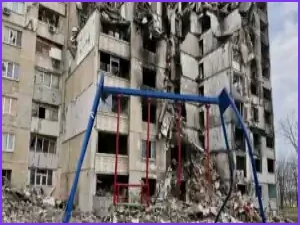
A damaged playground and residential building in Kharkiv, Ukraine.
You have reached the limit of 3 free articles this month.
Related Articles

Mr. Udoy is a professional Web Developer and Blogger with 7+ years of experience in the tech world. He specializes in web architecture and digital storytelling. As the driving force behind worldincidents.com, he focuses on delivering high-quality, well-researched content to a global audience.