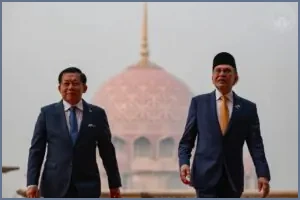
Ongoing conflicts and restrictive domestic economic policies continue to undermine Naypyidaw’s pursuit of foreign investment and trade. Following controversial elections held in December 2025 and January 2026, Myanmar’s President Min Aung Hlaing, the former head of the military junta, has embarked on a series of official visits to neighboring nations. Economic diplomacy has emerged as a central theme during his travels to China, Thailand, and Malaysia, where he has been accompanied by representatives from Myanmar’s leading business conglomerates. These contradictions are deeply rooted in the interests of powerful domestic groups, where political authorities and business elites form a small coalition that controls access to trade and investment. Their interest in maintaining restrictions on imports, foreign currency, and trade revenues sustains domestic policies that undermine the regime’s own foreign economic commitments.
Myanmar’s precarious post-coup economic conditions and ongoing conflicts have further compounded these political constraints and undermined its ability to deliver on trade commitments. Therefore, the regime’s ongoing efforts to expand economic relations with neighboring countries should be analyzed in light of its continued reliance on domestic economic controls. During a visit to China from June 15 to 19, Min Aung Hlaing and leader Xi Jinping agreed to accelerate ongoing China–Myanmar Economic Corridor projects and enhance bilateral trade through yuan–kyat settlements. In a subsequent visit to Thailand on August 6-7, Min Aung Hlaing and Thai Prime Minister Anutin Charnvirakul agreed to strengthen bilateral trade relations, setting a $12 billion bilateral trade target, though no timeline was provided. Both sides also agreed to ease existing regulatory barriers and facilitate cross-border trade. Furthermore, during the Malaysia-Myanmar economic dialogue in Kuala Lumpur on October 7, Min Aung Hlaing called for investment from Malaysian companies in sectors such as food processing, manufacturing, logistics, and special economic zones.
Implementing these proposals would require businesses to obtain foreign currency to import machinery and raw materials. In reality, the regime still heavily regulates imports and foreign currency, and imposes import restrictions to maintain depleted foreign currency reserves. Such regulatory measures would therefore hinder the implementation of agreed trade and investment commitments. Myanmar’s weakened economic position further complicates these overseas commitments. The World Bank’s June 2026 Economic Monitor on Myanmar estimated a 2 percent contraction in the economy compared to the previous fiscal year, with an inflation rate of 24.6 percent in April 2026. This assessment reflected the government’s heavy administrative burden and uneven policy implementation. Although some economic activities have begun to stabilize, the World Bank noted that many businesses continue to face electricity shortages, weak demand, and rising production costs amid the ongoing conflict and the 2025 earthquake. Under these circumstances, businesses focus more on survival than on expansion, creating a difficult operating environment for international investors.
Despite its commitments to economic cooperation, the regime continues to restrict the trade it has promised to facilitate. The March 2026 U.S. International Trade Administration’s commercial guide highlights unpredictable import license approvals and non-automatic licensing for border trade. Shortly after Min Aung Hlaing visited Thailand, Myanmar authorities stalled shipments of frozen food and other imports from the Tachilek-Mae Sai Border on September 21, citing standards checks and unpaid taxes. This disruption caused traffic congestion and the accumulation of commodities at the border, illustrating the difficulties of implementing bilateral trade commitments amid unpredictable domestic policies. Similar restrictions are occurring at the China-Myanmar border. While China recently eased restrictions at some crossings controlled by ethnic armed organizations, imports face challenges in accessing Myanmar’s domestic markets. Since August, the military and combined departmental teams have tightened border trade, hindering the informal flow of imports and increasing uncertainty for businesses.
The political motivations behind these restrictions have become evident. Following Operation 1027, an offensive launched by ethnic armed groups in late 2023, most border trade routes fell under the control of these organizations. On October 28, Min Aung Hlaing called for action against informal border trade, citing its role in strengthening the capabilities of armed groups. This remark highlights that such restrictions serve military and revenue objectives alongside foreign exchange management. The facilitation of trade outside of Naypyidaw’s control contradicts its efforts to deny resources to armed opponents. These measures also align with the interests of domestic economic elites. Since 2021, the regime has tightened control over imports and foreign currency, leaving businesses to rely on administrative approvals. Traders reported to The Irrawaddy that import licenses for the reopening of the Thai-Myanmar border trade in June 2026 were awarded through a patronage network controlled by Vice-President Nyo Saw, who is also responsible for approving the use of foreign currency. For business elites controlling a monopoly on imports, easing restrictions could reduce their advantages. Such elites may seek foreign partnerships while retaining domestic control.
Despite restrictive policies, crafting close economic relations with neighbors may create new opportunities. Myanmar’s policymakers should implement predictable and transparent import licensing criteria, consistent approval timelines, and eased foreign currency restrictions to help realize overseas trade commitments. Neighboring counterparts should also push for the implementation of agreed commitments to improve firms’ ability to purchase supplies and deliver goods. However, prospects for trade normalization and economic recovery remain uncertain. Such outcomes depend on the regime’s political will and ability to reconcile its economic commitments with domestic elite interests and security priorities. Ongoing trade restrictions are still obstructing revenue to armed opponents and preserving advantages for well-connected business elites. Under such circumstances, administrative reforms alone are unlikely to overcome the political interests influencing ongoing trade restrictions. Therefore, durable political progress that addresses the ongoing political crisis and competing control over trade routes is necessary for trade normalization and economic recovery.
Related Articles

Md. Kazi Bijoy is a dedicated tech enthusiast and content creator with a passion for digital innovation. With years of experience in the tech industry, he specializes in breaking down complex topics into easy-to-understand guides. When he isn’t writing, he explores the latest gadgets and researches emerging trends in the digital world.