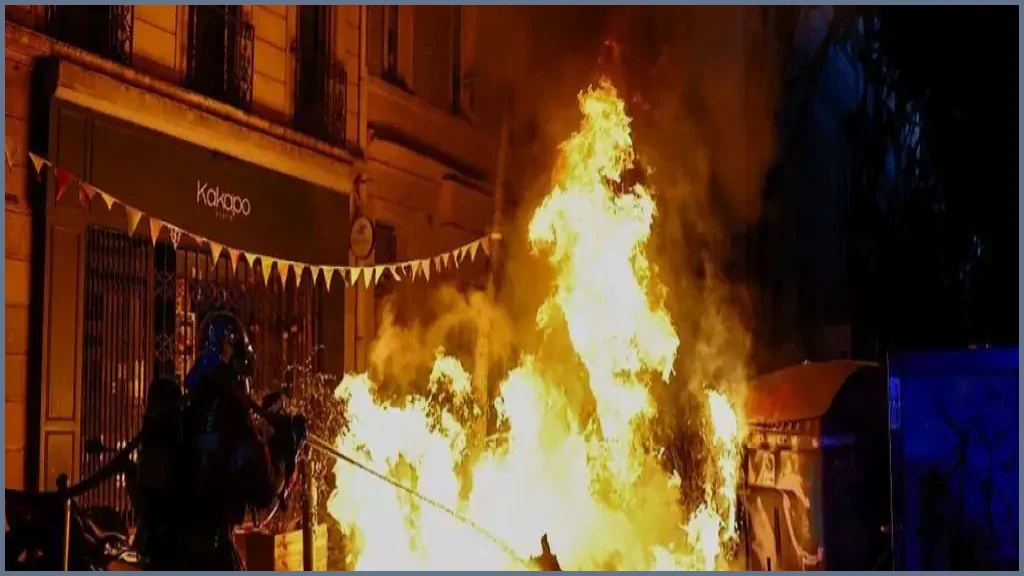
French authorities made nearly 1,000 arrests on Saturday following a fresh wave of nationwide demonstrations and late-night clashes between demonstrators and security forces. Hundreds of thousands gathered across the country in protests driven by economic frustration, with official turnout figures from the Interior Ministry placing participation at approximately 410,000, while trade unions estimated the crowd size at around 800,000.
While daytime marches remained predominantly peaceful, night-time confrontations broke out in several major urban centers. Police deployed tear gas and water cannon to disperse crowds in Paris, while unrest was reported in Marseille, Bordeaux, and Lyon. Despite the skirmishes, officials noted that the scale of rioting and looting remained below the severe disorder recorded during the previous weekend, which had marked some of the worst unrest in modern French history.
French Interior Minister Laurent Nuñez confirmed the tally of nearly 1,000 arrests late on Saturday, warning that the final figure would likely rise. Nuñez stated that several thousand radical activists gathered at the rear of the march, including around 500 individuals identified as rioters. He also reported two serious injuries during the day's events, with one individual severely hurt in the south-western city of Toulouse and another in Clermont-Ferrand, located in central France.
In the southern port city of Marseille, France's second-largest city, protesters erected makeshift street barricades using metal sheets and set them alight alongside burning rubbish bins. A law enforcement vehicle was recorded driving through a blazing barricade as masked youths smashed car dealership windows, prompting police baton charges while officers were pelted with projectiles. In the southern city of Bordeaux, demonstrators dressed in dark clothing and face coverings dismantled wooden boards from a building to construct street obstacles.
Tension also flared in Lyon, France's third-largest city, where police launched tear gas grenades to clear a crowd that assembled in an area designated off-limits by the local prefecture. A student protester present in Lyon described the rapid escalation, stating that there were around 150 participants, mostly secondary school and university students, when tear gas came almost immediately, making it hard to see anything in the street.
Earlier in the week, President Emmanuel Macron had decreed that only demonstrations organized by officially recognized trade unions would be allowed to take place. In the days leading up to Saturday's marches, hundreds of people were handed prison sentences for acts of vandalism, arson, and looting following fast-track court proceedings.
Demonstrators expressed deep economic discontent and anger toward the government. In Paris, a 26-year-old peaceful protester named Zelie explained that citizens were really frustrated and had been suffering a lot since Macron assumed office. She stated that people were kept quiet while being taxed heavily, adding that they had taken to the streets because it had been too long and too much.
Two masked teenage demonstrators, speaking on condition of anonymity, described widespread despair among young people who feel abandoned by state authorities. Addressing the previous weekend's unrest, one teenager remarked that while looting is not good, it stems from poverty and police violence. He added that demonstrations would continue until demands are met, emphasizing that protesters really want a change in France.
In a separate event in the north-central city of Orléans, approximately 13,000 people gathered peacefully for a demonstration held against the hard-right National Rally party.
The weekend turmoil in France coincided with anti-government demonstrations and security alerts in several other European capitals. In Tirana, Albania, riot police fired tear gas to break up thousands of demonstrators targeting the government. Clashes were also recorded in Brussels, Belgium. In Milan, Italy, authorities deployed a massive security presence, including hundreds of soldiers alongside police officers, to prevent crowds from gathering following violence the previous week that involved fires, window-smashing, and store looting.
Saturday's actions followed a massive mobilization the previous weekend, when roughly 550,000 people demonstrated across France against rising fuel prices and high living costs after weeks of student protests. That earlier unrest led to over 2,500 arrests and widespread property damage. According to France's Chambers of Commerce and Industry, more than 2,000 shops and businesses were directly affected, with overall structural damage estimated at hundreds of millions of euros.
The fallout from last weekend's violence also resulted in roughly 1,000 injured police officers, while one demonstrator suffered a severe injury when their hand was blown off by a police crowd-control grenade. French authorities subsequently instituted overnight curfews in Paris and several other municipalities to restore order.
The ongoing unrest arrives six months ahead of France's upcoming presidential election. Political opponents and leading contenders across the political spectrum have increasingly directed blame at Macron and his cabinet ministers for failing to address public grievances and manage the crisis.
Related Articles

Md. Kazi Bijoy is a dedicated tech enthusiast and content creator with a passion for digital innovation. With years of experience in the tech industry, he specializes in breaking down complex topics into easy-to-understand guides. When he isn’t writing, he explores the latest gadgets and researches emerging trends in the digital world.