Internal differences within the Philippine Cabinet have come to light regarding the country's strategy for addressing ongoing maritime disputes with China in the South China Sea. The debate centers on balancing traditional diplomatic engagement with public transparency, following statements issued during the conclusion of Manila's hosting duties for regional talks.
Philippine Department of Foreign Affairs (DFA) Secretary Ma. Theresa Lazaro announced on the final day of the 49th Summit of the Association of Southeast Asian Nations (ASEAN) that provisional agreements had been reached with Beijing on more than 80 percent of the draft text for a regional Code of Conduct (COC) in the South China Sea. Although the Philippines concluded its ASEAN chairmanship without finalizing the long-sought agreement intended to manage maritime disputes peacefully, the facilitation of the negotiations has now been handed over to Singapore.
Alongside presiding over the negotiations and assisting President Ferdinand Marcos Jr. with summit preparations, Lazaro faced intense scrutiny on several fronts. The country's ombudsman accused the DFA of turning visa issuance operations in China into a business. The foreign department strongly denied the accusation, asserting that the claims undermined its institutional integrity and maligned the reputation of foreign service personnel. Concurrently, human rights organizations denounced Lazaro's recent visit to Myanmar to distribute humanitarian aid in coordination with junta-appointed agencies, characterizing the effort as a legitimization of war criminals under the guise of diplomacy.
Tensions reached a broader public level following weeks of escalatory verbal exchanges between Philippine defense officials and the Chinese embassy in Manila over disputed waters. The disputes repeatedly forced Lazaro to intervene and urge Chinese diplomats to refrain from eroding mutual trust and confidence between the two nations.
In a detailed statement, the DFA emphasized that civilian authorities must direct the country's international relations, highlighting the necessity of a unified posture. "In high-stakes diplomacy, a disciplined and coherent national voice remains essential to advancing our national interests," the statement read. The DFA noted that transparency is a tool rather than a substitute for statecraft or long-term strategy, addressing the Philippine Coast Guard and defense officials who routinely publish video evidence of Beijing's maritime activities.
Addressing the release of maritime footage, the DFA stated that "releasing footage or shaping an online narrative does not, by itself, act as a physical deterrent at sea or a legal strategy." The foreign ministry stressed that the landmark 2016 South China Sea Arbitral Award "was secured through rigorous legal proceedings under international law, not through public messaging or social media." Clarifying that diplomatic engagement should not be viewed as appeasement, the DFA added: "There are moments when public disclosure serves strategic purposes, and moments when discretion, restraint, and quiet engagement produce better results."
While no defense officials publicly contested the DFA's stance, several political parties criticized the foreign ministry for reprimanding officials who expose illegal maritime actions and the harassment of local fisherfolk. Political critics expressed concern that directing officials to censor public statements could inadvertently serve Beijing's interests. Meanwhile, President Marcos' spokesperson expressed support for the DFA statement and called for unity ahead of the ASEAN summit, while simultaneously acknowledging that the public actions and statements of defense officials remain aligned with their official duties.
With the ASEAN summit concluded and Singapore taking over the facilitation of the COC negotiations, questions remain over whether the DFA will maintain control of the government's rhetoric on China and the West Philippine Sea, or if defense agencies will resume active media campaigns advocating for military alliances, primarily with the United States and its partners, as a physical deterrent.
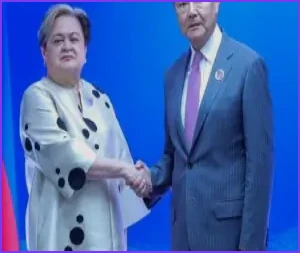
Philippine Foreign Secretary Ma. Theresa Lazaro and Chinese Foreign Minister Wang Yi shake hands during a meeting in Manila, Philippines, July 22, 2026.
You have reached the limit of 3 free articles this month.
Related Articles

Meet Md. Rubel Rana
As a core contributor to Worlddincidents.com, Rubel Rana brings a unique perspective to the world of journalism. Whether it’s deep-diving into historical trivia or covering the latest global headlines, Rubel Rana is committed to delivering high-quality, high-impact articles. Their writing blends meticulous research with a compelling voice, helping readers stay informed and curious about the world around them.