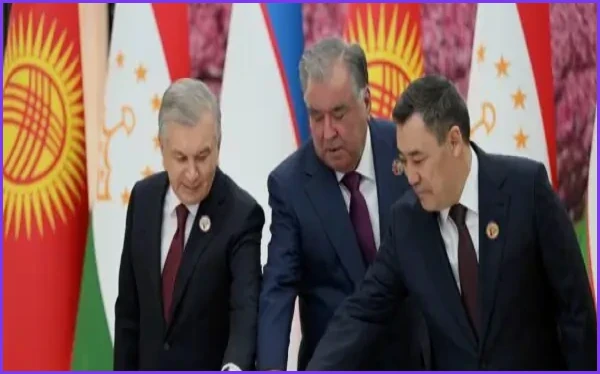
In a global landscape often defined by ongoing conflict, the peaceful settlement of contested borders in the Fergana Valley stands as a notable exception. On March 31, 2025, the presidents of Kyrgyzstan, Tajikistan, and Uzbekistan gathered for a trilateral summit in Khujand, the capital of Tajikistan’s Sughd province. This meeting marked the definitive conclusion to three decades of persistent arguments regarding their shared borders.
The geography of this region has long been a source of complexity, with borders that curl around one another like a vortex. The Fergana Valley contains a scattering of exclaves that complicate the map: Tajik territory wrapped within Kyrgyzstan, Uzbek towns surrounded by Kyrgyz land, and Kyrgyz villages hemmed in by Uzbekistan. These confusing boundaries became a focal point for tension as the region transitioned into independence, generating conflict that persisted for decades.
The path to this diplomatic resolution was marked by a rapid shift from violence to peace. While the border disputes had festered for years with occasional flare-ups of low-level violence, the situation escalated dramatically in 2021. By 2022, the conflict had intensified to the point of near-war, involving heavy shelling, the use of drone strikes, and resulting in scores of casualties on both sides. The transition from such significant fighting to a valley-wide peace agreement in less than three years represents a major development for the region.
The summit in Khujand serves as the culmination of efforts to address these historical grievances. By finalizing the borders, the three nations have moved to resolve the structural issues that defined the Fergana Valley’s turbulent recent history, signaling a new era of regional stability.
You have reached the limit of 3 free articles this month.
Related Articles

Md. Kazi Bijoy is a dedicated tech enthusiast and content creator with a passion for digital innovation. With years of experience in the tech industry, he specializes in breaking down complex topics into easy-to-understand guides. When he isn’t writing, he explores the latest gadgets and researches emerging trends in the digital world.