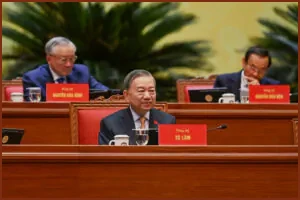
General Secretary To Lam of the Communist Party of Vietnam (CPV) attended a session of the party's 14th National Congress in Hanoi on January 21, 2026, amid a sweeping transformation of the country's political and economic direction. Shortly after assuming leadership of the CPV in July 2024, the former police general proclaimed a "new era of national rise" and pledged to accelerate Vietnam's annual economic growth rate to double digits from its prior level of 7 percent. He swiftly translated those pronouncements into directives that have reinforced party authority while fundamentally altering governance structures.
Central to Lam's immediate priorities was a rapid streamlining of Vietnam's administrative and political system. Under his mandate, multiple ministries were either eliminated or merged. The government completely abolished district-level governance, transferring incumbent personnel to provincial or commune levels or offering them retirement incentives. Furthermore, Vietnam compressed its 63 provincial and provincial-level units into 34 new administrative divisions within just a few months, cutting the total number by nearly half.
Departing from the rigid focus on socialist ideology championed by his predecessor, former CPV chief Nguyen Phu Trong, Lam has designated the private sector as the primary driver of Vietnam's economic engine. He sanctioned major infrastructure initiatives, including high-speed rail development and nuclear power plants. These high-stakes contracts have been granted to a small number of politically connected private conglomerates, even though these firms possess no background or proven track record in those specialized sectors.
On the international stage, Lam has pursued an aggressive foreign policy schedule, visiting approximately two dozen countries over a two-year span. Under his administration, Vietnam elevated several bilateral ties to the highest diplomatic tier. Economically, the nation maintains positive momentum, with its trade surplus with the United States expanding further despite tariffs imposed by President Trump on Vietnamese exports.
Characterized by foreign commentary in outlets like The Economist as a "hardman, capitalist, and hedonist," Lam carries a personal profile that sets him apart from standard party figures. Born in 1957 in North Vietnam's Hung Yen province, he reached adulthood in 1975 as the civil war concluded with a Northern victory. His father, Colonel To Quyen, was a security operative who spent much of the war in South Vietnam assisting the revolutionary movement. To Quyen later became head of the Prison Department within the Ministry of Internal Affairs—the precursor to today's Ministry of Public Security—where he oversaw a nationwide penal system.
Educated at the College of Public Security, Lam spent his entire career in the nation's security apparatus. He attained the rank of major general at age 50 and became minister at 59, benefiting in part from family heritage, which remains a key component of career progression in Vietnam. While the CPV maintains intense internal secrecy reminiscent of its underground revolutionary origins and officially discourages individualism in favor of collectivism, Lam's background features distinct personal details. He divorced his first wife, with whom he had two children, and remarried Ngo Phuong Ly, a former television host trained in painting who is 13 years his junior and the daughter of an artist and an actress. Those close to him also note his private hobby of collecting antiques, while one of his daughters has pursued studies in England.
Ideological complexity also marks Lam's tenure in the security sector. In 2017, while under his oversight, a bust of Felix Dzerzhinsky was installed at his alma mater, now known as the People's Academy of Security Services. Dzerzhinsky, a Polish-born associate of Lenin who established the Soviet Cheka and the early Gulag camp system, stands as an unusual icon for a leader spearheading capitalist economic shifts. This apparent contradiction underscores broader political, social, and economic transitions that have shaped Vietnam since market reforms were initiated more than three decades ago.
Related Articles

Mr. Udoy is a professional Web Developer and Blogger with 7+ years of experience in the tech world. He specializes in web architecture and digital storytelling. As the driving force behind worldincidents.com, he focuses on delivering high-quality, well-researched content to a global audience.