AI Translation Glasses 2026: Break Language Barriers Instantly
Introduction
The emergence of AI Translation Glasses 2026 is redefining how humans communicate across cultures and languages. For centuries, language barriers have been one of the biggest obstacles to global communication. Whether in business, travel, education, or diplomacy, people often struggle to connect due to differences in language.
Now, artificial intelligence is changing that reality. With advanced wearable technology and real-time translation systems, AI Translation Glasses 2026 promise to break language barriers instantly.
These innovative devices combine artificial intelligence, augmented reality, and speech recognition to deliver seamless translation experiences. As global interaction continues to grow, the demand for smart translation tools is rising rapidly.
Understanding how AI Translation Glasses 2026 work and why they matter could help individuals and businesses adapt to a new era of communication.
What Are AI Translation Glasses?
AI Translation Glasses 2026 are wearable smart glasses that provide real-time language translation during conversations.
Unlike traditional translation apps that require smartphones, these glasses allow users to see translated text directly in their field of vision.
For example, if someone speaks Spanish, the glasses can instantly translate the speech into English subtitles displayed on the lenses.
This technology combines several advanced systems:
speech recognition
natural language processing
augmented reality display
cloud-based AI translation engines
Together, these technologies make AI Translation Glasses 2026 one of the most exciting innovations in wearable technology.
How AI Translation Glasses Work
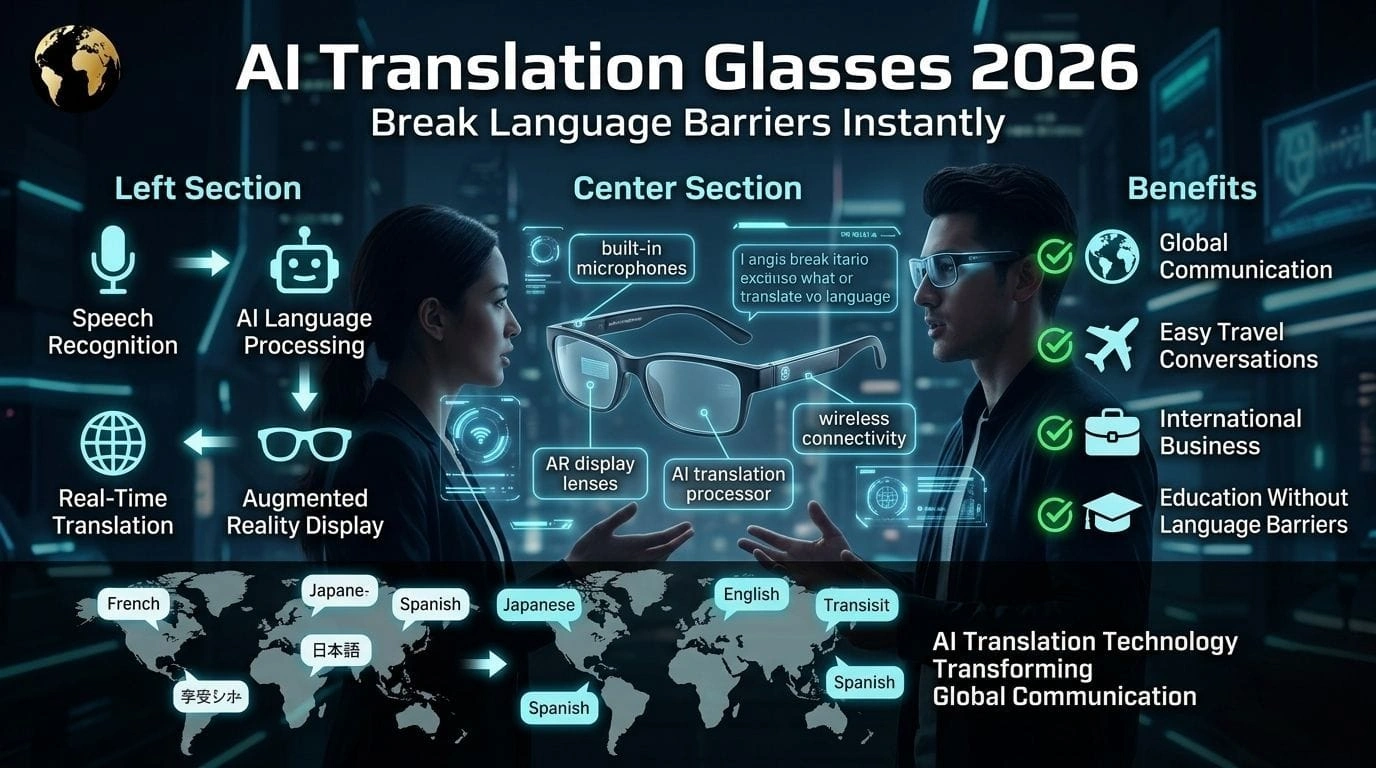
The technology behind AI Translation Glasses 2026 relies on several AI-powered components working together in real time.
Speech Recognition
The first step is capturing spoken language through built-in microphones. Advanced speech recognition software converts speech into digital text.
AI Language Processing
Once speech is converted into text, artificial intelligence analyzes the sentence structure and context. This step ensures accurate translation.
Real-Time Translation
The translated text is then displayed instantly through augmented reality lenses. This allows users to read translations without interrupting conversations.
Cloud AI Integration
Many AI Translation Glasses 2026 rely on cloud-based translation models that continuously improve through machine learning.
Why AI Translation Glasses Are a Breakthrough
The introduction of AI Translation Glasses 2026 represents a major breakthrough in communication technology.
Traditional translation methods require:
interpreters
smartphone apps
manual text input
In contrast, AI-powered glasses provide seamless conversation translation without disrupting the flow of communication.
This breakthrough makes AI Translation Glasses 2026 especially useful for global travel, international business, and cross-cultural collaboration.
Key Benefits of AI Translation Glasses
1. Instant Communication
One of the biggest advantages of AI Translation Glasses 2026 is the ability to translate conversations instantly.
This eliminates the delay often experienced when using translation apps.
Read More: PHYSICAL AI
2. Improved Travel Experiences
Tourists often face communication challenges in foreign countries.
With AI Translation Glasses 2026, travelers can easily understand local languages when speaking with guides, hotel staff, or shop owners.
3. Better Global Business Communication
Businesses operating internationally often rely on interpreters.
However, AI Translation Glasses 2026 allow professionals to communicate directly with global partners without language barriers.
4. Educational Advantages
Students studying abroad can benefit greatly from AI Translation Glasses 2026 by understanding lectures and discussions in foreign languages.
Industries That Will Benefit
Several industries are expected to adopt AI Translation Glasses 2026 quickly.
Tourism and Hospitality
Hotels, tour guides, and travel agencies can use the technology to communicate with international visitors.
Global Business
Companies operating across borders can use smart translation glasses to improve collaboration.
Healthcare
Doctors treating international patients can benefit from instant translation during consultations.
Education
Schools and universities can use AI-powered translation to support international students.
Challenges and Limitations
Despite their advantages, AI Translation Glasses 2026 still face several challenges.
Accuracy in Complex Conversations
While AI translation systems are improving, some complex phrases or cultural expressions may still be difficult to translate accurately.
Privacy Concerns
Because the glasses capture audio during conversations, privacy and data security are important concerns.
Battery and Connectivity
Real-time translation often requires internet connectivity and battery power, which may limit usage in some situations.
Future of AI Translation Technology
The future of AI Translation Glasses 2026 looks promising.
Technology companies are investing heavily in AI wearables and language models.
Future improvements may include:
offline translation capabilities
more accurate AI language models
integration with augmented reality navigation
multi-speaker conversation translation
As technology evolves, AI Translation Glasses 2026 could become as common as smartphones.
Conclusion
The development of AI Translation Glasses 2026 marks a significant step toward a world without language barriers. By combining artificial intelligence, augmented reality, and real-time translation, these devices allow people to communicate more easily than ever before.
As globalization continues to expand, technologies like AI Translation Glasses 2026 will play a critical role in connecting cultures, businesses, and communities worldwide.
FAQ Section
How do smart translation glasses work?
Smart translation glasses capture speech through microphones, process it using AI translation systems, and display translated text through augmented reality lenses.
Can translation glasses work offline?
Some models may support offline translation for limited languages, but most rely on cloud-based AI translation services.
Are translation glasses accurate?
Accuracy depends on the AI model and language complexity, but modern systems provide increasingly reliable translations.
Who can benefit from translation glasses?
Travelers, business professionals, students, and healthcare workers can benefit from real-time language translation technology.
Will translation glasses replace human translators?
While translation glasses improve communication, human translators are still essential for complex conversations and professional interpretation.

Meet Md. Rubel Rana
As a core contributor to Worlddincidents.com, Rubel Rana brings a unique perspective to the world of journalism. Whether it’s deep-diving into historical trivia or covering the latest global headlines, Rubel Rana is committed to delivering high-quality, high-impact articles. Their writing blends meticulous research with a compelling voice, helping readers stay informed and curious about the world around them.