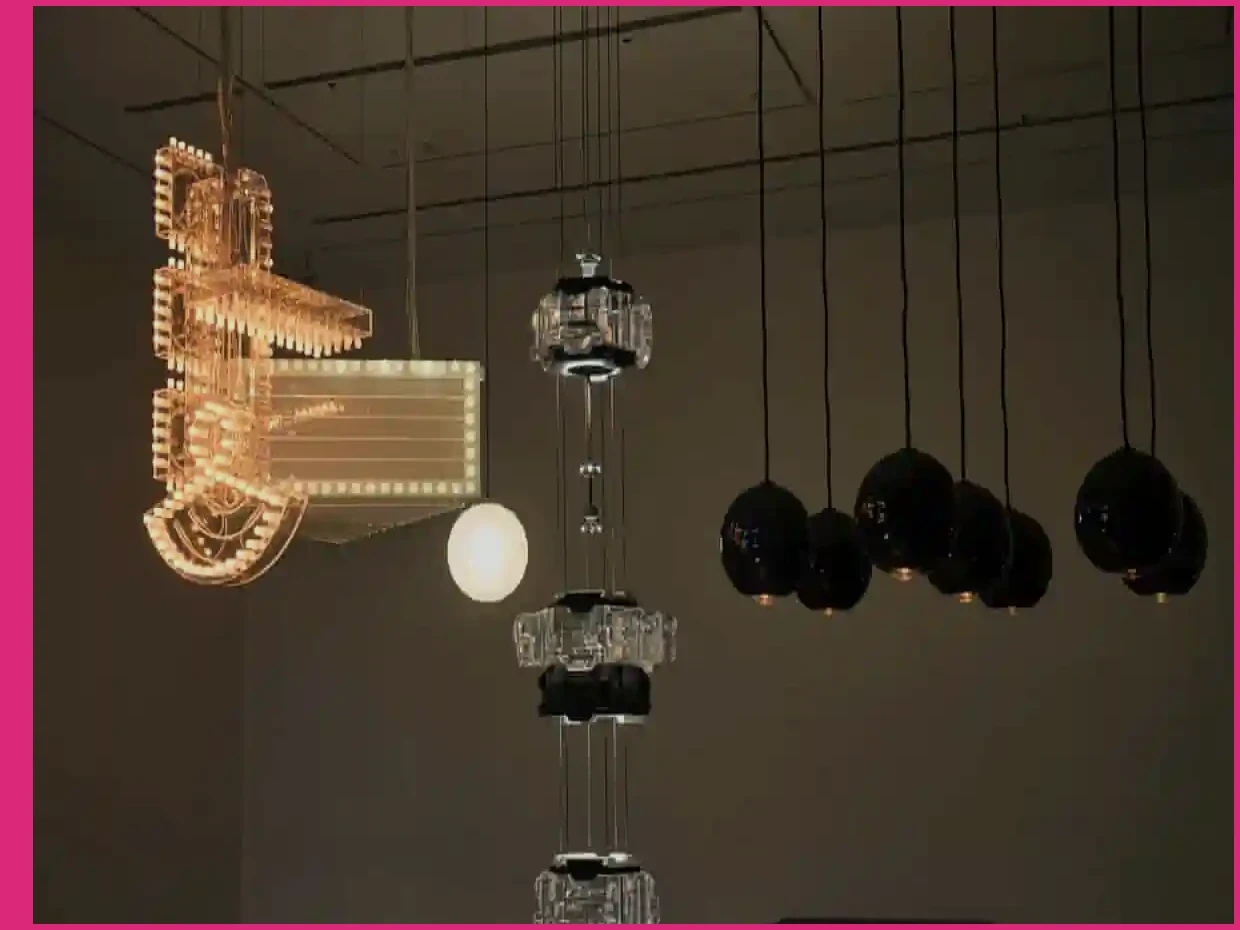
The Museum of Contemporary Art in Sydney has launched a major exhibition by acclaimed French contemporary artist Philippe Parreno. Titled 5 Moons, the show is named for the five lunar cycles it will span during its residency. The exhibition represents Parreno’s first major presentation in Australia, following his past work at prominent institutions such as the Tate Modern’s Turbine Hall and the Palais de Tokyo in Paris.
Visitors entering the museum are met with a series of connected environments spread across three levels. The installation features a collection of objects including industrial fans, marquee lights, lamps, and speaker banks. In one orange-carpeted room, helium-filled fish balloons float near a grand piano playing an enigmatic score, while another area displays a large screen featuring a luminescent cuttlefish. The atmosphere is designed to feel like a haunted house, with machines appearing to operate under supernatural influence.
These kinetic arrangements are actually driven by nature. Sensors located on an abandoned almond farm in the Tabernas desert in south-eastern Spain—a region historically used as a backdrop for spaghetti westerns—capture real-time environmental data. Information regarding wind speed, humidity, and temperature is transmitted 17,000km to Sydney, where an algorithm translates the data into the exhibition’s sound, air flow, and lighting patterns.
The museum’s third floor features a darkened gallery displaying an 11-hour film composed of footage from the same Spanish almond farm. The live sound from the terrain is also broadcast in the gallery, creating a unique sensory experience where nocturnal Spanish insect noises may be interrupted by the sounds of Sydney Harbour. Parreno, who was born in Algeria to a family that migrated from that same region of Spain centuries ago, describes his goal as creating an ecosystem where elements respond to one another.
Parreno’s approach often relies on fiction to provide context for his work. “Lots of the things I do require people to endorse a fiction,” Parreno commented at the time. For instance, a display of flashing lights and balloons is revealed to be a Morse code translation of a mystical adventure by French writer René Daumal. Reflecting on his career, which began in the late 1980s and 1990s, Parreno noted that he initially sought to produce a new reality. When he started out making exhibitions in the late 80s and 90s, Parreno had revolutionary ideals. “You want to change the world. You want to produce a new reality,” he tells me. And now? “I want to create that thing that you don’t see much [these days],” he says. “In the system we live in, you are always obliged to respond to a signal. Here you are not. You just float with your own attention, and you spend the time you want.”
Philippe Parreno: 5 Moons is open to the public at the Museum of Contemporary Art in Sydney until 26 April 2027.
Upstairs, there’s an orange-carpeted gallery populated by floating, helium-filled, fish-shaped balloons in citrus tones, in which a grand piano plays an enigmatic score. On another floor, a giant luminescent cuttlefish gazes out impassively from a screen, its fins and arms gently undulating, as ambient electronic noise emanates from large swiveling speaker banks.
Backstory is important for Parreno’s art: without it, his ecosystems risk seeming frustratingly opaque or worse, inane.
Related Articles

Meet Md. Rubel Rana
As a core contributor to Worlddincidents.com, Rubel Rana brings a unique perspective to the world of journalism. Whether it’s deep-diving into historical trivia or covering the latest global headlines, Rubel Rana is committed to delivering high-quality, high-impact articles. Their writing blends meticulous research with a compelling voice, helping readers stay informed and curious about the world around them.