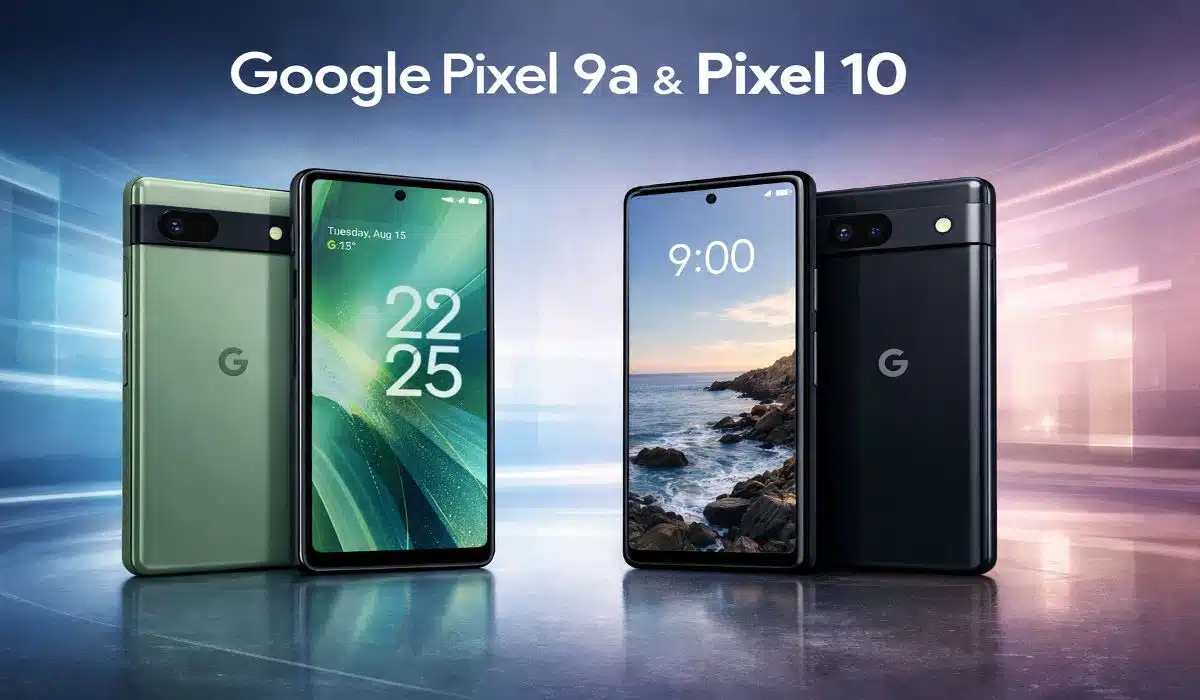
The landscape of Android smartphones has shifted dramatically this year. With the recent launch of the Google Pixel 9a & Pixel 10, consumers are now faced with a difficult choice: go with the refined, budget-friendly “A-series” or invest in the revolutionary hardware of the flagship 10. Both devices represent Google’s commitment to AI-driven software, but they cater to very different types of users.
Why the Pixel 10 is Different
The Google Pixel 10 is a milestone for the company. Released in late 2025 and currently dominating the early 2026 market, it is the first device to feature the Tensor G5 chipset. Unlike previous chips, the G5 is built entirely in-house by Google using TSMC’s advanced 3nm process.
Performance: This shift away from Samsung’s architecture means the Google Pixel 10 is significantly more efficient, runs cooler, and offers a 30% boost in multi-core performance.
Pro-Grade Cameras: The base Pixel 10 now includes a dedicated 10.8MP telephoto lens, offering 5x optical zoom—a feature previously reserved for the Pro models.
The Value Champion
For those who want the “Google Experience” without the $799+ price tag, the Google Pixel 9a is the standout choice. Launched in March 2025 and now widely available at discounted rates in 2026, it brings flagship-level photography to the mid-range segment.
Design: The Google Pixel 9a features a unique, nearly flush camera module that departs from the traditional “visor” look.
Battery King: Interestingly, the Google Pixel 9a packs a massive 5,100mAh battery, which is actually larger than the one found in the flagship Pixel 10. This makes it the better choice for users who prioritize longevity over raw processing speed.
AI and Software
One area where the Google Pixel 9a & Pixel 10 find common ground is software support. Google has promised 7 years of OS and security updates for both devices.
Pixel Drops: Both phones receive regular “Feature Drops,” adding new AI tools like Magic Editor and Best Take.
Android 16: As of today, both the Google Pixel 9a & Pixel 10 are at the front of the line for the Android 16 beta and final releases, ensuring your device stays fresh until 2032.
Technical Specifications and Hardware Analysis
When diving into the technical architecture of the Google Pixel 9a & Pixel 10, the hardware divergence becomes clear. The flagship Google Pixel 10 utilizes a cutting-edge LTPO OLED panel, allowing its refresh rate to scale dynamically from 1Hz to 120Hz, which significantly preserves battery life during static tasks. In contrast, the Google Pixel 9a uses a high-quality Actua display that, while supporting a smooth 120Hz, lacks the ultra-efficient LTPO scaling technology.
Under the hood, the performance gap is defined by the chipset generation. The Google Pixel 10 is the first to debut the Tensor G5, an in-house chip built on TSMC’s 3nm process that excels in thermal management and heavy multitasking. Meanwhile, the Google Pixel 9a relies on the dependable Tensor G4. While the G4 is more than capable of handling daily apps and moderate gaming, it cannot match the raw AI processing speed of the G5. Interestingly, the Google Pixel 9a manages to edge out its flagship sibling in raw battery capacity with a 5,100 mAh cell, though the Google Pixel 10 often matches its real-world endurance thanks to the superior efficiency of its newer 3nm processor.
Charging Speeds and Modern Connectivity
A major practical difference between the Google Pixel 9a & Pixel 10 is how quickly you can get back to full power. The flagship Google Pixel 10 has finally moved toward modern standards, supporting 45W wired fast charging, which can take the battery from 0 to 70% in just 30 minutes. It also introduces Pixelsnap (Google’s version of magnetic Qi2 charging), allowing for effortless alignment with wireless chargers and magnetic accessories. On the other hand, the Google Pixel 9a remains more conservative, capping at 23W wired charging and standard 7.5W wireless charging. While the 9a has fantastic endurance, it requires nearly an hour and forty minutes for a full charge, making the Pixel 10 the clear winner for power users who are always on the move.
Display Durability and Peak Brightness
The screen technology on the Google Pixel 9a & Pixel 10 reveals another layer of the “budget vs. flagship” trade-off. The Google Pixel 10 features a cutting-edge display protected by Gorilla Glass Victus 2, offering the highest level of scratch and drop resistance available in 2026. Its screen can also reach a staggering 3,000 nits of peak brightness, ensuring perfect visibility even under the harsh glare of direct afternoon sunlight. In comparison, the Google Pixel 9a uses the much older Gorilla Glass 3, which is effective but significantly more prone to minor scratches over time. While the 9a’s 2,700 nits of brightness is impressive for a mid-range phone, it lacks the professional-grade outdoor clarity and ruggedness of the flagship model.
Cinematic Blur and Zoom Enhance
The camera software on the Google Pixel 9a & Pixel 10 has received a massive update for 2026. While both phones now support “Cinematic Blur” at 4K resolution, the Google Pixel 10 uses its Tensor G5 chip to apply this effect in real-time with zero lag. On the other hand, the Google Pixel 9a relies on cloud-based processing for similar results. This distinction makes the Google Pixel 10 the superior choice for content creators, while the Google Pixel 9a remains perfect for casual social media users who want high-quality video without the professional price tag.
Furthermore, the Google Pixel 9a & Pixel 10 both benefit from Google’s new “Zoom Enhance” AI, which uses generative AI to sharpen long-distance shots after they are taken. However, because the Google Pixel 10 features a dedicated telephoto lens, its starting image quality is significantly higher, allowing the AI to produce near-perfect results. The Google Pixel 9a must rely more heavily on software interpolation, yet it still outperforms almost every other mid-range competitor in its class. Ultimately, the video and photo capabilities of the Google Pixel 9a & Pixel 10 showcase how Google is using different hardware tiers to master the art of computational photography.
Sustainable Design and Repairability Standards
In line with global environmental trends, the construction of the Google Pixel 9a & Pixel 10 marks a significant step forward in eco-friendly technology. Both devices are crafted using 100% recycled aluminum for their internal frames, reducing the carbon footprint of the Google Pixel 9a & Pixel 10 compared to previous generations. Google has also optimized the internal layout to make screen and battery replacements much easier for third-party repair shops.
For users who plan to keep their phones for several years, the Google Pixel 9a & Pixel 10 provide peace of mind through modular components that are easier to source and install. While the Google Pixel 10 uses a more premium matte glass finish, it remains just as repairable as the high-gloss Google Pixel 9a, ensuring that both models meet the highest standards for longevity. This commitment to sustainability ensures that whether you choose the flagship or the budget-friendly option, the Google Pixel 9a & Pixel 10 are built to last well into the next decade.
FAQ
Q1: Does the Pixel 9a have wireless charging?
Ans: Yes, the Google Pixel 9a supports Qi wireless charging, though it is limited to 7.5W compared to the faster 15W charging on the flagship.
Q2: Is the Tensor G5 a big upgrade over the G4?
Ans: Absolutely. The Tensor G5 in the Google Pixel 10 offers better thermal management and faster AI processing because it is built on TSMC’s superior 3nm node.
Q3: Can the Google Pixel 9a run all the same AI features as the Pixel 10?
Ans: While both phones share the “Google AI” branding, the Google Pixel 10 has a clear edge in functionality. Due to its superior 12GB+ RAM and the Tensor G5’s dedicated AI engine, the Google Pixel 10 can run Gemini Nano locally for advanced multimodal tasks like “Pixel Screenshots” and “Call Notes” summaries. In contrast, the Google Pixel 9a uses a lighter version of the AI model (Gemini Nano XXS) because it is limited to 8GB of RAM. This means while the 9a can handle basic AI edits, it lacks the heavy-duty, on-device processing capabilities found in the flagship Google Pixel 10.
Conclusion
When comparing the Google Pixel 9a & Pixel 10, the decision comes down to your priorities. If you are a mobile gamer or a photography enthusiast who needs optical zoom and the latest 3nm efficiency, the Google Pixel 10 is a worthwhile investment.
However, if you want a reliable phone with incredible battery life and the best mid-range camera on the market, the Google Pixel 9a remains the smartest purchase you can make in 2026.
read more: Legion Pro 7i

Mr. Udoy is a professional Web Developer and Blogger with 7+ years of experience in the tech world. He specializes in web architecture and digital storytelling. As the driving force behind worldincidents.com, he focuses on delivering high-quality, well-researched content to a global audience.