Hormuz Strait: Breaking 2026 Blockade News & Tanker Updates
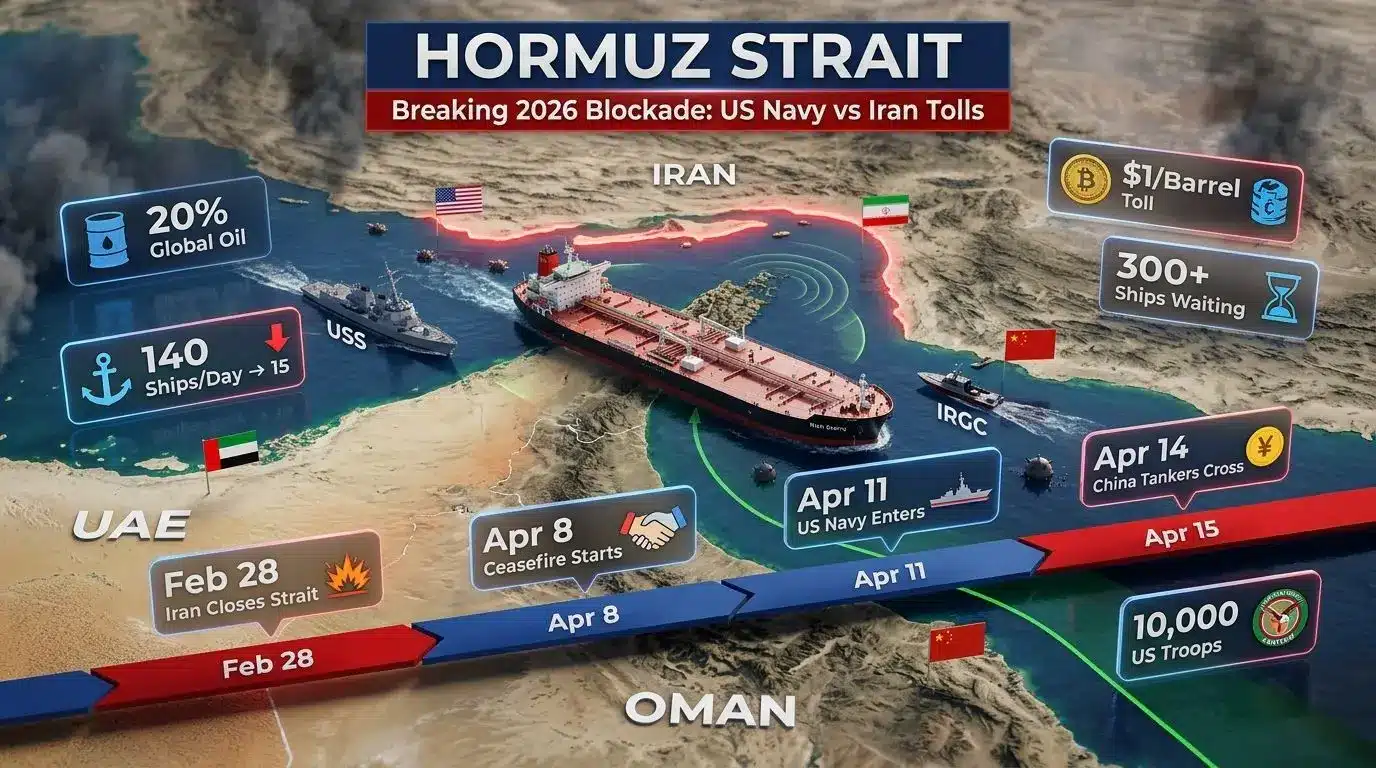
The hormuz straitbecame the world’s most contested waterway in 2026. After Iran closed the chokepoint on February 28 following US-Israeli strikes, a two-week ceasefire started April 8. Yet the hormuz strait remains only partially open as of April 15. Chinese tankers cross under Iranian permission, US Navy destroyers are clearing mines, and 300+ ships wait to transit. This is the complete breakdown of hormuz strait news for April 2026.
About 20% of global oil and LNG flows through the hormuz strait. It also carries 25% of world fertilizer. The closure pushed fuel prices up and threatened food security for 45 million people. The US, Iran, Oman, and China are now negotiating passage rules, tolls, and ceasefire terms. Every ship owner is watching hormuz strait updates daily.
Hormuz Strait Timeline: February to April 2026
The crisis in the hormuz strait began when the US and Israel struck Iranian nuclear and military sites on February 28. Iran responded by closing the strait to all foreign shipping. The IRGC warned on VHF radio that no ship could pass. The UK Royal Navy said the closure was not legally binding but safety was not guaranteed.
On March 19, the US began an aerial campaign to reopen the hormuz strait. Israel assassinated IRGC naval commander Alireza Tangsiri. The US announced a plan to destroy Iranian naval vessels and drones targeting shipping. On April 8, a two-week ceasefire started on condition that the strait be reopened.
On April 11, USS Frank E. Petersen and USS Michael Murphy entered the hormuz strait for the first time since the war began. They are clearing mines and establishing a safe passage. On April 13, US CENTCOM announced a naval blockade of Iranian ports starting 11:00 AM ET. The hormuz strait is now split: US forces control one lane, Iran controls the other.
Who Can Cross the Hormuz Strait Today?
Read More: The Billion-Dollar Handshake: Decoding the 2026 Elon Musk & Trump Alliance
They exploited a loophole: visit non-Iranian ports with Iranian permission. Both tankers called UAE ports before transiting the hormuz strait. Rich Starry exited toward the Indian Ocean. Murlikishan entered the Persian Gulf. Chinese Foreign Ministry said keeping the area safe serves the common interest of the international community.
US CENTCOM stated no ships made it past the US blockade of Iranian ports. However, it supports freedom of navigation for vessels to and from non-Iranian ports. Around 10 to 15 ships creep through the hormuz strait per day under Iranian military coordination, down from 140 on a normal day.
US Navy Operation in the Hormuz Strait
More than 10,000 US Sailors, Marines, and Airmen with over a dozen warships and dozens of aircraft are executing the mission to blockade Iranian ports. The first 24 hours saw no ships pass the US blockade and 6 merchant vessels turned back.
On April 11, two guided-missile destroyers entered the hormuz strait to begin setting conditions for clearing mines. CENTCOM Commander Adm. Brad Cooper said the US will share the safe pathway with the maritime industry soon to encourage free flow of commerce. Underwater drones are also deployed.
President Trump posted that the US has destroyed Iran’s Navy and Air Force and the hormuz strait will soon be open. He said empty oil tankers are rushing to the US to load up. Trump warned shooting starts if Iran fails to reopen the strait and told the regime to stop charging tolls.
Iran Tolls and the Tehran Tollbooth
Iran proposed letting ships exit safely through the Oman side of the hormuz strait without attack, if a deal is clinched. The proposal is seen as a gesture, not a breakthrough. Iran had been charging up to $1 per barrel of oil for safe passage, paid in cryptocurrency or Chinese yuan.
The Islamic Revolutionary Guard Corps threatened that vessels exiting without permission will be destroyed. About 300 to 400 ships were approved under Iranian military coordination. The so-called Tehran Tollbooth requires ships to provide documentation and sometimes payment to sail around Larak Island in Iranian waters.
Iran also issued a chart showing a large section of the hormuz strait as a danger to navigation due to possible sea mines. This forces ships into two routes, both controlled by Tehran. Oman rejected any tolls on its side and claims authority over its waters.
Oil, Gas, and Fertilizer Impact of Hormuz Strait Closure
The hormuz strait handles 20% of world oil and LNG. The closure caused the largest-ever disruption of global energy supplies. The EIA said fuel prices will continue to rise until the strait fully reopens. Full restoration of flows will take months.
About 25% of global fertilizer also passes through the hormuz strait. The UN estimates the conflict could drive fertilizer prices up 15% to 20% and push 45 million people into acute hunger. Half of all calories consumed globally depend on artificial fertilizers derived from natural gas.
Iran previously closed the hormuz strait to all oil tankers on April 8 after accusing Israel of violating the ceasefire by striking Hezbollah in Lebanon. Two tankers had transited with Iranian permission that morning before the closure.
Bypass Routes and Alternatives to the Hormuz Strait
The Iranian area of the hormuz strait is theoretically avoidable through Omani and UAE territorial waters. Oman’s deep-water ports of Duqm, Salalah, and Sohar allow tankers to bypass the chokepoint. But drones struck Duqm and Salalah in March. Sohar falls within a war risk area, raising insurance costs.
Most shipping companies use a longer route around the southern tip of Africa. Maersk announced Suez Canal usage from January 2026. Saudi Arabia diverts oil to Yanbu via the East-West Crude Oil Pipeline. The UAE uses the Abu Dhabi Crude Oil Pipeline to Fujairah. These pipelines handle 3.5 to 5.5 million barrels per day versus 20 million through the hormuz strait.
International Response to Hormuz Strait Crisis
On March 19, leaders of the UK, France, Germany, Italy, Netherlands, Japan, Canada and others condemned Iran’s closure of the hormuz strait. They cited UN Security Council Resolution 2817 and called attacks on civilian infrastructure a threat to international peace.
The group expressed readiness to contribute to safe passage and welcomed the IEA decision to release strategic petroleum reserves. They will work with producing nations to increase output and support affected nations through the UN.
India and Pakistan sent destroyers to escort tankers in the Gulf of Oman, but not in the hormuz strait. Sustained escort of 3 to 4 ships per day needs 7 to 8 destroyers. Oman is claiming authority over its side and rejecting tolls.
Current Traffic in the Hormuz Strait: April 14-15
Traffic remains a slow trickle despite the ceasefire. Lloyd’s List Intelligence data showed 6 transits on April 9 and 3 on April 10. Before Trump’s April 8 deadline, there were 15 transits on April 8. On a normal day, about 140 ships pass.
Hundreds of tankers and 20,000 seafarers remain stuck inside the Gulf. Defense Secretary Pete Hegseth said the hormuz strait is open and called on the world to keep it open. However, maritime experts say it will take time to move the logjam even if fully open.
As of April 15, ship tracking shows limited movement. One oil tanker and six dry bulk carriers passed in 24 hours. Large crude tankers hold up to 2 million barrels. The Norwegian Shipowners’ Association said the situation remains unresolved and unpredictable.
What Happens Next in the Hormuz Strait?
Three variables control the hormuz strait outlook: duration of closure, production shut-ins, and reopening speed. The US blockade of Iranian ports started April 13. Iran’s proposal for Oman-side passage is under discussion. Trump said the war is close to over, but control of the strait is key.
If Iran fully reopens the hormuz strait, insurance war risk premiums will drop. Xclusiv Shipbrokers noted premiums for cleared vessels fell on April 8. If conflict resumes, prices will spike again. The International Maritime Organization welcomed any moves to permit safe transit through the traffic separation scheme.
FAQ Section
1. Is the Strait of Hormuz open right now?
Partially. A two-week ceasefire started April 8. Iran allows friendly vessels like Chinese tankers. The US Navy is clearing mines and operating a separate lane. Only 10-15 ships pass daily versus 140 normal.
2. Why did Iran close the strait?
Iran closed it on February 28 after US-Israeli strikes on Iranian nuclear and military sites. Iran said it was retaliation and demanded sovereignty over the strait as a condition to end the war.
3. Can US ships use the strait?
Yes. On April 11, two US destroyers entered for the first time since the war began. They are clearing mines and setting up a safe passage. Iran threatened to attack US vessels.
4. What is the Tehran Tollbooth?
It is Iran’s system requiring permission and sometimes $1 per barrel payment to pass near Larak Island. Ships must provide documentation to the IRGC.
5. How does the closure affect oil prices?
The EIA said the closure is a key driver of higher fuel prices. About 20% of global oil flows through the strait. Full restoration will take months.
6. Are Chinese ships allowed through?
Yes. Chinese-owned tankers Rich Starry and Murlikishan crossed after visiting UAE ports with Iranian permission. China called for unimpeded passage.
7. What is the Oman side proposal?
Iran proposed letting ships use the Omani side of the strait without attack if a deal is reached. Oman rejects tolls and claims authority over its waters.
8. How many ships are stuck?
Hundreds of tankers and 20,000 seafarers are stuck inside the Gulf since February 28. About 300-400 ships were approved by Iran to transit.

Meet Md. Rubel Rana
As a core contributor to Worlddincidents.com, Rubel Rana brings a unique perspective to the world of journalism. Whether it’s deep-diving into historical trivia or covering the latest global headlines, Rubel Rana is committed to delivering high-quality, high-impact articles. Their writing blends meticulous research with a compelling voice, helping readers stay informed and curious about the world around them.
2 thoughts on “Hormuz Strait: Breaking 2026 Blockade News & Tanker Updates”