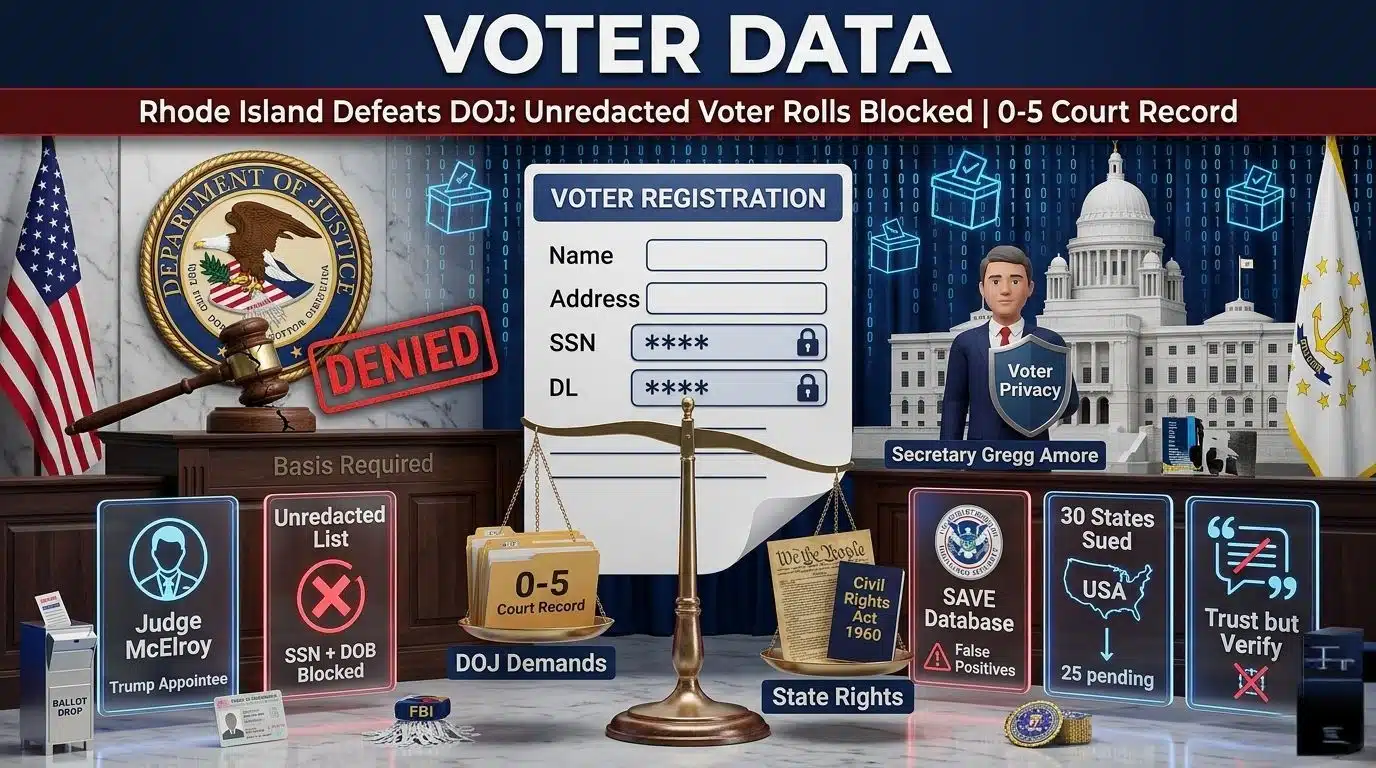
Voter Data: Critical Rhode Island Lawsuit Defeat for DOJ 2026
The Department of Justice lost another major fight over voter data on April 16, 2026. U.S. District Judge Mary S. McElroy tossed the Trump administration’s lawsuit seeking Rhode Island’s unredacted statewide voter registration list. The ruling makes Rhode Island the fifth state to defeat the DOJ in court, joining California, Oregon, Michigan, and Massachusetts. The voter data case is now 0-5 for the federal government, with 25 cases still pending nationwide.
At issue: the DOJ demanded names, addresses, dates of birth, driver’s license numbers, and the last four digits of Social Security numbers for every registered Rhode Island voter. Secretary of State Gregg Amore refused, calling it an “unprecedented fishing expedition.” The court agreed. This voter data decision sets precedent for how far the federal government can go to access state election records.
How the Rhode Island Voter Data Lawsuit Started
On September 8, 2025, the DOJ sent a letter to Secretary Amore requesting an unredacted electronic copy of Rhode Island’s statewide voter registration list. The letter said the purpose was “to ascertain Rhode Island’s compliance with the list maintenance requirements” of the National Voter Registration Act and Help America Vote Act.
Amore provided a redacted list but refused to include Social Security numbers and driver’s license numbers. He argued the Civil Rights Act of 1960 “allows access to voter records only in connection with an investigation into the infringement or denial of constitutional voting rights.” The DOJ cited no such investigation. On December 2, 2025, the DOJ sued.
The voter data lawsuit is part of a broader push. The DOJ has now sued 30 states plus Washington, D.C. — all of which refused to hand over unredacted files. Seventeen Republican-led states complied voluntarily. The rest are fighting in court.
Judge McElroy’s Ruling: Why DOJ Lost the Voter Data Case
Judge McElroy, a Trump appointee, ruled the DOJ failed to meet the basic requirements of the Civil Rights Act of 1960. That law lets the Attorney General demand voter records but requires the government to provide a “basis” and “purpose” for the request.
McElroy found the DOJ “did not identify any facts suggesting that Rhode Island has not complied” with federal law. During a March 26, 2026 hearing, DOJ lawyer Eric Neff admitted the demand letter “stated no factual basis for DOJ’s request.” Instead, Neff called it a “trust but verify” approach to list maintenance.
The judge rejected that. She wrote the CRA was enacted to combat racial discrimination in voting, not to conduct routine audits without cause. Demanding sensitive voter data without evidence is not allowed. The court granted Amore’s motion to dismiss and denied DOJ’s motion to compel.
What Is “Unredacted Voter Data”?
Redacted voter lists are public records. Anyone can request names and addresses of registered voters in Rhode Island. Unredacted lists include:
- Date of birth
- Driver’s license number
- Last four digits of Social Security number
- Place of birth
- Signature
Election officials use unredacted data for internal list maintenance. Privacy advocates say releasing it risks identity theft, phishing, and voter intimidation. That is why the voter data fight is so heated.
The SAVE Database: Why DOJ Wants Voter Data
During the March 26 hearing, DOJ attorney Eric Neff revealed the administration’s plan. The DOJ wants to run state voter data against the Department of Homeland Security’s SAVE database. SAVE stands for Systematic Alien Verification for Entitlements.
DHS revamped SAVE over the past year to check citizenship status. Neff said the goal is to flag noncitizens on voter rolls and prompt states to purge them. “Our intention is to run this against the DHS SAVE database,” Neff told Judge McElroy.
The problem: SAVE has inaccurately flagged U.S. citizens. Texas and Louisiana tested it and found very small numbers of potential noncitizens, but also false positives. Voting rights groups warn that errors could lead to eligible voters being removed. Sharing sensitive voter data with DHS expands that risk nationwide.
Four Other States That Beat DOJ on Voter Data
Rhode Island is not alone. Four district courts already rejected DOJ suits on identical grounds:
| State | Judge | Ruling Date | Reason |
|---|---|---|---|
| California | Not specified | Early 2026 | No factual basis under CRA |
| Oregon | Not specified | Early 2026 | No evidence of NVRA violation |
| Michigan | Not specified | Feb 2026 | DOJ demand lacked “basis” |
| Massachusetts | Patti Saris | April 2026 | Letter did not cite Civil Rights Act |
| Rhode Island | Mary McElroy | April 16, 2026 | No facts suggesting non-compliance |
The voter data scorecard is now 5-0 against DOJ. The Massachusetts ruling came days before Rhode Island. Judge Saris said the DOJ letter did not “use the word ‘basis’ or any equivalent phrase” and cited no suspected violation. Rhode Island’s Secretary Amore used that decision to bolster his motion to dismiss.
What Laws Govern Voter Data Access?
Three federal laws dominate the voter data fight:
1. Civil Rights Act of 1960
Title III lets the Attorney General demand voter records if there is a basis to believe voting rights are denied. It was written to fight racial discrimination. DOJ now argues it applies to list maintenance. Courts disagree when no basis is given.
Read More: Trump vs. Lisa Cook: Supreme Court Decision on Fed Governor Dismissal Update
2. National Voter Registration Act (NVRA)
Also called “Motor Voter,” the NVRA requires states to maintain accurate rolls and allow public inspection. But it does not require states to give unredacted data to DOJ without cause. States must have programs to remove dead voters and duplicates.
3. Help America Vote Act (HAVA)
HAVA requires statewide computerized lists and ID for first-time voters. It lets DOJ enforce compliance but does not grant automatic access to SSNs. The voter data lawsuits test how far DOJ can stretch HAVA.
DOJ’s Next Move After Losing Rhode Island Voter Data Case
On April 14, 2026, five DOJ lawyers filed a response to the Massachusetts loss. They “respectfully disagreed” with Judge Saris and asked Judge McElroy to ignore that precedent. If she did not, they asked to send Amore a “curing elaboration letter” instead of dismissing the case.
McElroy was not persuaded. She dismissed the case on the merits April 16. DOJ has not said if it will appeal. Legal experts expect appeals in multiple circuits, possibly setting up Supreme Court review of voter data access under the CRA.
Why Voter Data Privacy Matters in 2026
The voter data includes Social Security numbers, dates of birth, and addresses. Data breaches in 2024-2025 exposed millions of records. Privacy groups argue mass federal collection creates a honeypot for hackers and foreign actors.
There is also political risk. The SAVE system could flag naturalized citizens if data mismatches occur. A name change after marriage, a hyphenated surname, or a data entry error can trigger a flag. If states purge based on bad flags, eligible voters lose rights. That is why 30 states refuse to share unredacted voter data.
States That Gave DOJ Voter Data
At least 12 states provided or promised full lists: Alaska, Arkansas, Indiana, Louisiana, Mississippi, Nebraska, Ohio, Oklahoma, South Dakota, Tennessee, Texas, and Wyoming. Most have Republican secretaries of state. They argue transparency helps election integrity.
Critics note those states have not reported finding widespread noncitizen voting. Louisiana and Texas ran SAVE checks and found very small numbers. Yet they still gave DOJ the voter data. Rhode Island, with Democratic leadership, chose to fight.
Impact of Rhode Island Voter Data Ruling on 2026 Elections
The ruling does not stop Rhode Island from cleaning rolls. Amore’s office runs regular maintenance using death records, DMV data, and USPS changes. What stops is federal mass collection of SSNs without cause.
For voters, nothing changes immediately. Your registration is still valid. For campaigns, redacted lists remain available. For DOJ, the loss narrows its path to nationwide voter data audits. It must now show evidence before demanding records, state by state.
FAQ Section
1. What did the DOJ want from Rhode Island?
An unredacted statewide voter registration list including names, addresses, dates of birth, driver’s license numbers, and last four digits of Social Security numbers.
2. Why did Rhode Island refuse?
Secretary Amore said federal law requires a factual basis for such requests. The DOJ provided none and did not allege any violation of voting rights law.
3. What is the SAVE database?
SAVE is a DHS system that checks citizenship status. DOJ wanted to run state voter rolls through SAVE to find noncitizens. It has flagged U.S. citizens by error.
4. Have other states won similar cases?
Yes. California, Oregon, Michigan, and Massachusetts also won dismissals. The DOJ is 0-5 in court so far.
5. Is my voter data public?
Partial data is. Names and addresses are public record in Rhode Island. Social Security numbers and driver’s license numbers are not.
6. Will DOJ appeal the Rhode Island decision?
The DOJ has not announced an appeal as of April 17, 2026. It asked for a “curing letter” but the judge dismissed the case instead.
7. Can DHS access my voter file now?
Not from Rhode Island. The court blocked transfer of unredacted data. DHS can only access what states voluntarily share.
8. Does this affect my ability to vote?
No. The ruling protects data privacy but does not change registration or voting procedures for the 2026 elections.

Meet Md. Rubel Rana
As a core contributor to Worlddincidents.com, Rubel Rana brings a unique perspective to the world of journalism. Whether it’s deep-diving into historical trivia or covering the latest global headlines, Rubel Rana is committed to delivering high-quality, high-impact articles. Their writing blends meticulous research with a compelling voice, helping readers stay informed and curious about the world around them.
2 thoughts on “Voter Data: Critical Rhode Island Lawsuit Defeat for DOJ 2026”