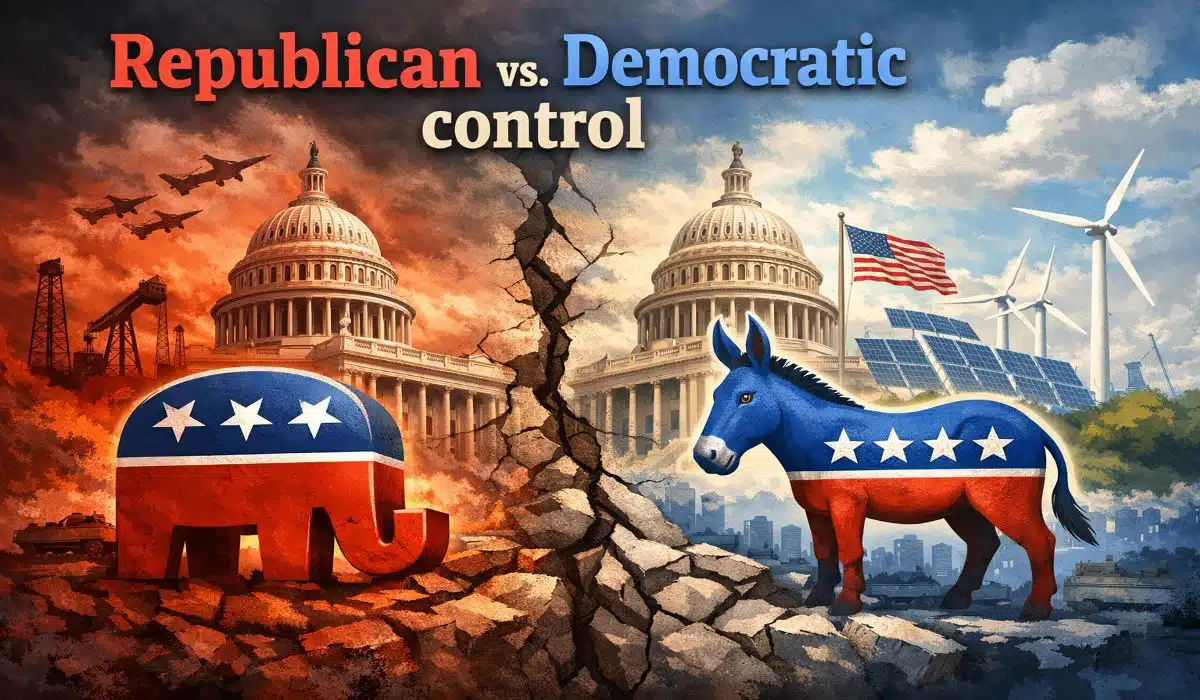
At its heart, the debate over Republican vs. Democratic control is a debate over the role of government. When Republicans hold the gavel, the focus shifts toward “limited government,” emphasizing deregulation, lower corporate taxes, and individual liberty. Conversely, Republican vs. Democratic control shifts the needle toward “active government” under Democratic leadership, where the state is seen as a tool for social equity, environmental protection, and a robust safety net.
Economic Policy and Tax Structures
One of the most visible impacts of Republican vs. Democratic control is seen in the national budget. Under Republican leadership, the priority is often the extension of tax cuts and the reduction of federal spending on social programs to stimulate the private sector. Under Democratic leadership, however, the focus turns to “bottom-up” economics—increasing taxes on high earners to fund infrastructure, education, and green energy initiatives. In 2026, this tug-of-war continues to define the nation’s debt ceiling debates and fiscal outlook.
The Judicial Branch
The stakes of Republican vs. Democratic control extend far beyond a four-year term due to judicial appointments. Republican administrations prioritize originalist judges who interpret the Constitution strictly. Democratic administrations seek “living Constitution” advocates who adapt legal interpretations to modern societal needs. The current makeup of the federal courts is a direct result of which party held the Senate during key vacancy windows, proving that control of the legislative branch is as vital as control of the White House.
Environmental and Energy Sovereignty
In 2026, climate change remains a polarizing issue in the context of Republican vs. Democratic control. Democratic-controlled legislatures are pushing for aggressive transitions to renewables and strict carbon emission limits. In contrast, Republican-controlled areas emphasize energy independence through traditional fossil fuels and nuclear power, arguing that a rapid green transition compromises economic stability. The winner of this ideological battle dictates the global energy market’s direction.
Health Care and Social Safety Nets
The healthcare debate remains a primary pillar of Republican vs. Democratic control. Democrats continue to advocate for the expansion of the Affordable Care Act (ACA) or a move toward a public option to ensure universal coverage. Republicans generally favor a market-based approach, focusing on competition between private insurers and the decentralization of healthcare management to the states. This difference determines not just the cost of medicine, but the accessibility of care for millions of Americans.
Foreign Policy and Global Alliances
The international community watches the shift in Republican vs. Democratic control with high intensity. Historically, Democratic control favors multilateralism—strengthening alliances like NATO and participating in international climate accords. Republican control often leans toward a “National Interest” or “America First” perspective, prioritizing bilateral trade deals and demanding that allies increase their share of defense spending. In a volatile 2026 global environment, the party in power dictates the strength of America’s global handshake.
Immigration and Border Security
Perhaps no issue highlights the divide in Republican vs. Democratic control more than immigration. Republican strategies prioritize border security, physical barriers, and strict enforcement of existing laws. Democratic strategies tend to focus on comprehensive reform, providing pathways to legal status for DACA recipients, and addressing the “root causes” of migration in Central and South America. The party in control of Congress essentially decides the fate of the nation’s demographic and labor future.
The Battle for Information
In 2026, the debate over Republican vs. Democratic control has moved into the digital frontier. Democratic leadership typically pushes for stricter regulations on “Big Tech,” focusing on data privacy, antitrust laws, and combating online misinformation. On the other side, Republican vs. Democratic control in the legislative branch often leads to a focus on “free speech” protections, with Republicans arguing that social media algorithms unfairly censor conservative voices. This struggle for control over digital platforms determines how information is disseminated to the public and how political narratives are shaped in the age of Artificial Intelligence.
The 2026 Redistricting Wars
A defining factor of Republican vs. Democratic control in 2026 is the unprecedented mid-decade redistricting battle. While congressional maps are typically drawn once every ten years, 2025 and 2026 have seen several states, including Texas and California, initiate aggressive new map-drawing efforts to secure partisan advantages. Republican-led efforts in states like Texas aim to solidify a “locked-in” majority by creating more safe GOP districts, while Democratic leadership in California and North Carolina has pushed for maps that maximize their seat count. This tactical “cartography war” means that control of the House in 2026 may be decided by courtroom battles and map lines before a single vote is even cast in the November midterms.
The Education and Labor Divide
In 2026, the contrast between Republican vs. Democratic control has centered on how the American workforce is trained and protected. Under Republican leadership, there is a significant push for “vocational sovereignty”—prioritizing trade schools and apprenticeship programs over traditional four-year degrees. This includes policies like the federal scholarship tax credits found in the One Big Beautiful Bill Act, which incentivize market-driven education. Conversely, Republican vs. Democratic control in Democratic-led states emphasizes the expansion of public higher education and student debt relief. In the labor sector, Republican control has led to more “employer-friendly” shifts in the National Labor Relations Board (NLRB), focusing on narrowing the definition of joint-employment and independent contractors, while Democrats continue to push for the PRO Act and strengthened collective bargaining rights to empower unions.
Election Machinery and Voting Integrity Laws
As the 2026 midterm elections approach, the battle over Republican vs. Democratic control has moved directly into the “machinery of voting.” Under current Republican House leadership, there is a strong push for the SAVE (Safeguard American Voter Eligibility) Act, which mandates proof of citizenship for voter registration and strictly enforces photo ID requirements for all ballots. Republicans argue these measures are essential to ensure “election integrity” and restore public trust. Conversely, under Democratic control in various states, the focus is on “expanding the franchise” through automatic voter registration, pre-registration for young voters, and protected mail-in ballot access. This fundamental disagreement over who gets to vote and how their identity is verified is perhaps the most critical factor in determining which party will ultimately secure a congressional majority in the coming November elections.
FAQ
Q1: What is a “Trifecta” in party control?
Ans: A trifecta occurs when a single party (Republican or Democratic) controls the White House, the House of Representatives, and the Senate simultaneously.
Q2: How does Republican vs. Democratic control affect the stock market?
Ans: Historically, markets favor stability. While Republican control often leads to stock rallies in energy and defense, Democratic control can boost sectors like green energy and technology.
Q3: Can a party pass laws without total control?
Ans: It is difficult but possible through bipartisan negotiation. However, major “party-line” legislation usually requires control of both chambers of Congress.
Conclusion
Ultimately, the balance of Republican vs. Democratic control is decided by the American voter. As the 2026 cycle progresses, the results will determine whether the nation continues toward a path of progressive reform or returns to a conservative, market-driven status quo. The legislative “gridlock” often seen in Washington is a byproduct of this struggle, yet it also reflects a nation carefully weighing two very different visions for the future.
read more: Tax Refund Status 2026

Mr. Udoy is a professional Web Developer and Blogger with 7+ years of experience in the tech world. He specializes in web architecture and digital storytelling. As the driving force behind worldincidents.com, he focuses on delivering high-quality, well-researched content to a global audience.