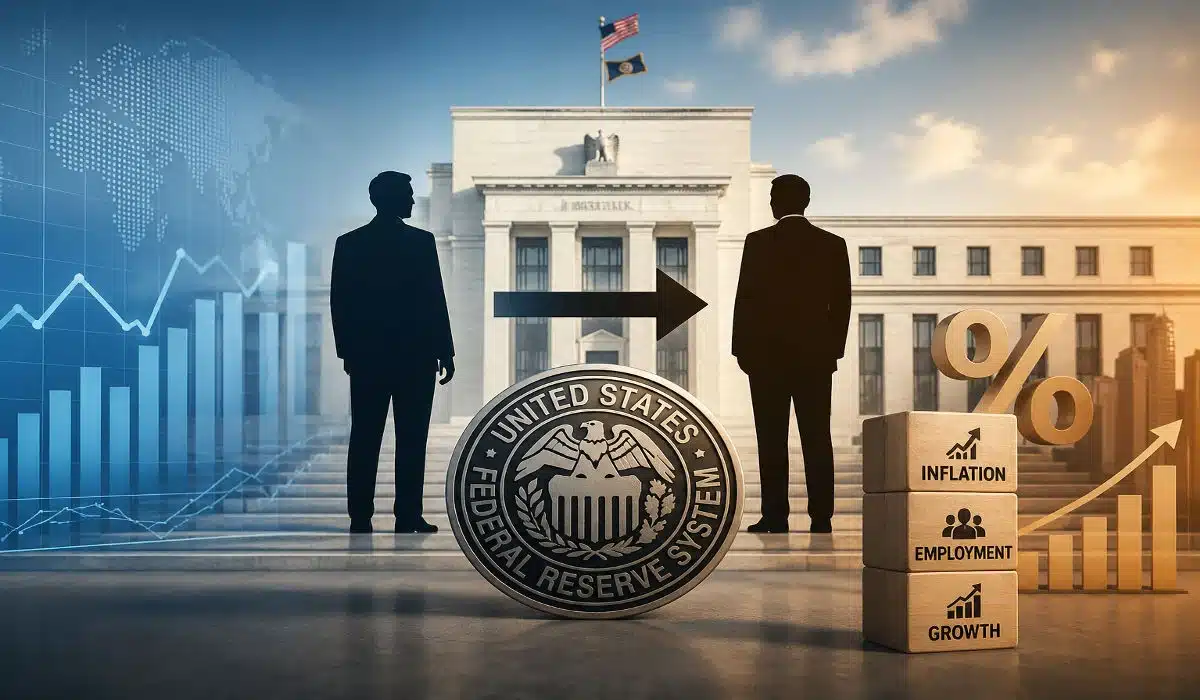
By April 30, 2026, the transition at the Federal Reserve is no longer a matter of speculation. With the Senate Banking Committee recently confirming Kevin Warsh to succeed Jerome Powell, investors and policymakers are laser-focused on the impact of Fed leadership change 2026. This transition comes at a delicate time when the U.S. economy faces renewed inflationary pressures from Middle East conflicts and a stabilizing but complex labor market.
A Shift Toward “Rule-Based” Monetary Policy
One of the most anticipated impacts of Fed leadership change 2026 is the transition from Jerome Powell’s data-dependent “discretionary” style to Kevin Warsh’s more rule-based approach. Warsh has historically advocated for a strategy that moves away from reacting to every cyclical “weather” report—such as temporary supply chain shocks—and toward a more long-term, price-stability-focused framework.
Price Stability Over Employment?
Under the new leadership, the Fed’s dual mandate may see a subtle but powerful re-prioritization. A key impact of Fed leadership change 2026 could be the elevation of price stability as the primary goal. Warsh has argued that full employment is a natural result of price stability, suggesting he may be less inclined to cut rates just to boost jobs if inflation remains even slightly above the 2% target.
The AI Productivity Bonus and Interest Rates
Warsh has been a vocal proponent of the “AI-linked productivity boom.” He believes that rapid AI adoption in 2026 is a disinflationary force, which could allow for lower interest rates without triggering inflation. This perspective is a core impact of Fed leadership change 2026, as it provides a theoretical justification for a more dovish stance on rates even if traditional metrics suggest a hawkish approach.
Central Bank Independence and Political Pressure
Jerome Powell’s final months were marked by public disagreements with the administration. An essential impact of Fed leadership change 2026 will be how Warsh navigates his relationship with the White House. While Trump nominated Warsh to foster a more accommodative environment, Warsh has a reputation for valuing Fed independence. Markets are closely watching to see if the Fed remains a neutral arbiter or becomes more synchronized with fiscal policy.
Market Volatility and the “Warsh Transition”
Historically, leadership changes at the Fed trigger temporary market volatility. The impact of Fed leadership change 2026 on the S&P 500 and bond yields is already visible. Analysts note that while Warsh is a “Wall Street veteran” who understands market mechanics, his potential shift away from traditional employment metrics is forcing institutional investors to recalibrate their 2027 and 2028 projections.
The Dollar and Emerging Markets
The U.S. Federal Reserve doesn’t just manage the American economy; it sets the tone for the world. The impact of Fed leadership change 2026 will ripple through global markets. If the Warsh-led Fed maintains a “higher for longer” stance to combat 3.3% inflation (as of March 2026), the U.S. Dollar will remain strong, potentially causing capital flight from emerging markets already struggling with energy costs.
Read More: The Ultimate Guide to Cocoa-Free Snack Benefits
Modernizing the Fed’s Communication Strategy
A significant impact of Fed leadership change 2026 is the anticipated overhaul of the “Dot Plot” and the Fed’s messaging style. Kevin Warsh has long criticized the Fed’s communication as being too opaque and overly focused on short-term market reactions. Under his leadership, we expect a shift toward more transparent, plain-English guidance that focuses on long-term structural trends rather than quarterly micro-data, potentially reducing the “flash volatility” seen during FOMC press conferences.
Deregulation and Financial Stability
Warsh’s background suggests a pivot toward a more “market-friendly” regulatory environment. One of the structural impacts of Fed leadership change 2026 could be a review of the Basel III endgame capital requirements. A less stringent regulatory stance could unlock more bank lending, providing a liquidity boost to the private sector, though critics argue this could heighten systemic risks in an era of high geopolitical tension.
Re-evaluating the Fed’s Balance Sheet
As of April 2026, the Federal Reserve’s balance sheet remains a point of contention. The impact of Fed leadership change 2026 will likely include a more aggressive stance on Quantitative Tightening (QT). Warsh is known for his skepticism of a bloated central bank balance sheet. He may push for a faster reduction of bond holdings to “normalize” the Fed’s footprint in the mortgage-backed securities (MBS) and Treasury markets, which could lead to a steepening of the yield curve.
Addressing the Fiscal-Monetary Conflict
With U.S. national debt reaching new heights in 2026, the impact of Fed leadership change 2026 involves managing “Fiscal Dominance.” Warsh will face the challenge of keeping interest rates high enough to fight inflation while dealing with an administration that needs low rates to service massive debt. His ability to maintain a “hard line” on inflation without causing a fiscal crisis will be the defining test of his first 100 days.
The “Dollar Weaponization” Debate
The 2026 geopolitical climate has seen a rise in “de-dollarization” discussions among BRICS+ nations. A critical impact of Fed leadership change 2026 will be the new Chair’s stance on the international role of the dollar. Warsh is expected to advocate for a “Strong Dollar” policy to maintain the currency’s reserve status, which may involve tighter coordination with G7 allies to counter the rise of alternative payment systems and CBDCs (Central Bank Digital Currencies).
Focus on Supply-Side Economics
While Powell focused heavily on managing demand, a core impact of Fed leadership change 2026 will be a shift toward supply-side considerations. Warsh often speaks about the “real economy”—innovation, energy production, and labor participation. He is likely to use his platform to urge Congress toward supply-side reforms, arguing that the Fed cannot solve inflation alone if the underlying supply of goods and services is constrained by regulation.
FAQ
Q1: When exactly does Jerome Powell step down?
Ans: Jerome Powell’s term as Chair expires in May 2026. However, he may choose to remain on the Board of Governors until his seat expires in 2028.
Q2: Will the impact of Fed leadership change 2026 lead to immediate rate cuts?
Ans: While the administration favors lower rates, current inflation at 3.3% and geopolitical shocks in the Middle East suggest the Fed will likely remain “on hold” through the transition.
Q3: How does Kevin Warsh view the 2% inflation target?
Ans: Warsh is a traditionalist regarding price stability. He is unlikely to officially raise the 2% target, but he may interpret “transitory” inflationary shocks differently due to AI-led productivity.

Mr. Udoy is a professional Web Developer and Blogger with 7+ years of experience in the tech world. He specializes in web architecture and digital storytelling. As the driving force behind worldincidents.com, he focuses on delivering high-quality, well-researched content to a global audience.