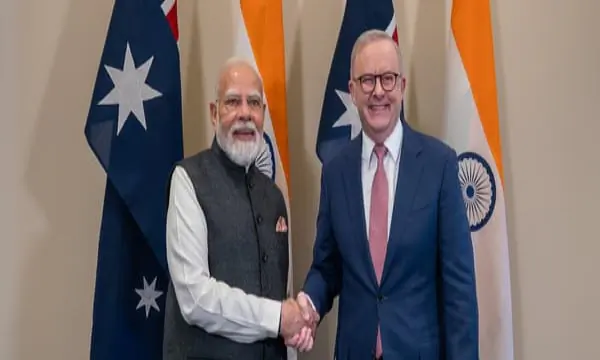
Indian Prime Minister Narendra Modi visited Australia from July 8-10, 2026, with a key meeting occurring on July 9, marking a significant milestone in the deepening geostrategic relationship between New Delhi and Canberra. During his state visit, Modi attended the third Australia-India Annual Summit in Melbourne, where the two nations finalized several memoranda of understanding (MoUs) and agreements. These pacts cover diverse sectors, including maritime security, civil nuclear energy, skill development, emerging technologies, science, and filmmaking.
Beyond his formal discussions with Australian Prime Minister Anthony Albanese, Modi held meetings with the governor-general and the leader of the opposition. His itinerary also included addressing the Australia-India CEOs Forum, the Economic Roadmap Business event, and a large gathering of approximately 30,000 people at Marvel Stadium, which included members of the Indian diaspora.
A notable aspect of the visit was the move toward expanded uranium cooperation. While Australia holds roughly 28 percent of global uranium resources, its exports currently account for only 1.9 percent of the global market due to domestic mining restrictions. Canberra’s decision to expedite uranium sales to India is viewed as a symbolic and strategic step, mirroring its earlier efforts to improve ties with China and Russia in 2009. This development is seen as removing a final hurdle in the evolution of a comprehensive strategic partnership, with goals extending toward 2027 and 2035.
The bilateral relationship has developed an independent dynamic, no longer reliant on U.S.-India relations as a prerequisite for progress. Former diplomat Peter Varghese observed that shifting U.S. commitments in the Indo-Pacific have necessitated deeper regional bonds, placing India and Australia in a position to fill potential voids. Their cooperation as Quad partners underscores a long-term commitment to regional stability.
Security remains a primary pillar of the relationship. During a media briefing, India’s Foreign Secretary Vikram Misri confirmed that Australia raised concerns regarding China’s recent intercontinental ballistic missile launch into the South Pacific. Misri emphasized that both nations are committed to intensifying cooperation to ensure peace and security in the Indo-Pacific. This follows the 2020 upgrade to a Comprehensive Strategic Partnership and the continued strengthening of institutional interoperability, bolstered by logistical agreements like the Mutual Logistics Support Arrangement and the Joint Declaration on Defense and Security Cooperation. Future plans include the deployment of an Indian military instructor to the Australian Defense College in 2028-29 and a new MoU between the Indian Coast Guard and Australia’s Maritime Border Command.
Cooperation is also expanding into the space sector, with Canberra supporting India’s Gaganyaan Human Spaceflight Program through tracking capabilities on the Cocos (Keeling) Islands. Back in 2012, an Australian commentator observed: “India is an important emerging power but not yet an important strategic player.” Today, that assessment seems obsolete. New Delhi is now recognized as a critical strategic player and a cornerstone of regional stability. Although the summit statement made no mention of the South China Sea, unlike the first annual summit statement in 2023, Beijing figured in the broader strategic dialogue, supported by 22 key bilateral initiatives.
Amid power shifts in the Indo-Pacific, there is greater realization in both countries of each other’s value as a stable, reliable partner.
You have reached the limit of 2 free articles this month.

Md. Kazi Bijoy is a dedicated tech enthusiast and content creator with a passion for digital innovation. With years of experience in the tech industry, he specializes in breaking down complex topics into easy-to-understand guides. When he isn’t writing, he explores the latest gadgets and researches emerging trends in the digital world.
1 thought on “India and Australia Deepen Strategic Ties at Annual Summit”