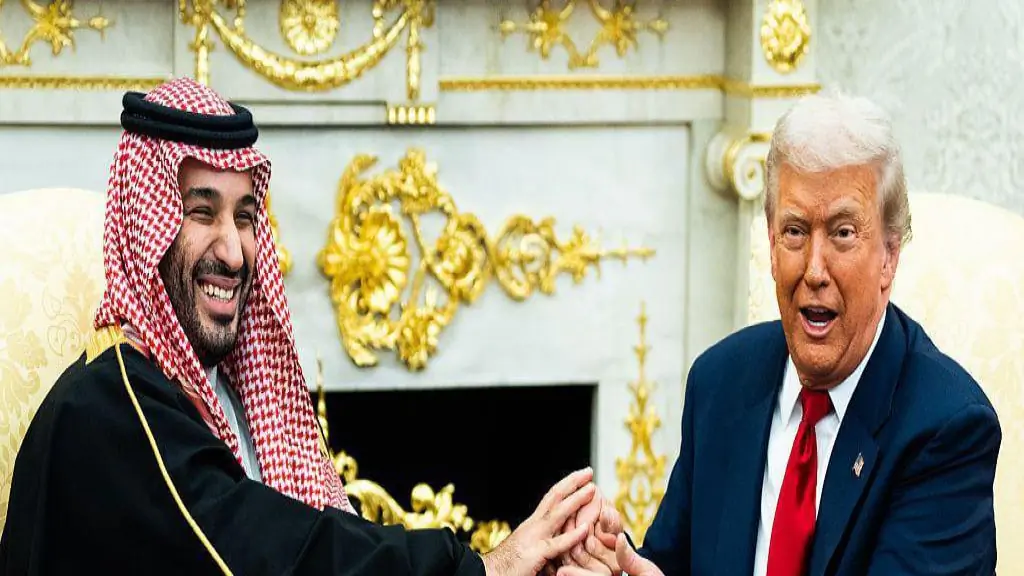
President Donald Trump has asserted that Saudi Arabia must normalize relations with Israel if it wishes to move forward with a nuclear cooperation agreement with the United States. White House press secretary Karoline Leavitt confirmed on Thursday that Trump has discussed this specific condition with Saudi leadership on numerous prior occasions.
The proposed arrangement, according to the US Department of Energy, involves a peaceful nuclear cooperation agreement alongside a bilateral safeguards agreement.
These two frameworks are intended to establish the legal foundation for a multi-billion-dollar partnership spanning several decades, aimed at advancing economic and strategic objectives, including nuclear nonproliferation. The department noted that any such agreement would be submitted to the US Congress for review.
The International Atomic Energy Agency (IAEA) stated on Thursday that it is aware of the plans between the US and Saudi Arabia regarding a bilateral civil nuclear cooperation agreement and the intent to request verification measures. The agency expressed readiness to receive such a request and to collaborate with both nations on implementation.
The prospect of such a deal has drawn mixed reactions. Israel has publicly welcomed the prospect of Saudi Arabia joining the Abraham Accords, with Prime Minister Benjamin Netanyahu’s office describing it as a historic leap for Middle East peace.
However, others have expressed caution; former Israeli defence minister Avigdor Lieberman remarked that every military nuclear program begins with a civilian one. While Israel is widely believed to possess nuclear weapons, the state maintains a policy of neither confirming nor denying their existence.
Concerns have also been raised regarding the potential for uranium enrichment. Rosemary Kelanic, director of the Middle East programme at the US-based Defense Priorities think tank, stated it would be quite shocking if the US allowed Saudi Arabia to operate its own enrichment facilities, noting that the US has never previously assisted another country in enriching uranium on its own soil.
She warned that the ability to produce domestic nuclear fuel increases the risk of weaponization. Saudi Crown Prince Mohammed bin Salman previously told CBS News in 2018 that while the Kingdom was not planning to acquire a nuclear weapon, it would follow suit if Iran were to develop one. Saudi Arabia has not yet provided a response to Trump’s recent remarks.
Sudan, Morocco and Kazakhstan have since also signed them, too.
The nuclear issue has been at the centre of the months-long US-Israeli conflict with Iran which has for years denied Western accusations that it aims to acquire nuclear weapons.

Md. Kazi Bijoy is a dedicated tech enthusiast and content creator with a passion for digital innovation. With years of experience in the tech industry, he specializes in breaking down complex topics into easy-to-understand guides. When he isn’t writing, he explores the latest gadgets and researches emerging trends in the digital world.
1 thought on “Trump Conditions Saudi Nuclear Deal on Israel Recognition”