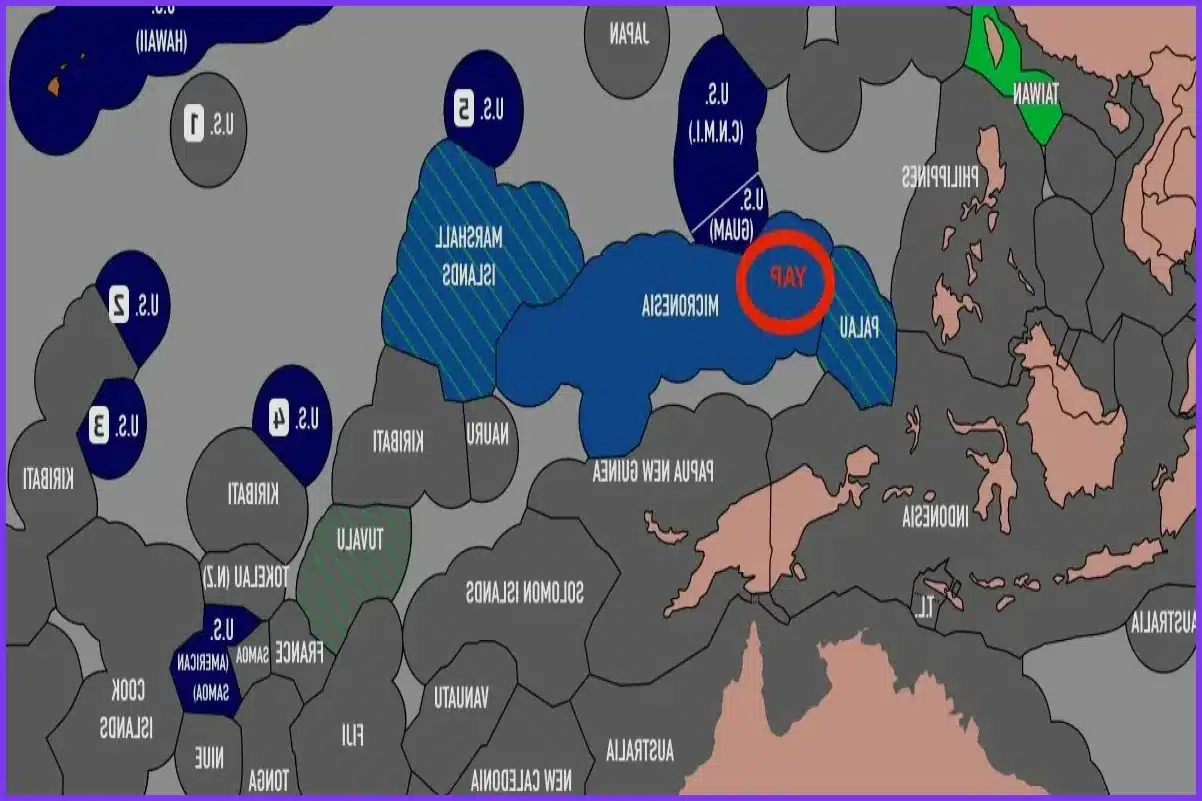
The United States military is considering relocating a planned $2 billion defense infrastructure project out of Yap, a state within the Federated States of Micronesia (FSM). The potential withdrawal of this massive Department of Defense investment follows a severe breakdown in bilateral negotiations, marking the second time recently that Washington has encountered major obstacles while negotiating defense access with a Compact of Free Association (COFA) partner.
The impasse was revealed in a June 29, 2026, letter from Admiral Samuel Paparo, commander of U.S. Pacific Command (PACOM), to FSM President Wesley Simina. In the letter, Paparo described Micronesia's demand for a "$1.3 billion compensation package" as "unreasonable, unanchored to demonstrable costs, and divergent from the spirit of our partnership under the Compact of Free Association." As a direct consequence of this dispute, Paparo stated that PACOM intends to move forward by assessing alternative locations across the region to meet its Pacific defense requirements.
Yap occupies a highly strategic position within the Second Island Chain. The main island of Yap state, which comprises over a hundred islands, lies just over 500 miles southwest of Guam. The military significance of the Yap island group was established during the final stages of World War II. After seizing the region from Japan, the United States transformed one of Yap's atolls, Ulithi, into the largest and busiest American naval base in the world. Following the war, Yap joined neighboring island groups to form the independent Federated States of Micronesia.
Under the Compact of Free Association, the FSM and the United States share a deeply integrated relationship. FSM citizens are permitted to live and work freely in the United States, while the U.S. government holds full authority and responsibility for security and defense matters in or relating to the FSM. This agreement goes beyond standard U.S. defense pacts, obligating the United States to defend the FSM and its people from attacks or threats in the same manner it defends its own citizens.
Howard Hills, who served as lead counsel and advisor for COFA negotiations under Presidents Ronald Reagan, Joseph Biden, and Donald Trump, explained the legal boundaries of the treaty. Hills noted that under COFA, the U.S. power to deny military access to third nations in the FSM, Palau, and the Republic of the Marshall Islands is absolute and permanent. However, Hills clarified that the specific military use and operating rights required for mutual security remain subject to mutual agreement by the respective governments.
The current friction in Yap represents a recurring challenge for U.S. defense planners in the region. Washington originally pursued the Yap airport improvements because previous Department of Defense negotiations for increased military access in Angaur, located in the neighboring Second Island Chain nation of Palau, had collapsed. Analysts point to several interconnected reasons for these repeated negotiation failures.
A primary factor is the local perception within the FSM that the U.S. government is an inexhaustible source of funds. This view is often reinforced when residents observe the comparatively lavish lifestyles of visiting U.S. officials, who stay in top hotels and dine out, alongside the high rates paid to American consultants and contractors. Combined with widespread reporting on the strategic importance of the Second Island Chain, some local negotiators believe they hold significant leverage over Washington. In Yap, this led to a $1.3 billion demand, which equates to more than $185,000 for each of the island's approximately 7,000 residents. When combined with the roughly $1.4 billion already appropriated in the National Defense Authorization Act (NDAA) for the Yap airport, the high cost has made alternative investments, such as upgrading the airport on the main island of Palau, look far more cost-effective.
Geopolitical dynamics and external political warfare also complicate the negotiations. Former FSM President David Panuelo wrote a series of letters in 2022 and 2023 warning that the FSM national government was heavily infiltrated by Chinese political warfare operations. In a letter dated March 9, 2023, Panuelo explicitly stated that FSM officials were being bribed by China to remain complicit and silent, noting that elected officials had received unaccounted-for checks for public projects. This suggests that during bilateral negotiations with the U.S., Chinese-aligned interests may be active in the room.
In April 2026, Admiral Paparo testified before the U.S. Senate that foreign information, influence, cognitive, and cyber operations are achieving strategic effects by shaping perceptions and disrupting decision-making in the Pacific. While the U.S. Department of State took action in February by designating corrupt actors in Palau and the Marshall Islands—such as calling out the president of the Palau Senate for significant corruption on behalf of China-based actors—no similar public actions have been taken against officials in the FSM.
Furthermore, the U.S. military has struggled to understand local dynamics due to a lack of permanent representation. There are no permanent U.S. government officials stationed in Yap, meaning locals have no daily contact with American representatives. In contrast, a Chinese state-owned company has established a permanent presence on the island. Consequently, short-term visiting U.S. officials are often viewed with suspicion as "spies," which plays directly into Chinese cognitive warfare strategies.
While Admiral Paparo's letter may serve as a negotiating tactic to revive the talks, FSM President Simina wrote to Yap Governor Francis Itimai on August 3, acknowledging the "possible setback" and leaving the door open to find a resolution. However, the delay threatens a project for which the NDAA had appropriated $1.49 billion, a program previously announced by Defense Secretary Pete Hegseth. Experts warn that simply shifting the location of the project without addressing the underlying local dynamics and foreign influence may not resolve the strategic challenges facing the United States in the Indo-Pacific.
A U.S. Marine Corps F-35B Lightning II prepares for takeoff after receiving fuel from a KC-130J Hercules during an aviation delivered ground refueling as part of exercise Slingshot in Pohnpei, Micronesia June 26, 2026.
You have reached the limit of 2 free articles this month.
Related Articles

Mr. Udoy is a professional Web Developer and Blogger with 7+ years of experience in the tech world. He specializes in web architecture and digital storytelling. As the driving force behind worldincidents.com, he focuses on delivering high-quality, well-researched content to a global audience.
2 thoughts on “US Military May Move $2 Billion Yap Project Over Compensation Dispute”