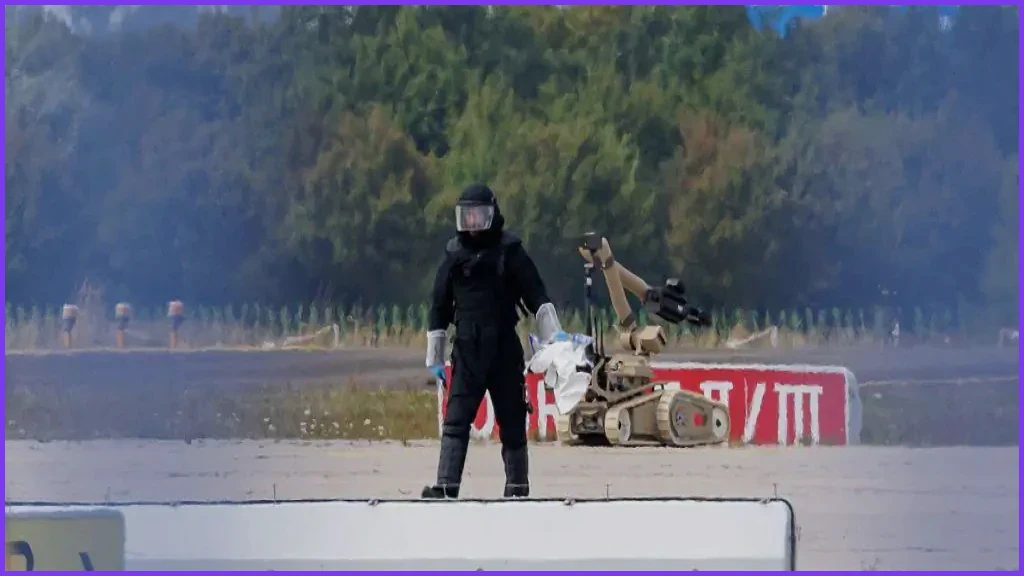
Germany has officially accused Russia of orchestrating a drone attack at Leipzig/Halle Airport last month, marking a dramatic escalation in tensions between Berlin and Moscow. The incident, which occurred on August 4, involved an explosive-laden drone discovered near Ukrainian cargo aircraft. German authorities have responded with a series of sweeping diplomatic and security measures, including the closure of a Russian consulate and tighter restrictions on Russian citizens.
The drone found at the eastern German airport failed to detonate because its detonator was apparently faulty. Investigators also suspect that a second drone collided with a cargo aircraft in the vicinity, while a third drone was reportedly discovered near the airport ten days later. Leipzig/Halle Airport serves as a vital logistics hub used by the German military and its NATO allies to transport military goods. Crucially, it also acts as a base for Ukraine’s Antonov Airlines, which is responsible for carrying the vast majority of Ukraine's aerial cargo.
Standing alongside Interior Minister Alexander Dobrindt at a press conference in Berlin, German Foreign Minister Johann Wadephul announced significant retaliatory steps. Wadephul stated that he would order the closure of the Russian consulate in Bonn. Additionally, the German government will terminate the contract for the Russian House in Berlin, an institution that many observers have long accused of being used for espionage and the dissemination of Russian propaganda. Wadephul also announced the introduction of tighter entry controls for Russian nationals and pledged to increase pressure on Moscow's "shadow fleet"—the aging tankers used by Russia to bypass Western sanctions imposed after its 2022 invasion of Ukraine.
Following the announcement, Wadephul summoned Russia's ambassador to Germany, Sergei Nechayev, who was seen arriving at the foreign ministry shortly afterward. The Russian embassy in Berlin quickly rejected the accusations, calling the claim "absurd" and describing Germany's retaliatory actions as an "unprecedented escalation in Russian-German relations." Maria Zakharova, the spokesperson for Russia's foreign ministry, warned that Moscow would respond with "mirror-image" measures. Speaking to the German Press Agency, Zakharova accused Berlin of "sponsoring terrorism" in reference to Germany's extensive military and economic support for Ukraine. Security experts have previously suggested that if Germany closed the Russian House, Moscow might retaliate by forcing the Goethe-Institut in Moscow to cease its operations.
Interior Minister Dobrindt explained that the Leipzig airport incident fits a "well-established pattern of Russian hybrid operations in Europe." He warned that Germany must assume it will be targeted again, noting that examinations of the recovered equipment and intelligence findings clearly proved Russian involvement. While security experts had previously speculated on Russian responsibility, Moscow had consistently denied any involvement. Until now, Berlin had remained tight-lipped about the perpetrators, stating only that "foreign powers" might have been behind the Leipzig incident, even as US media reported that American officials had already linked the attack to Russia.
The government's response comes amid warnings that Germany is a "daily target" of hybrid warfare. Chancellor Friedrich Merz warned last week that those who carry out hostile acts against Germany would "pay a price." In response to these growing threats, the German government is currently seeking to expand the powers of its intelligence services, which have faced long-standing criticism for being relatively toothless. However, the measures announced by Wadephul have already drawn criticism from within Merz's own Christian Democrats (CDU) party. Roderich Kiesewetter, a CDU member of parliament, argued that the government's actions "fall far short of what is required" and claimed that Moscow "just laughs" when its ambassador is summoned. Kiesewetter stated, "From a self-proclaimed leading nation, I expect courage and resolve, not self-deterrence and appeasement."
The timing of the announcement is highly sensitive for Chancellor Merz's government. A crucial state election in the eastern state of Saxony-Anhalt could potentially propel the far-right Alternative für Deutschland (AfD) into power at the state level for the first time. The AfD, which is currently Germany's largest opposition party, strongly advocates for halting all support to Ukraine and reopening diplomatic and economic ties with Russia.
Internationally, Germany's allies have rallied in support. NATO Secretary General Mark Rutte declared that the alliance "stands in full solidarity with Germany." Writing on X, Rutte stated, "The evidence is clear. And I welcome the measures announced by Germany in response." EU Commission President Ursula von der Leyen also expressed solidarity on X, writing, "We are united in our resolve to stand against Russian aggression. We will deter anyone who seeks to undermine our freedom and security." She added that the European Union is preparing additional sanctions against Russia. The issue was scheduled for discussion at a meeting of EU foreign ministers in Ireland.
Other regional leaders also voiced concern over Russian activities. Polish Prime Minister Donald Tusk accused Russia of "escalating tension across the whole region," noting that Polish prosecutors are currently investigating whether foreign intelligence services played a role in a fire at a factory manufacturing drone components. Meanwhile, British Prime Minister Andy Burnham stated, "Russian attempts to undermine our united resolve and our willingness to support Ukraine are futile and doomed to fail."
In a separate and unresolved development on Tuesday, German police announced they are investigating the discovery of improvised explosive and incendiary devices at a power substation in the eastern state of Brandenburg. A damaged power line caused a temporary electricity outage, though authorities do not yet know who planted the devices. Germany is one of several NATO member states that have reported drone sightings at airports, military bases, and industrial sites over the past year.
It failed to explode as the detonator was apparently faulty, and investigators suspect a second drone collided with a cargo aircraft nearby. A third drone was reportedly found near the airport 10 days later.
Related Articles

Md. Kazi Bijoy is a dedicated tech enthusiast and content creator with a passion for digital innovation. With years of experience in the tech industry, he specializes in breaking down complex topics into easy-to-understand guides. When he isn’t writing, he explores the latest gadgets and researches emerging trends in the digital world.