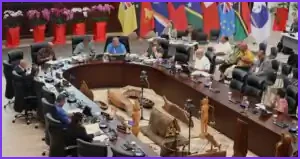
The 55th Pacific Islands Forum (PIF) Leaders' Meeting opened in Palau on August 31, 2026, under a banner of regional unity, but the gathering has quickly been overshadowed by the geopolitical tug-of-war between major global powers. With key leaders absent and consensus blocked over security issues, the forum's traditional decision-making model is facing unprecedented strain, raising doubts about whether its consensus-based system can still protect small-state sovereignty.
This year's summit, hosted in Palau under the official theme "B.E.L.A.U." (Building Economies, Life, Action, Unity), was intended to showcase collective regional resolve. However, at least five Pacific leaders chose not to attend. The leaders of Samoa, Vanuatu, and Kiribati sent deputies instead of attending themselves, while Fiji's Prime Minister Sitiveni Rabuka remained at home to handle domestic affairs. The most sudden departure was that of Solomon Islands' Prime Minister Matthew Wale. Having served as prime minister for only three months, the outgoing PIF chair landed in Palau but was forced to fly back to Honiara hours later due to a newly filed no-confidence motion. Wale left Foreign Minister Rick Hou to represent the Solomon Islands at the summit.
The decision by Kiribati's President Taneti Maamau to send David Teaabo, the director of foreign service and a former ambassador to China, rather than a cabinet minister, has drawn intense scrutiny. In an organization that relies on consensus among heads of state, dispatching a lower-ranking diplomat who lacks the authority to sign off on official communique language is seen as a deliberate political statement. This move comes in the wake of a major security incident on July 6, 2026, when China conducted a submarine-launched ballistic missile test in the Pacific. The missile, identified by Taiwan as a JL-2 launched from the South China Sea, carried a dummy warhead and transited the exclusive economic zones of the Federated States of Micronesia, Naoero (formerly Nauru), and Kiribati before splashing down near Tuvalu's maritime boundary. Beijing gave the affected nations only a few hours' notice.
While the missile test sparked immediate outrage from some regional leaders, others remained silent. Papua New Guinea's Prime Minister James Marape referenced the Pacific's painful history of nuclear testing, declaring that island nations "do not want history repeated," while Australian Prime Minister Anthony Albanese condemned the test as "provocative" and "destabilizing." However, when Pacific foreign ministers met in Fiji in early August, Kiribati and Naoero used their consensus rights to block a joint statement condemning the Chinese missile test. This move has raised fears that the PIF's traditional consensus model, designed to protect small states from being overridden by larger neighbors, is being weaponized by outside powers. New Zealand's Foreign Minister Winston Peters criticized the block, stating that two nations "were seeking to use the need for consensus as a veto provision" and asserting that "outsiders should not be telling insiders" what positions to take.
The geopolitical friction is further compounded by the return of Taiwan as a development partner. Taiwan was excluded from last year's 54th PIF Leaders' Meeting in the Solomon Islands under the guise of a partnership review. This year, host nation Palau, which maintains formal diplomatic ties with Taipei, welcomed Taiwan's Foreign Minister Lin Chia-lung. Leading a delegation focused on energy, technology, construction, and agriculture, Lin met with Palau's President Surangel Whipps Jr. and participated in the Taiwan/Republic of China-Forum Countries Dialogue. Although only three PIF members—the Marshall Islands, Palau, and Tuvalu—still maintain official diplomatic relations with Taiwan, Taipei's development aid reaches further. In July 2026, Taiwan donated $2 million to the Forum Secretariat, following a $3 million pledge to the Pacific Resilience Facility in 2025.
Beijing has reacted aggressively to Taiwan's inclusion. China's special envoy Qian Bo directly confronted President Whipps at a Forum Troika meeting in Fiji, demanding Taiwan's exclusion and warning of retaliation while dismissing Palau as "a small country." Whipps dismissed the remarks, stating, "It doesn’t matter. We’re a country," and later joked that "if you want somebody to love you, usually you come with chocolates and nice cards." On August 19, 2026, China followed through on its threats by issuing a travel advisory warning Chinese citizens against visiting Palau due to alleged high crime and dangerous marine conditions. The U.S. Embassy in Palau rejected the advisory, accusing China of attempting to "weaponize tourism to coerce Palau." Tourism accounts for roughly 40 percent of Palau's gross domestic product. China previously banned package tours to Palau in 2017 after the country refused to sever ties with Taiwan. Whipps remained resolute, telling reporters, "China continues to try to influence us… We’ve made it very clear from the beginning [that] nobody is going to tell us who our friends can be."
The shifting alliances in the region are clear: Taiwan's diplomatic footprint in the Pacific has halved since 2019, when it had six partners. The Solomon Islands and Kiribati switched recognition to Beijing in 2019, followed by Naoero in January 2024. Despite these geopolitical tensions, the PIF summit is attempting to address other critical regional issues. The agenda features a climate declaration ahead of COP31, a new maritime anti-smuggling initiative named Waqa Moana, and the Pacific Resilience Facility, which has secured $173 million in pledges toward its $500 million target. However, observers warn that the forum's credibility is at stake if it can organize financial mechanisms for climate change but remains paralyzed when a nuclear power conducts unannounced missile tests in its members' waters. The empty chairs and diplomatic standoffs in Palau highlight a regional order increasingly strained by external manipulation.
Related Articles

Md. Kazi Bijoy is a dedicated tech enthusiast and content creator with a passion for digital innovation. With years of experience in the tech industry, he specializes in breaking down complex topics into easy-to-understand guides. When he isn’t writing, he explores the latest gadgets and researches emerging trends in the digital world.