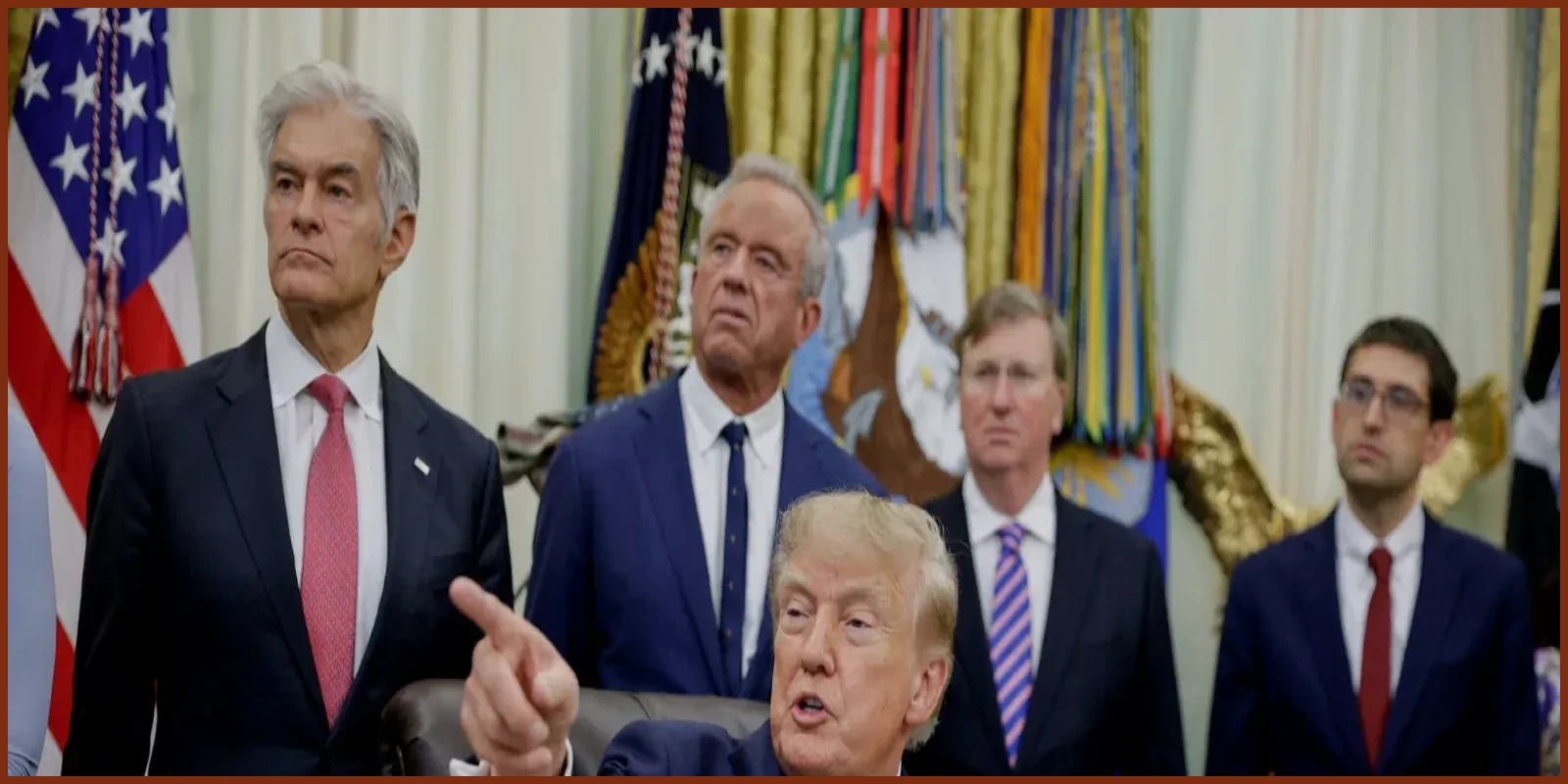
President Donald Trump has announced a ban on journalists representing three prominent media organizations—CNN, MS NOW, and Politico—from entering the White House. Making the announcement in a social media post on September 18, Trump declared that the restriction was being enacted because he characterizes their reporting as "FAKE NEWS." The decision marks a significant escalation in the administration's ongoing friction with the press, though the president later clarified that the move was not triggered by any single article or specific reporting incident.
Instead, Trump described the ban as the result of a long-standing frustration with the media. "It's really just cumulative stories over the last few years. You get sick of it," he told reporters when explaining his reasoning. Despite the sweeping nature of his announcement, the president acknowledged that the measure would not prevent the targeted news organizations from continuing to cover his administration from the outside. However, the exact operational details of the ban remain undefined, with Trump offering few specifics on whether it would involve the formal revocation of hard credentials, exclusion from the White House press pool, or a complete block on entering the White House grounds. He described it as "a very simple ban," adding, "I don’t want them in my office, I don’t want them here. I would say the ban would go as far as you can."
The affected media outlets quickly responded to the announcement, with some signaling readiness for a legal battle. A spokesperson for CNN characterized the proposed restriction as an "illegal assault" on press freedom. "CNN stands fully behind our White House team and their fair and accurate reporting," the network said in an official statement. "We have a right under the U.S. Constitution to do that reporting without hindrance or interference from the government." Politico also released a statement affirming its commitment to independent journalism, stating that the publication "will continue to fairly report on this White House and future ones" and "will vigorously defend our First Amendment rights against any attempt to restrict them." Meanwhile, representatives for MS NOW declined to comment on the matter.
When questioned about the potential unconstitutionality of barring reporters based on their coverage, Trump dismissed such concerns, arguing that the action is fully justified "because they’re fake news." He suggested that his primary goal was to establish a point of principle, regardless of how the policy might fare under judicial scrutiny. "We'll see," Trump remarked when asked about the legal viability of the ban. "I think it’s good to point it out, whether it survives or doesn’t . . . depends on the judge you get, to be honest with you. I don't think a court should allow fake news to be written day after day after day." He expanded on this view by criticizing the legal protections that allow critical coverage, saying, "There’s something wrong with a country that can allow people to write purposely negative stories. Now, if they want to write them, that’s fine, but I don’t have to let them into my, into the people’s house." When a reporter asked if the move was designed to intimidate journalists, Trump reacted sharply, saying, "I dislike dishonest press, like you. I think you're terrible. I like to see honest press."
This is not the first instance of the Trump administration restricting press access. During his first term in 2018, the White House revoked the press credentials of CNN correspondent Jim Acosta, citing his refusal to yield a microphone during a press conference. That decision was subsequently challenged in court, and a federal judge—who had been appointed by Trump—ordered the White House to restore Acosta's pass, ruling that the correspondent had not been provided a fair opportunity to defend himself.
More recently, in early 2025, the administration blocked the Associated Press (AP) from the Oval Office, the White House East Room, and the traveling press pool. The dispute arose after the AP declined to adopt the administration's mandated style change for the body of water bordering the United States and Mexico. Trump had ordered official maps to rename the "Gulf of Mexico" to the "Gulf of America," a change the AP refused to implement in its reporting.
The AP challenged the restrictions in court, initially securing a favorable ruling from Washington, D.C., federal trial Judge Trevor McFadden, a Trump appointee. McFadden issued a temporary injunction against the ban, writing that "under the First Amendment, if the Government opens its doors to some journalists – be it to the Oval Office, the East Room, or elsewhere – it cannot then shut those doors to other journalists because of their viewpoints."
However, that decision was largely overturned in a 2-1 ruling by a federal appeals court panel. The majority opinion, written by Judge Neomi Rao and joined by Judge Gregory G. Katsas—both Trump appointees—concluded that blocking the administration from restricting specific reporters from the Oval Office or the traveling pool constituted an undue intrusion into the president's authority. "While the AP has alleged financial loss from being denied access to the Oval Office, that harm does not, in our view, justify an intrusion on presidential prerogatives during this litigation," Rao wrote.
In contrast, Judge Cornelia T.L. Pillard, an appointee of President Barack Obama, strongly dissented from the majority's view. Pillard wrote that her colleagues' reasoning "cannot be squared with . . . any sensible understanding of the role of a free press in our constitutional democracy." Despite the reversal, the appeals court did strike down the administration's attempt to bar the AP from the East Room, noting that it is "a much larger space that can accommodate more members of the press." The judges also pointed out that the AP's ban did not prevent its reporters from entering other White House press facilities, such as the main briefing room. The AP litigation remains ongoing.
Legal and media analysts suggest that the latest sweeping ban on CNN, MS NOW, and Politico presents a different set of challenges. Clay Calvert, a nonresident senior fellow at the American Enterprise Institute, described the move as "thoroughly unsurprising," pointing out that it comes as Trump faces low approval ratings ahead of the upcoming midterm elections. Calvert observed that the news media serves as an "easy target" for the president, and implementing such bans is highly effective at appealing to his political base, which harbors deep distrust toward mainstream media.
Calvert noted, however, that the previous ban on the Associated Press was a "much more precise target" because it was tied to a single editorial decision—the refusal to use the term "Gulf of America"—and was confined to specific locations like the Oval Office and Air Force One. It remains unclear whether the new restrictions against CNN, MS NOW, and Politico will mirror those spatial limitations or attempt a total exclusion from the White House campus.
Advocates for press freedom have raised alarms about the broader consequences of these actions. Jenna Leventoff, senior policy counsel for the American Civil Liberties Union (ACLU), warned that blocking journalists from government spaces makes it "really difficult" to convey crucial information to the public. She recalled a 2025 case where a federal judge blocked a Pentagon press policy that threatened to revoke access for journalists who "solicited" unapproved information, as well as a subsequent interim policy requiring constant escorts, which was also struck down.
Leventoff emphasized that even if the administration's bans are ultimately overturned, the threat of protracted and expensive legal battles can have a chilling effect on journalism. "In that respect, it doesn’t matter if he wins in court or not, because he’s still chilling the media from saying things he dislikes," she said. National Press Club President Mark Schoeff Jr. echoed these concerns, stating in a press release that by restricting access, Trump "weakens one of the nation’s strongest checks on those who hold power." Schoeff added, "A government confident in its actions should never fear independent scrutiny."
Related Articles
Meet Md. Rubel Rana
As a core contributor to Worlddincidents.com, Rubel Rana brings a unique perspective to the world of journalism. Whether it’s deep-diving into historical trivia or covering the latest global headlines, Rubel Rana is committed to delivering high-quality, high-impact articles. Their writing blends meticulous research with a compelling voice, helping readers stay informed and curious about the world around them.