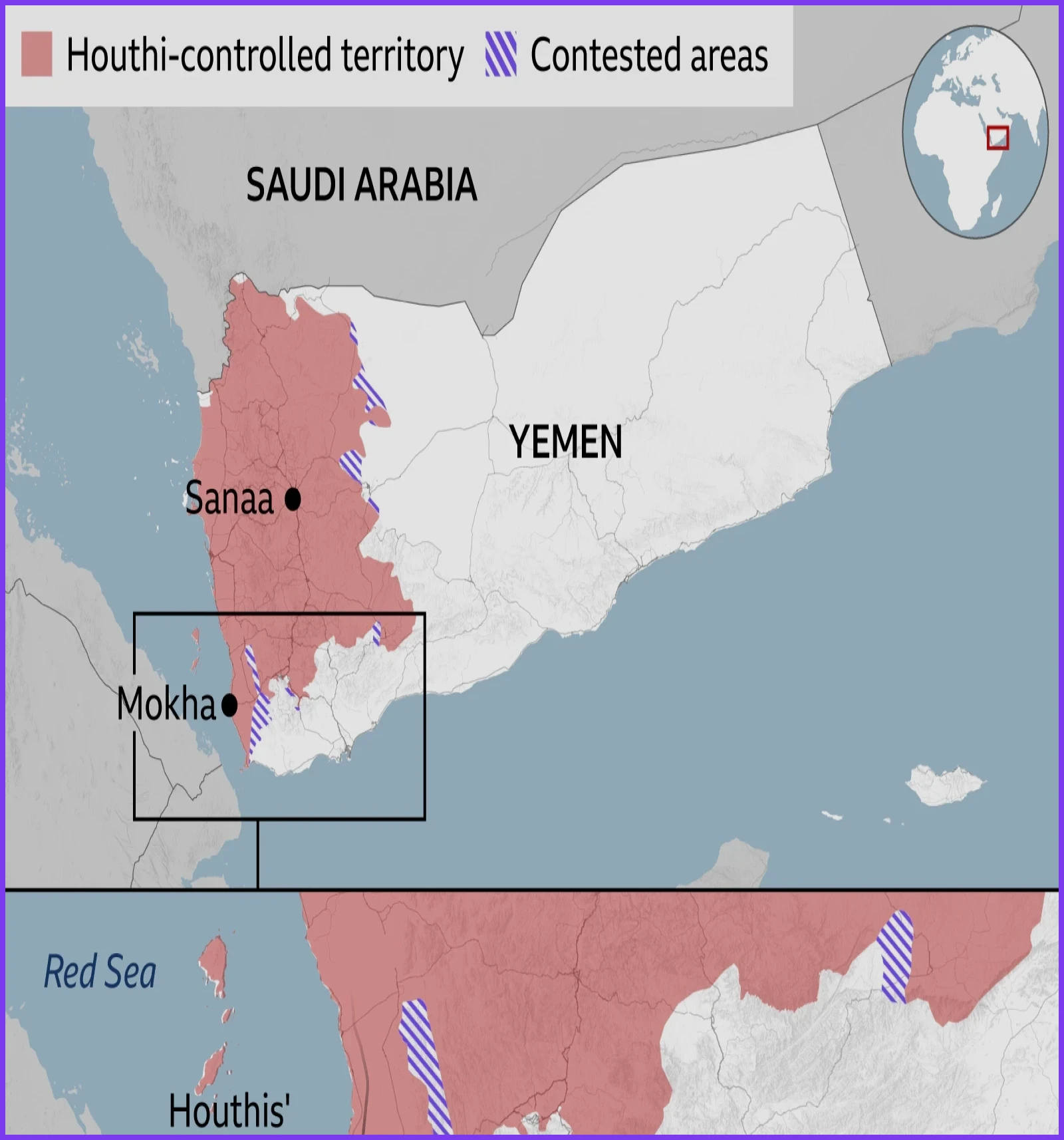
An intensifying wave of violence along Yemen's Red Sea coast has forced thousands of civilians to embark on a perilous sea crossing to East Africa. In just the last few days, more than 3,000 refugees, including many entire families, have arrived in Djibouti after fleeing across the narrow Bab al-Mandab Strait. According to estimates from the United Nations, the sudden and dramatic escalation in fighting has displaced more than 120,000 Yemenis in total, reversing years of relative stability and shattering a fragile peace.
Among those who recently escaped is 50-year-old Ibrahim Issa, a fisherman from Dhubab, a coastal town situated directly on the front lines of the conflict. Today, Issa sits with his family on a tarpaulin spread over the sandy ground of a massive, open-sided warehouse. The shelter is located inside the Markazi refugee camp in Obock, a northern region of Djibouti. The camp is packed with displaced families who made the journey by boat before traveling to the facility by truck and on foot. "How could I just sit there when my kids are screaming and shaking in terror?" Issa said, recalling the moments before their escape. "When the sound of the planes start, and the kids hear the planes, they begin shouting and screaming. As parents it is our responsibility, what can you do when you see this? That is why we fled, to save them."
As a fisherman, Issa was fortunate enough to own a boat large enough to transport his family across the water. He even managed to bring along several of the family's goats, which now forage for scraps amidst discarded plastic bottles and empty cooking gas canisters in the camp. While some families successfully transported small bundles of possessions, including one that brought a tall metal shisha pipe known as a "jeraak," many others arrived completely exhausted, carrying nothing but the clothes they wore when they fled.
The sudden exodus is the direct result of a rapid military offensive. Houthi rebel forces, who seized control of most of Yemen's populated areas years ago, recently made a swift advance down the coastline toward the Bab al-Mandab Strait. This narrow maritime chokepoint is of vital global importance, serving as the gateway where the southern Red Sea connects to the Gulf of Aden and the wider Indian Ocean. In response to the Houthi advance, Saudi Arabia, which leads the military coalition backing Yemen's internationally recognized government, launched hundreds of airstrikes across the flat coastal plain where Houthi forces are currently digging in. The Houthis have retaliated by launching hundreds of drones and missiles targeting infrastructure and cities in southwestern Saudi Arabia.
For the civilians caught in the crossfire, the geopolitical alliances of the warring factions matter very little. The overwhelming sentiment among the refugees in Markazi is a desire to escape the violence. "We don't care which side it is that's attacking," multiple refugees stated. "It's the bombs falling all around us that have caused us to flee."
Djibouti, a small former French colony situated directly across the water from Yemen, has maintained a strict policy of neutrality, stating clearly that it has no intention of participating in the war. However, the nation is highly militarized and serves as a major strategic hub for global superpowers. Since 2003, the United States has operated Camp Lemonnier, a massive multinational military base that once housed the French Foreign Legion. China also maintains a major presence in Djibouti, having recently upgraded its largest military base on the Indian Ocean.
The Markazi camp, jointly administered by the United Nations and the Djiboutian government, hosts refugees from different phases of Yemen's protracted conflict. Among them is Qassim Abraham Abssy, a former fisherman whose identity card lists his age as 100. "What led us to come here?" Abssy asked. "It was the planes. The sounds of the planes, boom! That's what made us flee, for the sake of our children. It burns our hearts. We don't know which side they are from. They are bombing everywhere, because the Houthis are everywhere, in the mountains, in the roads. A plane comes, bombs everywhere."
Living nearby in the camp is 63-year-old Mohammed Abdullarim, a former tour guide from Aden who was born when the city was still a British protectorate. Standing near the neat rows of tents provided by the UN refugee agency, UNHCR, in the stifling 37C heat, Abdullarim represents an earlier wave of displacement. He fled to Djibouti in 2015, shortly after the initial outbreak of hostilities between Houthi forces and the government of the now-ousted President Abdrabbuh Mansour Hadi. Having spent nearly a decade in the camp, Abdullarim was overcome with emotion while discussing the plight of his fellow countrymen. "Most of the people here are in the worst condition, inside the tents here," he said through tears. "I am very touched, I'm crying for these people, for my people, for their suffering. I want our voices to be heard by the NGOs and the Djibouti government. And I'm thankful to them for accepting us."
The duration of their stay in Djibouti remains highly uncertain, tethered entirely to the shifting dynamics of the conflict. Yemen has been devastated by a brutal civil war since 2014, a conflict that has claimed tens of thousands of lives and displaced millions. A fragile, UN-brokered truce established in 2022 between Saudi Arabia and the Houthis has completely collapsed in recent months, replaced by a renewed exchange of heavy weaponry, airstrikes, and drone attacks.
While international attention often focuses on the economic ramifications of the conflict, particularly the threat to global oil exports routed through the Bab al-Mandab Strait, the human cost is frequently overlooked. For those residing in the camp, safety remains the absolute priority. Sitting on their tarpaulin amid the noise of the camp, Qassim Abssy expressed reluctance to leave the safety of Djibouti, stating that they will remain there as long as the war continues because they have found peace. His wife, Aisha Abdulkadir Mohammed, shared this sentiment. "We are willing to go back in peace if peace returns to our country, and we are praying to God that peace does return," she said. "All we need is peace, even for our children's future, they get safety first, then food, water and an education. As you see we just fled with our clothes, and left everything behind, because there is no peace."
UK to provide Saudi Arabia with 'defensive' military support, says Burnham
Lightning Houthi advance in Yemen may bring dangerous new dimension to Iran war
Related Articles

Mr. Udoy is a professional Web Developer and Blogger with 7+ years of experience in the tech world. He specializes in web architecture and digital storytelling. As the driving force behind worldincidents.com, he focuses on delivering high-quality, well-researched content to a global audience.