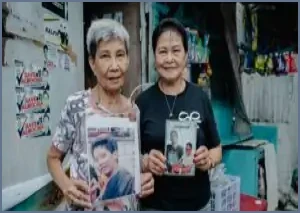
In the Batasan neighborhood on the outskirts of Manila, 68-year-old Salvacion Ramos operates a small convenience store to support her grandson, a life altered permanently by the events of February 2017. It was on her doorstep that her daughter, Cristeta Ramos, was killed by four plainclothes police officers, shot once in the back and three times in the head. “She died in my arms. I didn’t even get to say goodbye,” Salvacion recalls. Nearby, her neighbor Llore Pasco mourns her two sons, Cristanto and Juan Carlos, who were killed during a police operation in May 2017 while commuting to work. Despite police claims they were thieves, their wounds were on the front of their bodies, contradicting official narratives.
These families are among many seeking justice for the thousands killed during the administration of former President Rodrigo Duterte. The campaign, which saw barangay officials compile "watch lists" of alleged drug users, often became a trap for the vulnerable. Salvacion notes that some families paid as much as 10,000 pesos to have names removed from these lists to ensure their children's safety. Beyond the loss of life, families faced the cold reality of paying to retrieve bodies from the morgue, with costs initially set at 120,000 pesos before NGO intervention reduced the burden. Leah Valencia, a coordinator with the organization Rise Up for Life and For Rights, notes that the drug war destroyed families, leaving mothers to raise orphaned grandchildren while struggling to survive.
The International Criminal Court (ICC) in The Hague has become a focal point for these families. Duterte, arrested in March 2025 at Manila’s airport based on an Interpol Red Notice, faces charges of crimes against humanity for incidents spanning 2011 to 2019, covering his tenure as Davao City mayor and president. The case involves 78 specific victims—76 murders and two attempted murders—serving as a representative selection for the broader prosecution. The historic trial is scheduled to begin on November 30. If found guilty, Duterte would be the first former president convicted by the ICC.
Senator Ronald "Bato" dela Rosa, the former police chief who implemented the "Double Barrel" operation, remains a target of the investigation. Estimates from various NGOs suggest the drug war claimed 30,000 lives, significantly higher than the official police estimate of 6,000. On May 11, an attempted arrest of dela Rosa led to a tense standoff at the Philippine Senate, where he sought refuge. He remains at large and is currently wanted by Philippine authorities.
The political landscape remains complex under President Ferdinand Marcos Jr. While Marcos initially maintained an alliance with the Duterte camp, the relationship fractured, leading to a shift in policy regarding the ICC. Marcos eventually signaled a willingness to comply with international obligations, allowing police to enforce the ICC warrant for Duterte’s arrest. Despite this, researcher Joel Ariate of the University of the Philippines describes the current government's claim of a "bloodless" drug war as propaganda, noting that 200 to 300 deaths still occur annually, often at the hands of private militias or hit men. Ariate notes that while the violence has decreased, the institutions that failed during the drug war remain unchanged, and many low-ranking police officers involved in the killings remain in their positions.
The newly established Truth Commission, formed in 2026, seeks to document these atrocities and provide a platform for victims. Criminologist Christopher Magno, a co-founder of the commission, emphasizes that the goal is to humanize the victims and address the institutional failures that allowed the violence to persist. While some police officers have begun to cooperate with the commission, the road to healing remains difficult in a society that still shows significant support for Duterte’s populist platform. As the nation watches the ICC proceedings, survivors like Salvacion and Llore continue to demand that all responsible parties be held to account.
Related Articles

Meet Md. Rubel Rana
As a core contributor to Worlddincidents.com, Rubel Rana brings a unique perspective to the world of journalism. Whether it’s deep-diving into historical trivia or covering the latest global headlines, Rubel Rana is committed to delivering high-quality, high-impact articles. Their writing blends meticulous research with a compelling voice, helping readers stay informed and curious about the world around them.