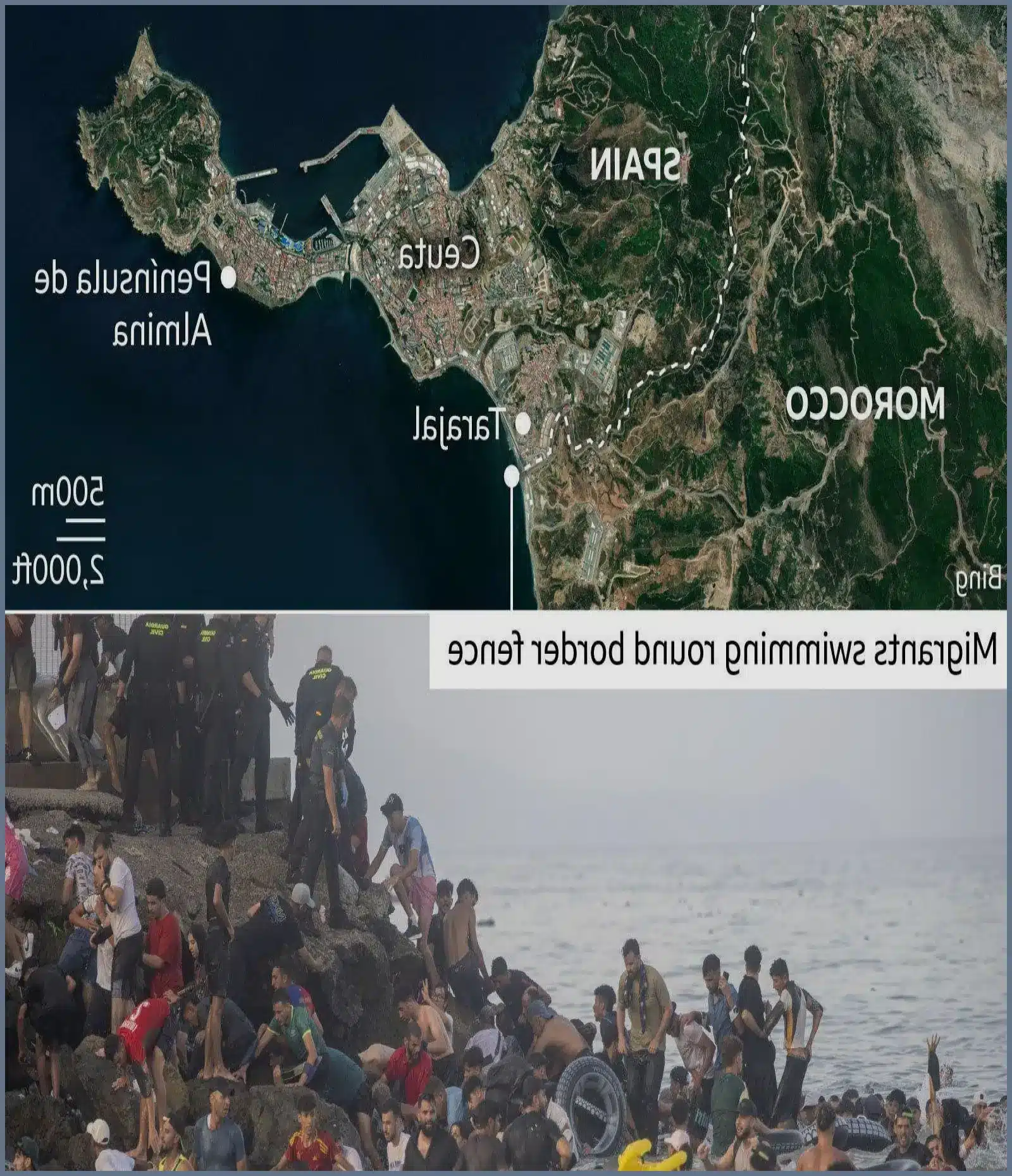
European Commission President Ursula von der Leyen has issued a call for "united action" regarding border security in the wake of the chaotic influx of tens of thousands of migrants into the Spanish exclave of Ceuta last week. In a formal letter to Spanish Prime Minister Pedro Sánchez, von der Leyen praised his "swift handling" of the crisis while asserting that the incident demonstrates a clear need to further strengthen external borders at critical points. She emphasized that protecting these borders is a shared European responsibility, requiring both vigilant monitoring and the implementation of physical barriers where necessary.
The situation has strained relations among the 27 member states of the European Union. In response to the crossings, Italy temporarily suspended the Schengen arrangement with Spain, an agreement that normally eliminates border checks across 29 countries and 450 million people. Prime Minister Sánchez expressed "serious concerns" regarding the actions of some European governments, noting that Ceuta is not part of the Schengen area. He stated that while many nations demonstrated "support and solidarity," others chose to attack Spain, driven by "prejudice, fake news, ignorance, or political interest."
Spain estimates that approximately 69,500 migrants have now returned to Morocco, a figure that exceeds initial projections of 50,000. The official death toll from the crisis stands at 72 on the Spanish side of the border, with an additional 11 deaths reported on the Moroccan side. To address these challenges, EU interior ministers are scheduled to hold emergency talks via video conference on Tuesday. Von der Leyen noted that the meeting will provide an opportunity to draw lessons from the Ceuta episode, warning that illegal immigration requires a common European response and united action.
The European Commission President urged the EU to "double down" on five specific areas: preventing irregular migration through cooperation with partner states, strengthening external borders, implementing early warning systems, dismantling smuggling networks, and reinforcing return procedures. Prime Minister Sánchez has accused migrant traffickers of exploiting a recent Spanish Supreme Court decision that limited the government's ability to immediately deport individuals arriving by sea. On Saturday, Spanish Interior Minister Fernando Grande-Marlaska stated that the situation had nearly returned to normal, adding that the government is currently working on an inflatable barrier to prevent future illegal migration via the water.
The scenes in Ceuta have strained relations among some of the EU's 27 member states.
How Spain's migrant crisis created a political storm – whipped up by social media
Related Articles

Meet Md. Rubel Rana
As a core contributor to Worlddincidents.com, Rubel Rana brings a unique perspective to the world of journalism. Whether it’s deep-diving into historical trivia or covering the latest global headlines, Rubel Rana is committed to delivering high-quality, high-impact articles. Their writing blends meticulous research with a compelling voice, helping readers stay informed and curious about the world around them.