Taiwan’s modern defense strategy relies heavily on its newly acquired F-16 Block 70 fighter jets, a procurement effort that spans decades of shifting geopolitical dynamics. The origins of this airpower narrative date back to the 1970s, when Taipei realized its aging fleet of F-100 and F-104 combat aircraft was rapidly becoming obsolete. Although the United States and Taiwan agreed to co-produce the upgraded F-5E/F, American officials recognized that this was not a viable long-term solution. However, Washington's growing reconciliation with mainland China complicated future defense agreements. In 1978, Taipei's request for F-16s was rejected, leaving the F-4 and additional F-5E/Fs as the primary options, with the latter ultimately selected. Despite high-performance fighters remaining at the top of Taiwan's military wishlist in 1979, the U.S. maintained its refusal to supply F-4, F-16, or F-18 jets.
The U.S. government consistently calibrated Taiwan's access to advanced fighters based on its assessment of China's military capabilities and the broader U.S.-China relationship. Ronald Reagan’s 1980 presidential campaign featured supportive rhetoric toward Taiwan, but his administration ultimately rejected Taipei's requests for the F-5G (later known as the F-20) and the F-16/79, a lower-performance export variant. Instead, the U.S. focused on the F-5E/F and authorized the transfer of used F-104 fighters from West Germany, judging these assets qualitatively adequate against China's contemporary air force. In 1982, Reagan formalized this policy via the Third Communiqué with Beijing, pledging that arms sales to Taiwan would not exceed recent levels and would gradually decline, provided Beijing maintained a peaceful approach to the island. Conversely, the Six Assurances issued to Taipei clarified that Washington had not agreed to a specific end date for arms sales. Faced with these limitations, Taiwan developed the F-CK-1 Indigenous Defense Fighter with significant assistance from U.S. aerospace companies.
This historical procurement struggle occurred alongside Taiwan's growing realization that it could not match the People's Republic of China on a system-for-system basis. Conventional combat aircraft are highly vulnerable because their reliance on large, fixed bases leaves them exposed to preemptive destruction. This vulnerability historically drove Taiwan's interest in the F-35B, which is less dependent on traditional runways. While Taiwan has established an extensive network of hardened underground shelters and practiced highway operations, the sheer volume of precision fire the People's Liberation Army (PLA) can deliver would make it extremely difficult to sustain continuous air operations.
Recent global conflicts highlight these vulnerabilities. During the Russian invasion of Ukraine, Kyiv's air force managed to survive and operate by dispersing assets and using concealment. However, China possesses a far larger precision-missile arsenal and a more persistent surveillance network than Russia did in 2022, and Taiwan's small geographic size limits its defensive depth. Furthermore, the 2026 conflict with Iran showcased how vulnerable military bases are to repeated missile and drone attacks when located near an adversary with advanced precision-strike capabilities.
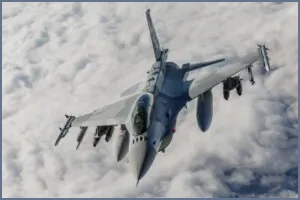
Given these challenges, defense analysts often debate the utility of conventional fighters in the opening phase of a conflict. Yet, the F-16 Block 70 offers critical advantages. These new aircraft will supplement an existing Taiwanese fleet that has endured decades of heavy use. While they feature the same radar as Taiwan's upgraded older F-16s, the Block 70 variant boasts more powerful engines, greater range, and extended endurance due to fuselage-mounted conformal fuel tanks—a crucial addition since Taiwan lacks aerial-refueling tankers. These upgrades enhance the aircraft's capabilities in interception, patrol, strike, and reconnaissance roles, particularly when equipped with the MS-110 multispectral pod. For defense, they are designed to carry the AN/ALQ-254 Viper Shield electronic warfare suite, though production delays have temporarily postponed its installation. Additionally, the Block 70 has a structural service life of 12,000 hours, which is roughly 50 percent greater than earlier F-16 models.
In peacetime and "gray zone" scenarios, these fighters provide Taipei with a flexible tool to visually identify, shadow, and escort PLA aircraft, demonstrating defense resolve without escalating to surface-to-air missile engagement. This is especially vital given the high tempo of Chinese military flights around the island, which Taipei views as a deliberate attempt to wear down the readiness of its air force. The new airframes are essential to meeting this demanding operational tempo.
Furthermore, these aircraft would be valuable during a limited blockade, quarantine, or coercive military operation. By patrolling threatened air corridors, escorting friendly aircraft, and contesting Chinese attempts to control the airspace, the F-16s offer options to resist coercion short of launching a full-scale air campaign. In the event of an all-out war, a surviving Taiwanese fighter force would complicate PLA planning. Air suppression is highly resource-intensive; any active Taiwanese jets would force the PLA to continuously allocate intelligence, surveillance, reconnaissance, strike aircraft, and missiles to locate and neutralize them. Because large-scale amphibious and airborne operations require localized air and sea control, even a small surviving ROCAF force remains a threat that China cannot ignore. Ultimately, the new F-16s do not replace the need for mobile, survivable asymmetric systems, but they ensure Taiwanese airpower remains a viable instrument from peacetime coercion to full-scale conflict.
Air Force Reserve Crews over Southern California with the 370th FLTS from Edwards Air Force Base provide aerial refueling from a KC-135 to a Lockheed Martin F-16 Block 70 aircraft for the Royal Bahraini Air Force in 2024.
You have reached the limit of 2 free articles this month.
Related Articles

Md. Kazi Bijoy is a dedicated tech enthusiast and content creator with a passion for digital innovation. With years of experience in the tech industry, he specializes in breaking down complex topics into easy-to-understand guides. When he isn’t writing, he explores the latest gadgets and researches emerging trends in the digital world.