Accountant: Epic Careers That Pay $110K+ in 2026
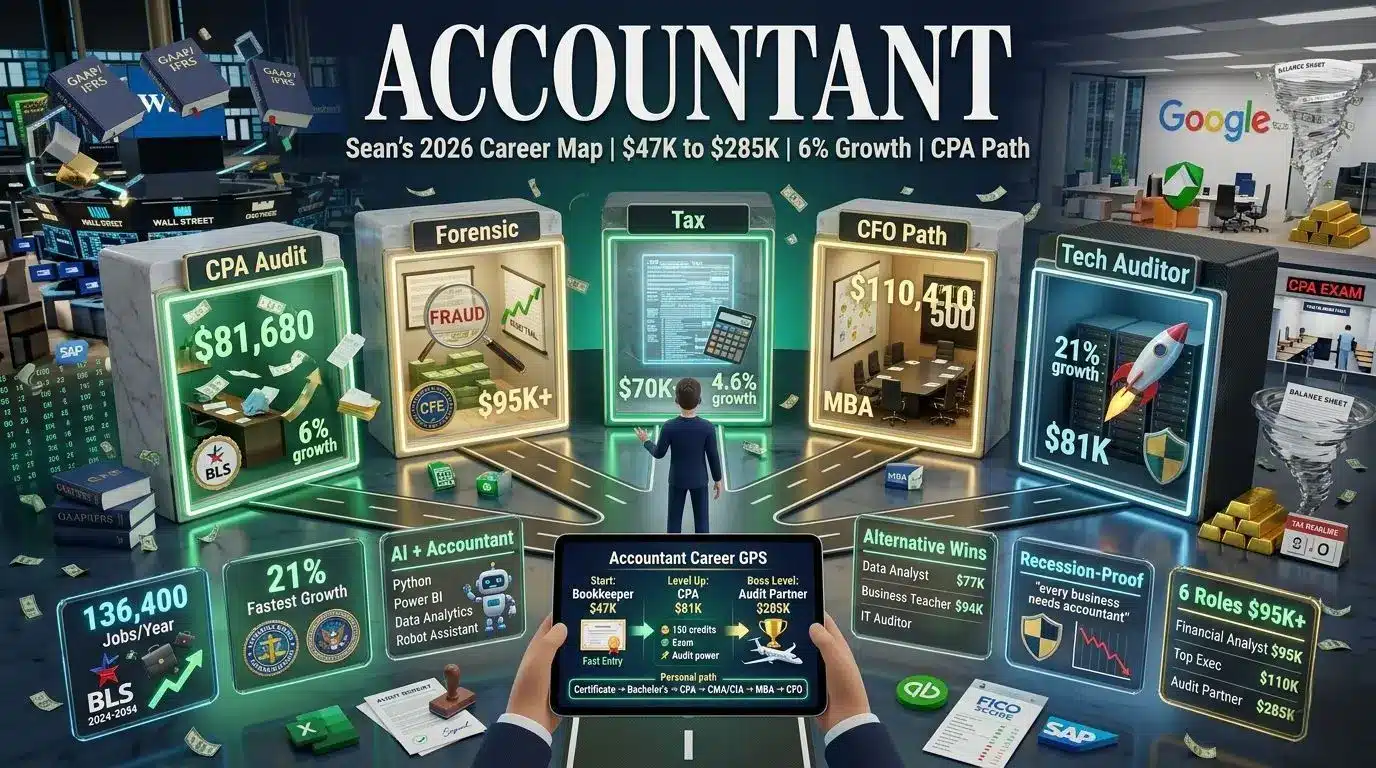
Sean is an accountant. Which of the following describes typical accounting careers? The answer: accounting offers one of the broadest career ladders in business. From bookkeeping to CFO, every accountant path combines stability, strong pay, and clear growth. The U.S. Bureau of Labor Statistics projects 6% growth for accountants and auditors from 2024 to 2034. That means 136,400 job openings per year. The median acountant salary is $81,680 in 2026. Top executives with accounting backgrounds earn $110,410.
Financial accounting comes with a clear career progression route. You can start as a clerk and end as a top executive. Every acountant role serves one purpose: help people and organizations make smart financial decisions. If Sean wants options, accounting delivers. This guide shows typical acountant careers in 2026, skills needed, education paths, and salary data.
Accountant: 2026 Job Outlook and Salary Data
The accountant job outlook is positive. BLS data shows 6% growth through 2034 for accountants and auditors. That beats the average for all jobs. The acountant role is recession-resistant because every business needs financial reporting, tax compliance, and budgeting. In 2026, small businesses need 3-4 accounting staff. Mid-sized firms with $500 million revenue need 23-39 finance employees. Large enterprises need 45-78 FTEs per $1 billion revenue.
Here is what an acountant can earn in 2026:
| Career | Median Salary 2026 | Job Growth 2024-2034 | Education Needed |
|---|---|---|---|
| Bookkeeping/Accounting Clerk | $47,440 | -4% | Certificate/Associate |
| Tax Preparer | $54,500 | 3% | Certificate/Associate |
| Accountant or Auditor | $81,680 | 6% | Bachelor’s |
| Budget Analyst | $79,940 | 3% | Bachelor’s |
| Financial Analyst | $95,570 | 9% | Bachelor’s |
| Financial Examiner | $81,410 | 21% | Bachelor’s |
| Internal Auditor | $63,013 | 6% | Bachelor’s + CIA |
| Top Executive/CFO | $110,410 | 6% | Bachelor’s + CPA/MBA |
An acountant with a CPA earns a median $78,000. Audit partners make up to $285,937 per year. The acountant career pays well because the skills are technical and regulated.
Accountant: Typical Entry-Level Careers
If Sean is new, these are typical accountant entry points in 2026:
1. Accounting Clerk and Technician
Businesses need accurate records more than ever in 2026. The accountant clerk verifies financial details, processes transactions, and prepares reports. Median pay is $47,440. You need a certificate or associate degree. It is the fastest way to start as an acountant.
2. Bookkeeper
Bookkeepers record transactions and prepare financial statements. They also handle payroll, invoices, and bank reconciliation. The acountant career often starts here. You can work with just a certificate in 2026. Median pay is $47,440.
3. Tax Preparer
Tax preparers complete returns for individuals and small firms. The acountant who likes seasonal work fits here. Median pay is $54,500 with 3% growth. Tax laws change yearly, so demand stays steady. An acountant can advance to tax accountant with a bachelor’s.
4. Accounts Payable/Receivable Clerk
These acountant specialists manage invoices and payments. Accounts receivable specialists track overdue accounts. It is detail work with strong demand. The acountant in this role keeps cash flow moving.
Accountant: Core Career Paths with a Bachelor’s
With a bachelor’s degree, Sean can access the main acountant careers:
Read More: Teachers: Powerful Professional Development Wins in 2026
1. Public Accountant and Auditor
This is the most common acountant path. You work for public firms or companies. Duties: audit financials, prepare taxes, advise clients. Median pay is $81,680. The CPA license is key. An acountant with a CPA can sign audit reports and represent clients before the IRS. BLS projects 135,000 openings yearly for accountants and auditors.
2. Management Accountant
Also called cost or corporate acountant. You work inside one company. You budget, manage costs, and guide strategy. The CMA certification helps. The acountant in this role impacts decisions daily. Median pay matches general acountant levels but rises with experience.
3. Government Accountant
The acountant in government ensures public funds are used correctly. Roles: tax examiner, revenue agent, financial examiner. Financial examiners have 21% growth, the fastest in accounting. Median pay is $81,410. The acountant here needs ethics and compliance skills.
4. Internal Auditor
Internal auditors work inside companies to review operations, risk, and controls. 24% of internal auditors work in Fortune 500 companies. The accountant who likes process improvement fits here. Average pay is $63,013. CIA certification boosts salary. Growth is 6% through 2034.
5. Forensic Accountant
The accountant who loves investigation becomes a forensic acountant. You detect fraud, trace money, and work with legal teams. It is a top alternative career for accounting graduates in 2026. The acountant needs CPA + CFE. Pay exceeds $95,000.
Accountant: Skills Needed in 2026
Every accountant needs these skills:
- Technical: GAAP, IFRS, tax law, Excel, QuickBooks, SAP, data analysis. The acountant must master software.
- Analytical: Interpret data, spot trends, solve problems. The acountant advises decision-makers.
- Communication: Explain numbers to non-finance people. The acountant writes reports and presents findings.
- Ethics: Handle confidential data. The acountant must follow AICPA Code of Conduct.
- Tech Literacy: AI, automation, and data analytics reshape accounting. The acountant who learns Python and Power BI leads.
- Attention to Detail: One error can cost millions. The acountant double-checks everything.
Robert Half says new tech and regulations create “new opportunities and a hunger for talented professionals with the right skill mix.” The acountant in 2026 blends finance with tech.
Accountant: Education and Certification Path
How can Sean start? Step by step:
- Earn a Degree: Associate for clerk roles. Bachelor’s for acountant or auditor. Accounting is 18% of business majors.
- Get Experience: Internships and entry jobs build skills. Bookkeeper and tax preparer roles need only a certificate.
- Choose Certification: CPA is gold standard. CMA for management acountant. CIA for internal audit. CFA for finance.
- Specialize: Tax, audit, forensic, IT audit, or data analysis. The acountant with a niche earns more.
- Advanced Degree: MBA or Master’s in Accounting helps you become CFO. Top executives earn $110,410 median.
Can you get an acountant job with just a certificate? Yes, for bookkeeping or accounts payable. But for CPA track, you need 150 credit hours, usually a bachelor’s plus master’s.
Accountant: Alternative Careers with an Accounting Degree
The accountant degree opens doors outside pure accounting:
| Alternative Career | Why Accountants Fit | Median Salary |
|---|---|---|
| Financial Analyst | Analyze data, build models | $95,570 |
| Data Analyst | Numbers, Excel, SQL skills transfer | $77,300 |
| IT Auditor | Understand systems + controls | $81,410 |
| Compliance Officer | Know regulations and reporting | $75,000 |
| Business Teacher | Teach accounting in college | $94,360 |
| Budget Analyst | Plan and monitor spending | $79,940 |
In 2026, accounting graduates work in finance, healthcare, tech, and government. The acountant skill set is universal.
Accountant: Which Path Fits Sean?
If Sean likes rules and detail: tax accountant or auditor. If he likes investigation: forensic accountant. If he likes business strategy: management acountant or CFO track. If he likes tech: IT auditor or data analyst. If he wants teaching: business teacher postsecondary. Every acountant career uses the same core: record, analyze, and report financial data.
So which describes typical accounting careers? They are diverse, stable, and well-paid. They range from $47,440 clerk jobs to $285,937 audit partners. They exist in every industry. The acountant can work in firms, government, nonprofits, or start a practice. CPA certification unlocks the highest tier.
FAQ Section
1. What degree do I need to start?
Certificate or associate for clerk and bookkeeper. Bachelor’s for accountant, auditor, and analyst. CPA requires 150 credits.
2. Is accounting being replaced by AI?
No. AI automates data entry. Humans still audit, advise, and make judgments. Demand grows 6% through 2034.
3. What is the fastest-growing accounting job?
Financial examiner at 21% growth. Followed by financial analyst at 9%. Both need a bachelor’s degree.
4. CPA vs CMA: which is better?
CPA for public accounting, audit, and tax. CMA for corporate management accounting. Many do both.
5. Can I work remotely as an accountant?
Yes. Bookkeeping, tax prep, and consulting roles are remote-friendly. Cloud software enables it.
6. What is forensic accounting?
Investigating fraud and financial crimes. You work with lawyers and law enforcement. Needs CPA + CFE.
7. How long to become a CPA?
4 years bachelor’s + 1 year master’s/extra credits + 1-2 years experience + pass exam. About 6-7 years total.
8. Is accounting stressful?
Tax season is busy. Deadlines matter. But remote work and tech reduce stress. Many report high job satisfaction.

Meet Md. Rubel Rana
As a core contributor to Worlddincidents.com, Rubel Rana brings a unique perspective to the world of journalism. Whether it’s deep-diving into historical trivia or covering the latest global headlines, Rubel Rana is committed to delivering high-quality, high-impact articles. Their writing blends meticulous research with a compelling voice, helping readers stay informed and curious about the world around them.
1 thought on “Accountant: Epic Careers That Pay $110K+ in 2026”