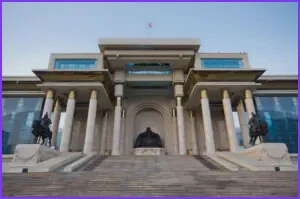
Mongolia relies on its fundamental foreign policy doctrine of cultivating balanced relations with its immediate neighbors, China and Russia, while actively expanding diplomatic and economic ties with "Third Neighbor" nations. Wedged entirely between China and Russia, the strategy serves as a mechanism for national survival, seeking to expand international partnerships without becoming overly dependent on either bordering power.
The strategy was formally codified when the Parliament of Mongolia adopted the Concept of Foreign Policy of Mongolia on June 30, 1994. The initial framework established the highest priority as maintaining balanced, good-neighborly relations with both Russia and China while broadening ties with advanced democracies. On February 10, 2011, parliament approved a revision that explicitly named the "Third Neighbor" concept. This update expanded the scope of partner nations beyond Western democracies to include countries such as India, South Korea, and Turkey.
The primary driver behind the 2011 policy revision was Mongolia’s rapidly expanding economic reliance on China, which threatened the country’s ability to sustain an equal balance between Beijing and Moscow. To counter over-reliance on China, the revised doctrine prioritized security and economic cooperation with Third Neighbor partners. At its core, the policy reflects long-standing concerns regarding Chinese influence, rooted deeply in Mongolian public sentiment and historical experience.
Mongolia’s security concerns date back to its initial break from the Qing Dynasty, a pre-modern empire that integrated Manchu imperial leadership, Mongol nobility, Han bureaucrats, and Tibetan Buddhist authorities. Following the outbreak of the Xinhai Revolution on October 10, 1911, the princes and lamas of Outer Mongolia voted to separate from Qing rule, declaring independence on December 1, 1911. On December 29, 1911, they enthroned Bogd Gegeen VIII, the supreme leader of Tibetan Buddhism, as Bogd Khan and established the Bogd Khan government. The Qing Dynasty dissolved shortly after when the Xuantong Emperor, Puyi, abdicated on February 12, 1912.
The newly formed Republic of China (ROC) refused to acknowledge Mongolian independence, claiming sovereignty over all former Qing territories. A temporary compromise was reached under the 1915 Kyakhta Treaty signed by Russia, China, and Mongolia, which granted Outer Mongolia autonomy while recognizing Chinese suzerainty. However, this arrangement ended in 1919 when Chinese warlord Xu Shuzheng invaded Outer Mongolia in violation of the treaty and abolished its autonomy.
In response to the Chinese occupation, Mongolian revolutionaries led by Damdin Sükhbaatar launched an independence movement. Early in 1921, Baron Ungern of the Russian White Army ousted the Chinese forces from Outer Mongolia. By July 1921, the Mongolian People’s Army, supported by the Soviet Russian Red Army, captured the capital and established a People’s Government. Although the Bogd Khan remained as a nominal head of state, actual governance shifted to the revolutionary leadership.
Following the death of the Bogd Khan in May 1924, the revolutionary government chose not to restore the monarchy. Instead, it declared the establishment of the Mongolian People’s Republic on November 26, 1924. This marked Mongolia’s transition into a modern socialist state heavily reliant on Soviet influence, driven by the persistent threat from China and the impact of the Russian Revolution.
Diplomatic recognition remained contentious throughout the mid-20th century. The ROC formally recognized Mongolian independence in 1946 but revoked its recognition in 1953, with official exchanges between the two not resuming until 2002. The People’s Republic of China (PRC) established diplomatic relations with Mongolia on October 16, 1949, shortly after its founding. However, Mao Zedong had previously approached Soviet leadership regarding placing Mongolia under Chinese authority and occasionally voiced ambitions for annexation in subsequent years.
Alarmed by Beijing's stance, Mongolia aligned more closely with Moscow as the Sino-Soviet split intensified during the late 1950s and 1960s. In 1966, Mongolia signed the Treaty of Friendship, Cooperation and Mutual Assistance with the Soviet Union. During the Cultural Revolution of the late 1960s, Beijing denounced Mongolia as revisionist, and ethnic Mongolians faced persecution in Inner Mongolia. As border tensions mounted, large-scale Soviet military forces were deployed inside Mongolian territory.
While security cooperation with Moscow protected Mongolia from Chinese threats, heavy reliance on the Soviet Union diminished its diplomatic autonomy. During the Brezhnev era, proposals for the Soviet annexation of Mongolia circulated. Although Mongolia resisted formal annexation, it functioned in practice much like a constituent Soviet republic. In the late 1980s, Soviet leader Mikhail Gorbachev initiated efforts to reconcile Sino-Soviet relations, leading to the withdrawal of Soviet troops. Following the 1990 democratic revolution, the collapse of the Soviet Union in 1991, and the adoption of a new constitution in 1992, the country was officially renamed Mongolia, ending its complete dependence on Moscow and shaping its modern Third Neighbor strategy.
Related Articles

Md. Kazi Bijoy is a dedicated tech enthusiast and content creator with a passion for digital innovation. With years of experience in the tech industry, he specializes in breaking down complex topics into easy-to-understand guides. When he isn’t writing, he explores the latest gadgets and researches emerging trends in the digital world.