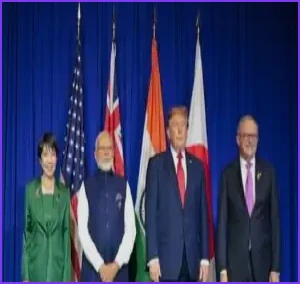
On November 17, 2026, leaders from the United States, India, Japan, and Australia convened on the sidelines of the ASEAN summit in Manila, the Philippines, to address the pressing strategic risks associated with China’s monopoly over critical minerals. U.S. President Donald Trump, Indian Prime Minister Narendra Modi, Japanese Prime Minister Takaichi Sanae, and Australian Prime Minister Anthony Albanese utilized the summit to prioritize this shared economic and security challenge, setting aside recent political friction.
The current push for cooperation follows a period of strained relations, particularly between the U.S. and India, after Washington imposed a 50 percent tariff on Indian imports in mid-2025 in response to India's purchase of Russian oil. Despite these past tensions and skepticism regarding the Quad’s ability to execute complex initiatives—stemming from previous unfulfilled commitments like the COVID-19 vaccine program—the group remains the primary minilateral framework capable of addressing this strategic bottleneck.
The Quad Critical Minerals Initiative, launched by U.S. Secretary of State Marco Rubio in Washington, D.C., is supported by the U.S. administration’s long-term commitment to securing domestic and allied mineral access. Since taking office last year, President Trump has made critical minerals a top-tier national priority, with the U.S. government committing or conditionally committing over $27 billion to projects in the U.S. and Australia. This investment signals a willingness to deploy significant financial resources abroad to decouple supply chains from Chinese control.
Each member state brings unique strengths to the coalition. Australia contributes raw ores and extensive mining expertise, Japan provides advanced manufacturing and technical skills, and the U.S. offers substantial capital and market power. India’s inclusion, while complex given its status as a developing economy, offers significant potential for growth in mineral processing, recycling, and manufacturing. These nations have already begun to leverage their combined influence, such as the investment in the Alcoa-Sojitz gallium recovery facility in Western Australia, which is projected to meet 10 percent of global gallium demand. Furthermore, bilateral and trilateral agreements involving companies like Lynas Rare Earths, Arafura, and Australian Strategic Materials demonstrate a shift toward coordinated offtake and investment strategies.
As the U.S. prepares to assume the G7 presidency next year, the Trump administration is expected to prioritize the Quad and its bilateral Forum on Resource Geostrategic Engagement (FORGE) over broader G7 frameworks, which have faced internal hurdles, such as the strained U.S.-Canada relationship. Despite the challenges of managing diverse national priorities, the Quad members maintain a strong strategic alignment on the critical minerals issue, making it a central pillar for the group's future diplomatic and economic agenda.
You have reached the limit of 3 free articles this month.
Lastly, other critical mineral groupings like the G7 Critical Minerals Resilience and Production Alliance – launched by Canada and formalized by France – face political difficulties. Poor Canada-U.S. relations limit what the G7 framework can currently achieve.
Related Articles

Md. Kazi Bijoy is a dedicated tech enthusiast and content creator with a passion for digital innovation. With years of experience in the tech industry, he specializes in breaking down complex topics into easy-to-understand guides. When he isn’t writing, he explores the latest gadgets and researches emerging trends in the digital world.