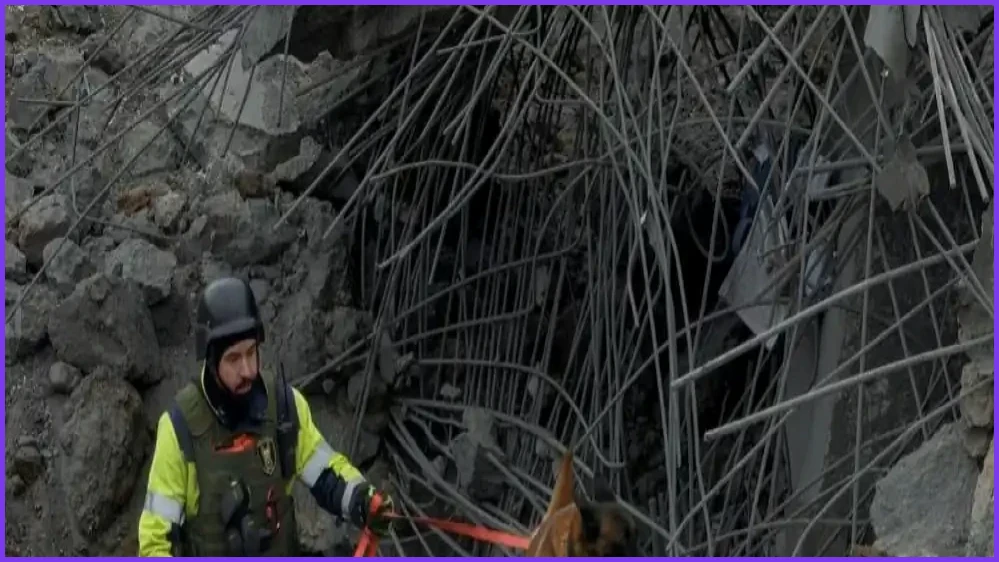
Newly released bodycam footage from Ukrainian national police documents the moments between two powerful Russian aerial strikes on the southern village of Kamyshuvakha in the Zaporizhzhia region, where at least 40 people were killed at a humanitarian aid centre and an underground shelter. Search and rescue operations continued for a third day following the bombardment, with Ukrainian President Volodymyr Zelensky stating that more than 30 people could still be trapped beneath the wreckage.
According to Ukrainian officials, Russian forces dropped nine heavy glide bombs—some weighing as much as 3,000 kilograms—on the village as local residents gathered to receive humanitarian aid. The intense bombardment completely destroyed the shelter, leaving a massive crater where the facility once stood.
The bodycam recording, made public on Wednesday, was filmed from the perspective of a Ukrainian police officer who was subsequently killed in the attack. The initial moments of the video capture widespread destruction across Kamyshuvakha following the first bomb strike, showing shocked civilians standing among severely damaged buildings and mounds of rubble.
As police officers moved through the site, a military official's voice came across a two-way radio warning personnel on the ground that additional glide bombs were being launched toward Kamyshuvakha. In response, an officer instructed gathered residents to quickly head into an underground shelter located at least two floors below ground. The shelter was situated near a local school that was being utilized for humanitarian aid distribution.
Footage shows residents walking into the underground facility just seconds before the second explosion struck. Flames immediately appear on camera as the bomb hits the shelter, abruptly ending the recording. Verification confirmed that the police footage was recorded at the identical location depicted in earlier video released by the State Emergency Service of Ukraine (DSNS), which showed the colossal crater left in the wake of Monday's strikes.
Addressing the double-tap attack in a social media statement on Wednesday, President Zelensky stated that nine aerial bombs were used in the assault. He noted that Russian forces targeted civilians receiving aid first, followed by a second strike against the police officers and emergency personnel who rushed to the scene to rescue survivors. Zelensky criticized the international community's response, remarking that there had been very little global reaction to what he called an insane attack and another entry among thousands of Russian war crimes. The Russian military has not issued any public statement regarding the strikes in Kamyshuvakha.
The deadly bombing comes amid broader diplomatic moves to restart peace negotiations. President Zelensky, who spoke during an unannounced visit to Spain on Wednesday, revealed that he held an extensive 90-minute discussion with Steve Witkoff and Jared Kushner, peace envoys for US President Donald Trump. The talks took place ahead of scheduled trilateral negotiations involving Ukraine, Russia, and the United States, set for 10-11 November in Abu Dhabi.
Zelensky also reported that Ukrainian representatives engaged in a separate, meaningful session in Brussels with officials from the United States, the European Union, France, Britain, Germany, NATO, and the World Bank to discuss post-war reconstruction plans. Those meetings in the Belgian capital are scheduled to continue on Thursday to focus on long-term security guarantees for Ukraine. Trilateral peace talks have been suspended since February, during which time Moscow escalated aerial attacks while Kyiv suffered shortages of Western-supplied air defence interceptors. Observers caution that significant breakthroughs are unlikely during the upcoming negotiations in the United Arab Emirates.
Analysts expect no major breakthrough when the talks resume in the capital of the United Arab Emirates.
Related Articles

Mr. Udoy is a professional Web Developer and Blogger with 7+ years of experience in the tech world. He specializes in web architecture and digital storytelling. As the driving force behind worldincidents.com, he focuses on delivering high-quality, well-researched content to a global audience.