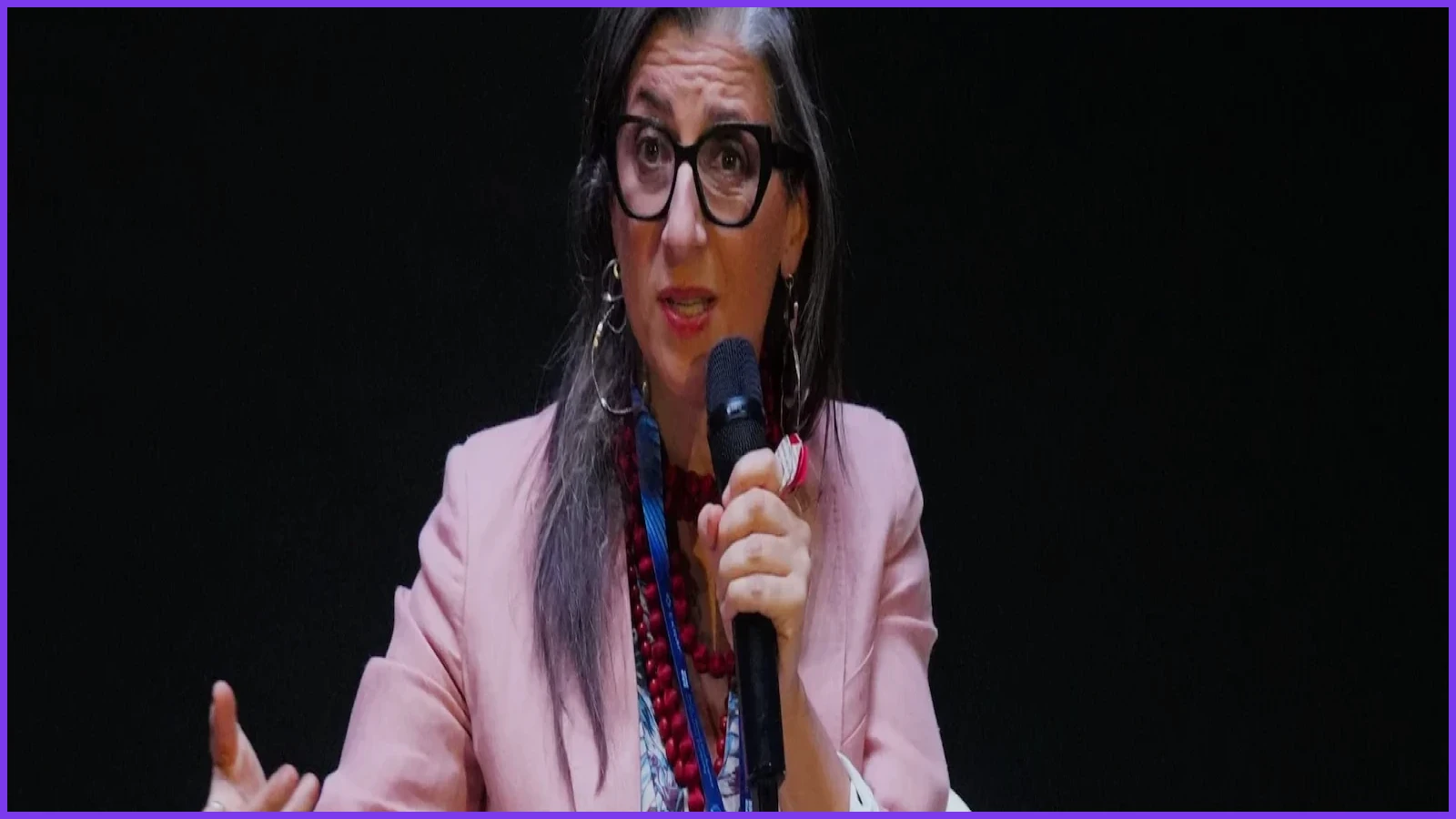
Francesca Albanese, the United Nations special rapporteur on human rights in the occupied Palestinian territories, was stranded at Costa Rica's primary international airport after immigration authorities refused to allow her entry into the Central American nation. The entry denial occurred on Thursday after officials cited an international alert alleging links to terrorism and claiming her presence posed a risk to national security.
Following the decision by border authorities, Albanese published a photo on social media showing her luggage positioned beside a row of vacant terminal seats, adding the caption: “This is where I will spend my first night in Costa Rica.” She has remained confined to a room at the airport in San José while waiting for a judicial ruling to determine whether she can legally enter the country or will be required to leave.
The restriction on her movement prompted legal representatives to lodge a habeas corpus petition on her behalf with the Constitutional Chamber of Costa Rica’s Supreme Court. The court subsequently issued an interim order permitting Albanese to remain in the country for the time being and gave immigration officials 24 hours to present a formal explanation detailing the reasons behind her entry refusal.
Albanese had traveled to the country upon receiving an official invitation from the University of Costa Rica, which had arranged to confer an honorary doctorate upon her. With the habeas corpus petition still pending, she was unable to attend the campus event in person and instead joined the university's award ceremony via a video connection from the airport terminal. An assistant traveling with her, who was granted entry into Costa Rica by border agents, accepted the degree on her behalf.
Denouncing the actions and claims of immigration authorities, Albanese strongly denied any connection to extremist activities. “I am deeply outraged that the Costa Rican government has spread false information linking me to terrorism. Defending human rights is not terrorism, and the government will answer for these insinuations, as it should in a country governed by the rule of law,” she said.
As an independent investigator tasked with examining human rights abuses in Palestinian territories, Albanese is part of a network of experts appointed by the 47-member U.N. Human Rights Council based in Geneva. Her global reporting has previously drawn political pushback, including sanctions imposed by the United States in July 2025 over her investigative work and sharp scrutiny of U.S. and Israeli actions during the conflict in Gaza. At the time, U.S. Secretary of State Marco Rubio characterized her activities as a “campaign of political and economic warfare against the United States and Israel.”
The entry denial takes place against the backdrop of political adjustments by Costa Rica’s right-wing administration, which has sought closer ties with the Trump administration. The government has faced substantial public debate over its agreement to accept third-country deportees from the U.S. and its construction of a Bukele-style mega-prison to carry out a broad crime crackdown. Albanese had previously voiced criticism regarding Costa Rica's political stance on the Israeli-Palestinian issue, highlighting the signing of a bilateral free-trade agreement with Israel that currently awaits ratification by the Costa Rican legislature.
While Costa Rican President Laura Fernández has refrained from commenting on the situation, her minister of the presidency, former President Rodrigo Chaves, publicly condemned the Supreme Court's intervention on social media. “Yet another usurpation by an increasingly arbitrary judiciary, one that usurps the powers of the other two branches of government and now protects foreigners flagged by international alerts for ties to TERRORIST ACTS!” Chaves wrote regarding the court order that halted her deportation.
The actions of immigration authorities have drawn sharp domestic and international criticism. Costa Rica’s ombudsman’s office faulted officials for “automatically” turning Albanese away without conducting an individualized assessment of her circumstances, her official standing, or her diplomatic immunity as a U.N. special rapporteur. Additionally, U.N. High Commissioner for Human Rights Volker Türk stated that he was “deeply concerned” by the Costa Rican government's decision to block her entry.
Related Articles
Mr. Udoy is a professional Web Developer and Blogger with 7+ years of experience in the tech world. He specializes in web architecture and digital storytelling. As the driving force behind worldincidents.com, he focuses on delivering high-quality, well-researched content to a global audience.