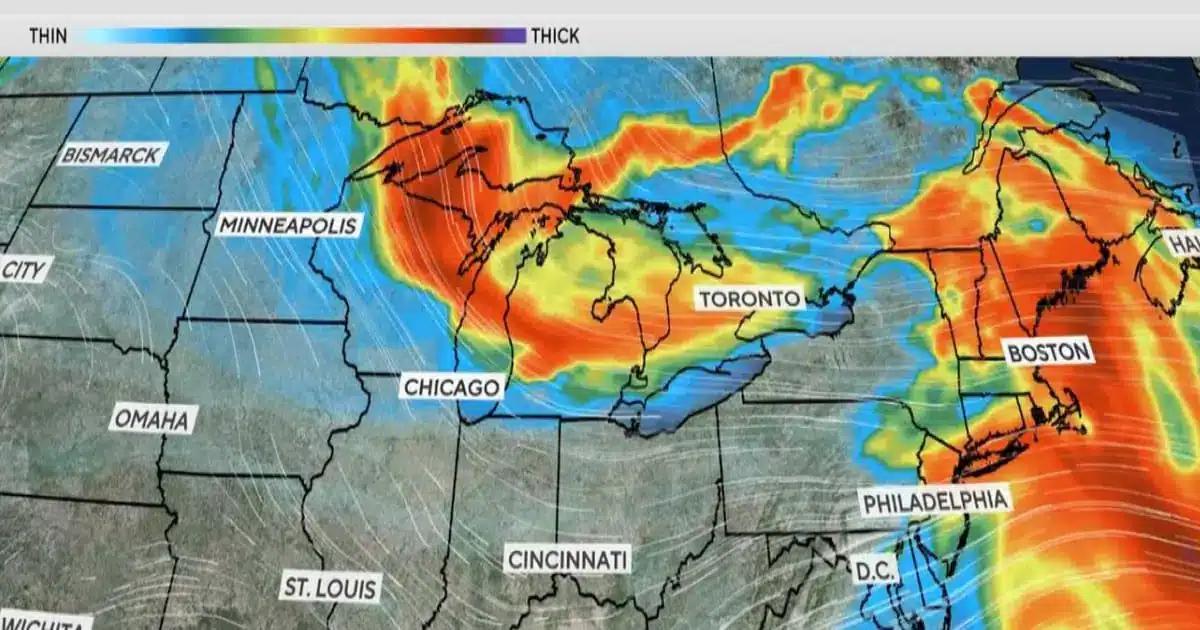
Hazardous smoke plumes originating from hundreds of wildfires in Canada and multiple active blazes in northern Minnesota have blanketed large areas of the Midwest and Northeast United States this week. The resulting air pollution has exposed millions of residents to unhealthy conditions, prompting a series of air quality alerts that stretched from Minnesota across to the East Coast. Conditions across the Northeast were expected to improve on Saturday, while smoky air persists in parts of the Midwest.
By Saturday morning, New York City and Washington, D.C., were ranked among the most polluted major cities globally. In Washington, D.C., officials implemented a Code Purple alert, signaling that air quality was "very unhealthy" for the general population. Authorities there urged all residents to avoid intense or long outdoor activities, while specifically advising older adults, children, and those with pre-existing heart or lung conditions to refrain from any physical activity outside. Meanwhile, Pennsylvania's Department of Environmental Protection downgraded its status to a Code Orange alert on Saturday, marking an improvement over the previous day's Code Purple conditions.
In the Midwest, Minnesota officials issued an air quality alert effective through the weekend, with the northeastern corner of the state experiencing particularly heavy, hazardous smoke. Air quality levels in northeast Minnesota reached hazardous levels, making it unsafe for everyone. Michigan and Wisconsin authorities also issued warnings to their residents, with the entire state of Michigan under an alert on Friday before conditions began to clear. In Chicago, forecasts indicated that smoke is expected to return late Saturday into Sunday.
Meteorologists expect the haze to thin across the Northeast by Saturday afternoon as a cold front moves through the region. This front is anticipated to bring storms accompanied by large hail, high winds, isolated tornadoes, and flash flooding. As the smoke moved into the Boston area earlier in the week, residents described the atmosphere as having an "ominous brown-yellow" tint. West Roxbury resident James Venezia remarked, "It almost felt like you were at a campsite with an active fire going." Similar yellowish haze was reported across Vermont, New Hampshire, and Maine.
Regarding the upcoming World Cup final in New Jersey, organizers stated they are monitoring the situation closely. Andrew Giuliani, executive director of the White House World Cup task force, confirmed that a National Weather Service representative is stationed at FIFA headquarters to track air quality developments for Sunday's match between Spain and Argentina.
Health experts warn that fine particulate matter from wildfire smoke can cause dizziness, coughing, shortness of breath, and fatigue, while also aggravating chronic diseases. Dr. Alexander Azan, an assistant professor at NYU Langone Health, emphasized that long-term exposure to these pollution levels increases the risk of developing chronic health conditions. He recommended that those who must be outdoors should utilize N95 or KN95-grade masks. Tyler Hasenstein, a meteorologist with the National Weather Service in Chanhassen, Minnesota, advised residents to remain indoors, noting that the combination of smoke and extreme heat creates a significant health risk.
The intensity of the fires has been attributed to severe drought and heat. Dan Westervelt, an associate professor at Columbia University's Climate School, described the current conditions as a "perfect storm" providing ample fuel for the blazes. Research suggests that warming temperatures linked to the burning of coal, oil, and gas are contributing to more frequent and intense fires.
In Canada, where most fires are burning out of control, a freight train near Armstrong, Ontario, was recently surrounded by a wall of fire. While the Canadian National Railway suspended operations in the area, all crew members were reported safe. Regarding the response, President Trump threatened additional tariffs on Canada, blaming the country for failing to contain the blazes. Canadian Minister of Emergency Management Eleanor Olszewski responded that the country is "working with urgency" alongside provincial partners and has invested billions in forest fire prevention.

Md. Kazi Bijoy is a dedicated tech enthusiast and content creator with a passion for digital innovation. With years of experience in the tech industry, he specializes in breaking down complex topics into easy-to-understand guides. When he isn’t writing, he explores the latest gadgets and researches emerging trends in the digital world.
1 thought on “Wildfire Smoke Triggers Air Quality Alerts Across U.S. Regions”