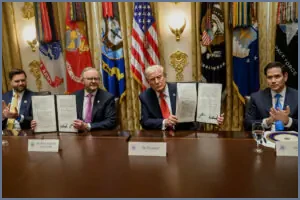
The 2026 midterm elections in the United States represent a consequential juncture in the evolution of the U.S.-led international order and Australia's immediate strategic environment. Beyond determining the legislative balance of power in Washington, the electoral outcome will offer critical indicators regarding the durability of President Donald Trump's political mandate, the strength of institutional checks on executive authority, and the long-term trajectory of American engagement with traditional allies.
For Australia, these political dynamics present profound challenges. Canberra's post-war security posture has long relied on the premise that U.S. military power, institutional continuity, and alliance commitments offer a durable foundation for national security. However, contemporary political reality in the United States presents a far more complex equation. While remaining vital to Australian defense, the U.S. is increasingly characterized by intense domestic political polarization, a transactional approach to international security, and an economic orientation grounded in protectionism.
Assessing the strategic ramifications of the midterms requires evaluating three interconnected areas: the domestic institutional limits imposed on the Trump administration, the credibility of U.S. security commitments across the Indo-Pacific, and the degree to which shifting American trade and industrial policies might impact Australian economic sovereignty.
The balance of power in the U.S. House of Representatives and Senate directly shapes presidential oversight, federal funding appropriations, executive appointments, and policy execution. Should Republicans strengthen their congressional majorities, Trump would be positioned to further consolidate an agenda focused on economic nationalism, strict immigration enforcement, domestic industrial protection, and explicit transactionalism in foreign relations. For Canberra, such alignment could speed up joint defense and industrial initiatives, but it also elevates the risk that alliance management becomes subordinate to narrow U.S. domestic economic interests. Protectionist measures passed by a sympathetic Congress could easily affect close security partners, as diplomatic ties offer no guaranteed immunity against Washington's economic nationalism.
Conversely, a Democratic takeover in either congressional chamber would create a fundamentally different, yet equally unpredictable, legislative backdrop. Heightened oversight and legislative resistance could restrict the administration's domestic program. However, congressional opposition would not automatically roll back executive trade tariffs, strip presidential authority in foreign policy, or reinstate traditional diplomatic norms. Instead, a divided government might induce ongoing policy instability over budget appropriations and national security priorities rather than yielding strategic moderation.
Underlying both political scenarios are broader structural forces that transcend political parties. Both major U.S. parties are operating under the weight of intense strategic rivalry with China, an overstretched foreign policy, concerns regarding domestic manufacturing capabilities, and strong public demands for allies to absorb a larger share of security costs. These systemic pressures will persist well beyond the 2026 election cycle.
This political reality directly impacts the AUKUS partnership, which represents Australia's most explicit reliance on sustained American strategic commitment. Built around a nuclear-powered submarine pathway and Pillar II advanced technology collaboration, AUKUS is designed to bolster regional deterrence and military interoperability. Yet, the agreement exposes a structural gap between Australia's need for decades-long industrial coordination and political continuity, and a U.S. political system governed by short election cycles and partisan friction.
Even if bipartisan political support for AUKUS remains intact, changes in congressional leadership could directly affect its execution. Capitol Hill scrutiny regarding submarine build schedules, U.S. shipyard limitations, workforce shortages, technology transfer approvals, and defense resource distribution could alter project timelines. Such oversight often stems not from hostility toward Australia, but from legitimate American concerns over whether U.S. industrial capacity can satisfy internal naval requirements while simultaneously meeting international commitments.
To navigate these dynamics, Australian policymakers must separate the general concept of alliance durability from the specific operational delivery of defense programs. Canberra can mitigate risks by pursuing sustained, bipartisan institutional outreach in Washington, emphasizing that AUKUS enhances U.S. national security, boosts American defense employment, and supports Indo-Pacific stability. Concurrently, Australia must expand its own domestic defense-industrial capability. The goal is not complete strategic self-sufficiency, which remains practical unfeasible, but rather enhanced strategic resilience against U.S. production delays.
Economic friction presents another layer of vulnerability. Australia finds itself in a delicate position: the United States serves as its primary security guarantor and a key source of foreign investment, yet American trade policies under Trump 2.0 prioritize domestic employment, local manufacturing, and national bargaining leverage over alliance considerations. Consequently, Australian exporters remain vulnerable to policy shifts driven by U.S. domestic politics rather than bilateral diplomacy.
While a Republican victory would reinforce the political mandate for tariffs and domestic industrial subsidies, Democratic gains would likely maintain the broader bipartisan consensus on industrial protection and supply chain security aimed at reducing dependence on China. As a result, Washington's move toward technological sovereignty and economic nationalism represents a long-term shift rather than a temporary trend.
In the broader Indo-Pacific, the election results will influence the regional balance between U.S. power and Chinese ambitions. A politically emboldened Trump administration might intensify confrontation with Beijing across trade, technology, and military posture. While this posture aligns with Australian concerns over regional coercion, a highly transactional U.S. approach can simultaneously heighten uncertainty among regional partners regarding the specific conditions under which Washington would offer support.
On the other hand, a Democratic-led Congress might demand greater consultation with regional partners, though fierce partisan battles in Washington could simultaneously impair policy execution and weaken deterrence. For Canberra, deterrence depends on credible political resolve and alliance cohesion. Australia must judge U.S. reliability through tangible metrics—such as operational funding, force deployments, and concrete policy implementation—rather than political rhetoric.
Furthermore, Australia's strategic priorities do not perfectly mirror those of the United States. Australia's ongoing economic stability and regional security depend on stable trade channels and open diplomatic dialogue in Asia. A severe escalation in U.S.-China conflict could impose severe economic and security costs on Australia, even if the underlying American strategic goals are defensible. Managing the alliance effectively requires combining defense cooperation with an independent assessment of Australian national interests alongside active regional diplomacy.
Ultimately, these developments challenge Australia to build genuine strategic autonomy. For decades, Australian governments have balanced military reliance on the U.S. with deep economic ties across Asia, particularly with China. As global competition expands into supply chains, infrastructure, critical technology, and energy, maintaining this balance grows increasingly difficult.
To cushion against abrupt policy shifts in Washington, Australia must deepen its investment in regional architecture, practical trade links, and diplomatic relationships across Southeast Asia and the Pacific Islands. Strategic autonomy does not mean stepping away from the alliance or adopting a neutral stance between major powers. Rather, it requires the self-reliant capacity to make independent determinations, maintain national military capabilities, and safeguard diplomatic flexibility when Australian and American interests diverge. The goal is to evolve from passive dependence to managed interdependence, preserving security cooperation while ensuring Australia retains the resilience needed to handle ongoing political volatility in the United States.
Nonetheless, greater rhetorical or economic confrontation should not automatically be interpreted as a strengthening of regional security. As has already been evident across the last two years, a more transactional U.S. foreign policy has engendered uncertainty about the circumstances in which Washington is willing to support its partners, the conditions attached to that support, and the relative priority assigned to different theaters.
Conclusion: “Sing Me Songs of No Denying”
Related Articles

Meet Md. Rubel Rana
As a core contributor to Worlddincidents.com, Rubel Rana brings a unique perspective to the world of journalism. Whether it’s deep-diving into historical trivia or covering the latest global headlines, Rubel Rana is committed to delivering high-quality, high-impact articles. Their writing blends meticulous research with a compelling voice, helping readers stay informed and curious about the world around them.